
Key Takeaways
- Adding biocharBiochar is a carbon-rich material created from biomass decomposition in low-oxygen conditions. It has important applications in environmental remediation, soil improvement, agriculture, carbon sequestration, energy storage, and sustainable materials, promoting efficiency and reducing waste in various contexts while addressing climate change challenges. More made from brewery waste to sand filters helps capture harmful water bacteria.
- Higher amounts of biochar change how sand traps bacteria by making microbes stick directly to the biochar surface.
- Saltier water slightly lowers the ability of biochar to capture bacteria due to chemical interference.
- Once bacteria attach to the biochar surface, they remain permanently bound rather than washing back out.
- Turning brewery residues into filter materials provides a practical solution for recycling waste while protecting groundwater.
Water contamination caused by pathogenic microorganisms moving through sandy soils presents a significant risk to clean groundwater supplies. In a new study published in the journal Biochar, authors Christos P. Giannopoulos, Christos A. Kolotouros, and Ioannis D. Manariotis investigated how converting brewing byproducts into carbon rich biochar can dramatically improve pathogen capture. The research team focused on malt spent rootlets, a major organic waste residue generated during the barley malting process. By subjecting these rootlets to high temperature processing without oxygen, the scientists produced a highly porous material capable of filtering biological contaminants out of flowing water.
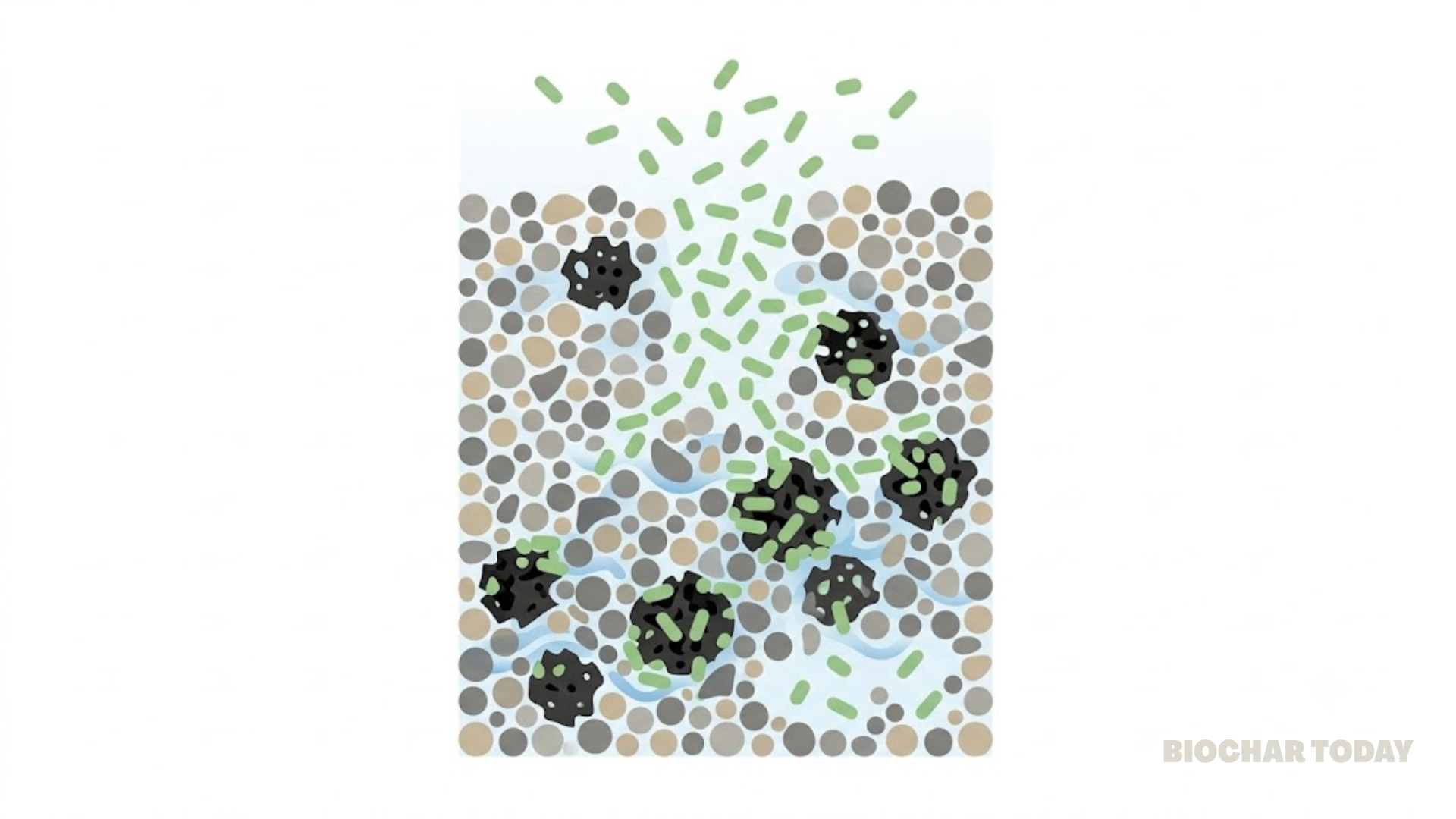
Sandy soils naturally struggle to trap microscopic contaminants due to relatively large gaps between sand grains. Unamended sand filters allow most bacteria to pass right through, posing challenges for rural water protection and decentralized treatment systems. When researchers added a small percentage of malt spent rootlets biochar to sand beds, the ability to trap bacterial cells improved instantly. At a low biochar mix, removal rates began to climb, but raising the biochar content to a higher level produced dramatic filtration results. The vast internal network of microscopic pores and high surface area provided ideal target sites for microbial interception.
The investigation demonstrated that adding biochar fundamentally changes how bacteria are retained inside the filter media. In standard sand beds, physical straining serves as the primary pathway for capturing cells, meaning bacteria only stop moving when they become physically wedged between narrow sand junctions. Adding higher amounts of malt spent rootlets biochar shifts the main capture process from simple mechanical wedging to direct chemical attachment. Bacteria hitting the biochar surface stick firmly, preventing them from continuing downstream toward groundwater reservoirs or drinking supply lines.
Mathematical modeling of the filtration process confirmed that this surface attachment is completely irreversible under standard operational conditions. Bacteria that bond with the biochar remain fixed to the material without washing loose over time. Chemical testing also revealed that water composition plays an important role in overall capture success. Higher concentrations of background dissolved salts slightly diminish bacterial binding capacity because dissolved mineral ions shield electrostatic interactions between bacterial cell walls and biochar surfaces. Despite this effect, overall retention performance remained exceptionally high compared to plain sand.
Utilizing industrial food and beverage waste to address environmental contamination represents an important step forward for sustainable water engineering. Brewery residues that would otherwise head to landfills or low value applications can now serve as functional materials in environmental protection. Adding processed rootlet biochar into sand filtration infrastructure offers a low cost, circular solution for agricultural runoff control, stormwater management, and sandy soil protection. Further development of this green filtration strategy promises to strengthen microbial protection while advancing global waste recycling goals.
Source: Giannopoulos, C. P., Kolotouros, C. A., & Manariotis, I. D. (2026). Sorption and transport of Escherichia coli CN-13 in saturated sand columns amended with biochar derived from malt spent rootlets. Biochar, 8, 130.

![Eucalyptus Wood Waste-Derived Biochar Achieves a Ninety-Eight Percent Removal Efficiency for Benzo[ghi]perylene in Vehicle-Wash Wastewater](https://biochartoday.com/wp-content/uploads/2026/10/SCIENCE-BLOGS-2026-2026-10-19T160523.703.jpg)


Leave a Reply