
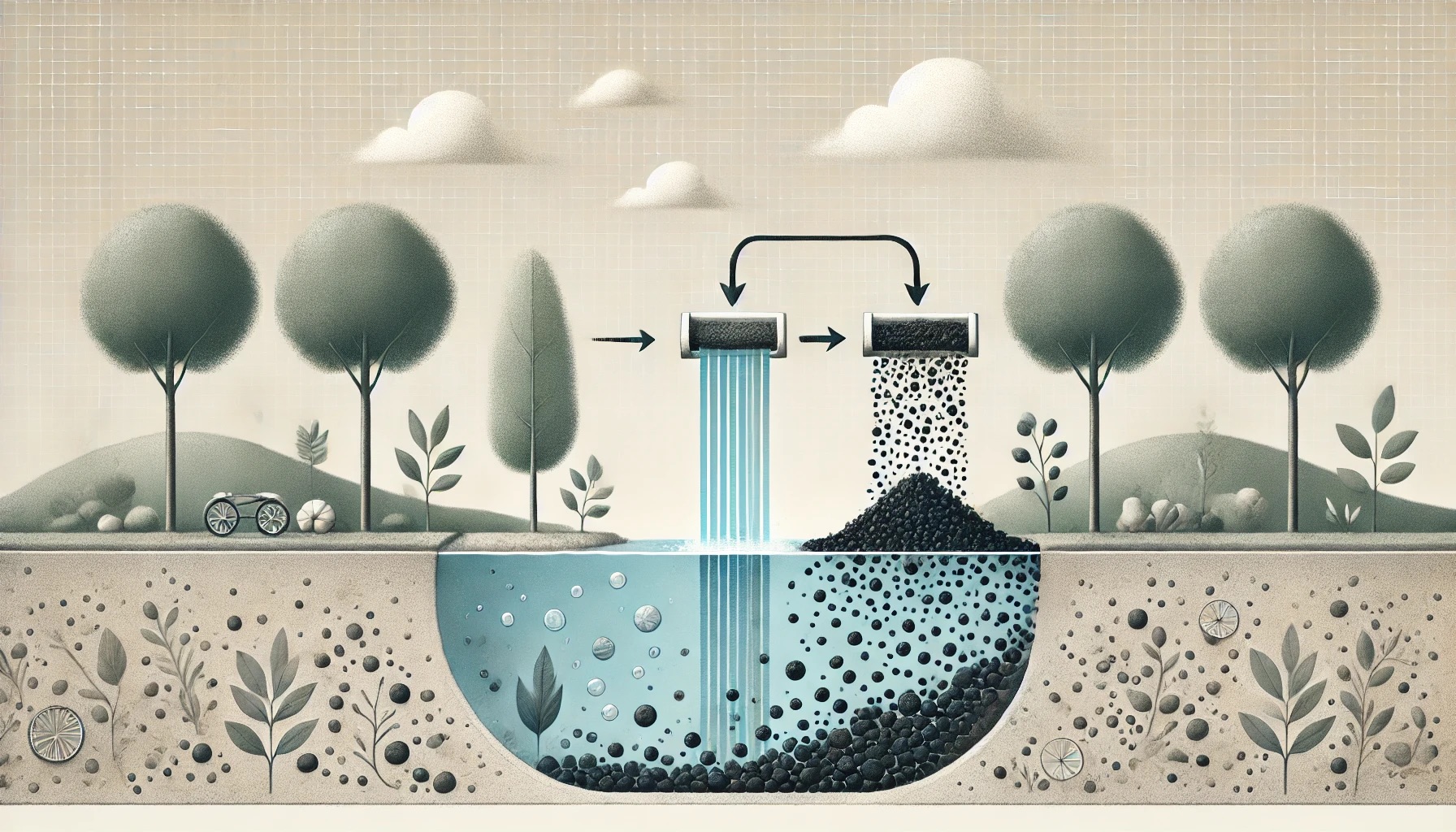
Jazić, et al (2024) Boosting advanced oxidation processes by biochar-based catalysts to mitigate pesticides and their metabolites in water treatment: a meta-analysis. Journal of Environmental Chemical Engineering. https://doi.org/10.1016/j.jece.2024.114260
BiocharBiochar is a carbon-rich material created from biomass decomposition in low-oxygen conditions. It has important applications in environmental remediation, soil improvement, agriculture, carbon sequestration, energy storage, and sustainable materials, promoting efficiency and reducing waste in various contexts while addressing climate change challenges. More, a carbon-rich material derived from organic waste, is gaining recognition for its potential in enhancing advanced oxidation processes (AOPs) used in water treatment. AOPs are widely studied for their ability to degrade organic micropollutants such as pesticides, which are persistent in wastewater and challenging to remove with conventional methods. This meta-analysis provides a quantitative evaluation of biochar’s role as a catalyst in AOPs, focusing on its ability to activate oxidants like persulfates (PS), peroxymonosulfates (PMS), and periodates (PI), as well as its application in photocatalysis.
Key Findings
The study reviewed 38 papers from 2016-2023 and revealed that biochar-based catalysts significantly improve the degradation of pesticides and their intermediate compounds. The research covers two main groups of AOPs: (i) sulfate radical-based AOPs (SR-AOP) and periodate-based AOPs (PI-AOP), where biochar helps activate PS, PMS, or PI, and (ii) photocatalysis, where biochar supports the breakdown of pollutants under light exposure. The meta-analysis identified that 74% of the studies were published between 2021-2023, reflecting a growing interest in biochar’s environmental applications.
Performance and Factors Influencing Degradation
The effectiveness of biochar as a catalyst in AOPs is strongly influenced by several factors:
1. Catalyst Type: Systems employing metal and non-metal co-doped biochar (e.g., FeS@BC, PCoFe@BC5) showed superior degradation efficacy, achieving up to 99% pesticide removal. Pristine biochar alone, though beneficial, showed less consistent performance compared to chemically modified variants.
2. Oxidant Type: No significant differences were observed between the performance of PS, PMS, and PI as oxidants. However, PMS systems displayed slightly more variability, suggesting that further optimization could enhance its reliability.
3. pHpH is a measure of how acidic or alkaline a substance is. A pH of 7 is neutral, while lower pH values indicate acidity and higher values indicate alkalinity. Biochars are normally alkaline and can influence soil pH, often increasing it, which can be beneficial More Sensitivity: The degradation efficiency of biochar-catalyzed AOPs was optimal at near-neutral pH levels (5-8). Alkaline conditions (pH ≥ 9) significantly reduced the efficacy, likely due to reduced production of reactive oxygen species (ROS) such as sulfate and hydroxyl radicals.
4. Water Matrix and Contaminants: The presence of organic matter and ions like bicarbonate and humic acids in wastewater negatively impacted the performance of AOPs. These substances compete with target pollutants for ROS, reducing degradation efficiency. Wastewater environments were particularly challenging, with degradation efficacy dropping to 62.3% compared to nearly 93% in deionized water.
Photocatalysis
Biochar-supported photocatalysis, particularly with multicomponent heterojunctions (e.g., g-C3N4/Bi2O2CO3), demonstrated high pesticide degradation rates under visible light. Biochar’s porous structure enhances the absorption of light and facilitates the separation of electron-hole pairs, key to improving photocatalytic reactions. These systems achieved an overall weighted degradation efficacy of 91.8%, showing great promise for solar-driven water purification.
Challenges and Future Directions
While biochar-based catalysts exhibit strong potential in AOP water treatment, several challenges remain. The variability in performance due to water matrix complexity and the need for further optimization in real-world conditions are key areas for future research. Additionally, scaling up these technologies for industrial applications requires further exploration into the cost-effectiveness and sustainability of biochar production and reuse. Toxicity testing and the identification of degradation by-products are also critical for ensuring that these methods are safe for widespread use.
Biochar-based catalysts offer an eco-friendly and highly effective solution for removing pesticides and other micropollutants from water. With further refinement and application in diverse environmental conditions, they could play a significant role in advancing water treatment technologies and addressing global water quality challenges.



Leave a Reply