
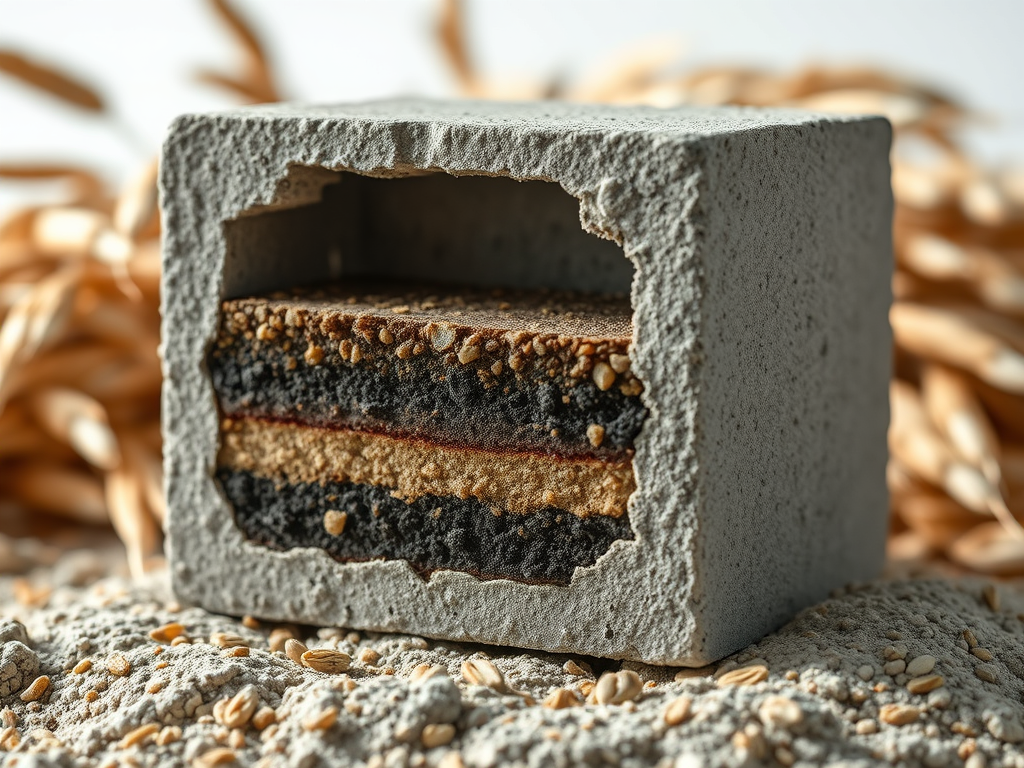
In a recent study published in Scientific Reports, Alaa A. Mahmoud and a team of researchers investigated the promising potential of rice husk-derived biocharBiochar is a carbon-rich material created from biomass decomposition in low-oxygen conditions. It has important applications in environmental remediation, soil improvement, agriculture, carbon sequestration, energy storage, and sustainable materials, promoting efficiency and reducing waste in various contexts while addressing climate change challenges. More (RHB) as a partial replacement for cement in ordinary concrete. The construction industry faces immense pressure to reduce its carbon footprint, with cement production alone contributing approximately 7% of global CO₂ emissions. Biochar, a carbon-rich material produced from biomassBiomass is a complex biological organic or non-organic solid product derived from living or recently living organism and available naturally. Various types of wastes such as animal manure, waste paper, sludge and many industrial wastes are also treated as biomass because like natural biomass these More pyrolysisPyrolysis is a thermochemical process that converts waste biomass into bio-char, bio-oil, and pyro-gas. It offers significant advantages in waste valorization, turning low-value materials into economically valuable resources. Its versatility allows for tailored products based on operational conditions, presenting itself as a cost-effective and efficient More, offers a sustainable avenue for carbon sequestration and waste valorization. This study not only explores RHB’s influence on concrete’s physical, mechanical, and microstructural properties but also, for the first time, examines its radiation shielding capabilities against gamma rays and fast neutrons.
The RHB used in this research is characterized by a unique chemical composition, boasting over 43% silicon and aluminum oxides by total weight, a significantly higher content compared to conventional rice husk biochar. This elevated oxide content is expected to enhance the concrete’s pozzolanic activity, leading to improved strength and durability. The RHB was incorporated into ordinary concrete at varying substitution ratios, ranging from 5% to 25% by cement weight.
The researchers conducted a comprehensive evaluation of the concrete’s properties. While RHB marginally increased cement setting time (maximum 7.14% at 25% replacement), it significantly increased the water demand for standard consistency (35.7% at 25% replacement), leading to a reduction in workability (maximum slump reduction of 57.3% at 25% replacement). These effects are attributed to biochar’s porous nature and high specific surface area, which enhance water absorption.
In terms of mechanical properties, the results were particularly encouraging. The optimal replacement level for enhancing compressive strength was 10% RHB, which yielded a 13.74% increase compared to the control mix. This improvement is linked to RHB’s pozzolanic activity, which promotes additional calcium-silicate-hydrate (C-S-H) gel formation, increased concrete density, and a refined microstructure. For tensile strength, the optimal replacement was 15% RHB, achieving a 9.48% improvement. Notably, even at a 25% replacement ratio, the tensile strength remained comparable to the control mix, with a slight improvement of approximately 1.83%. This preferential enhancement in tensile strength is attributed to the fibrous structure and inherent porosityPorosity of biochar is a key factor in its effectiveness as a soil amendment and its ability to retain water and nutrients. Biochar’s porosity is influenced by feedstock type and pyrolysis temperature, and it plays a crucial role in microbial activity and overall soil health. Biochar More of RHB, which contribute to crack bridging and stress redistribution.
Microstructural analysis using X-ray Diffraction (XRD) confirmed an increase in C-S-H peak intensity in RHB samples, especially at 10% and 15% RHB incorporation, coinciding with a slight reduction in portlandite peaks, suggesting moderate pozzolanic activity. Energy Dispersive X-ray Spectroscopy (EDX) revealed that a decrease in the calcium-to-silicon (Ca/Si) ratio correlated with increased C-S-H polymerization and improved compressive strength. A groundbreaking aspect of this study was the assessment of radiation shielding properties using Monte Carlo simulation code and PhyX software. The 15% RHB sample demonstrated superior gamma-ray shielding, exhibiting a higher linear attenuation coefficient (LAC) of 0.164 cm⁻¹ at 1 MeV, largely due to its increased density of 2.60 g/cm³. Furthermore, the 15% RHB sample showed the highest fast neutron removal cross-section (FCS) of 0.090 cm⁻¹ and the lowest half-value layer (HVL_FCS) of 7.699 cm, indicating its high efficacy as a neutron shield. This is attributed to the high density and concentration of light elements (carbon and oxygen) in the biochar.
These findings underscore that the unique chemical composition of this novel rice husk biochar makes it a viable and environmentally sound cement replacement material, aligning with sustainability goals by reducing cement consumption, mitigating CO₂ emissions, and facilitating carbon sequestration. The study proposes its use in sustainable construction for enhanced mechanical and radiation shielding performance. Future research will delve into the long-term durability and performance under harsh environmental conditions, as well as its integration into various specialized concrete types.
Source: Mahmoud, A. A., El-Sayed, A. A., Fathy, I. N., Fawzy, S., Alturki, M., Elfakharany, M. E., Abouelnour, M. A., Mahmoud, K. A., Dahish, H. A., ElTalawy, S. M., & Nabil, I. M. (2025). Evaluation of rice husk biochar influence as a partial cement replacement material on the physical, mechanical, microstructural, and radiation shielding properties of ordinary concrete. Scientific Reports, 15(1), 27229.



Leave a Reply