
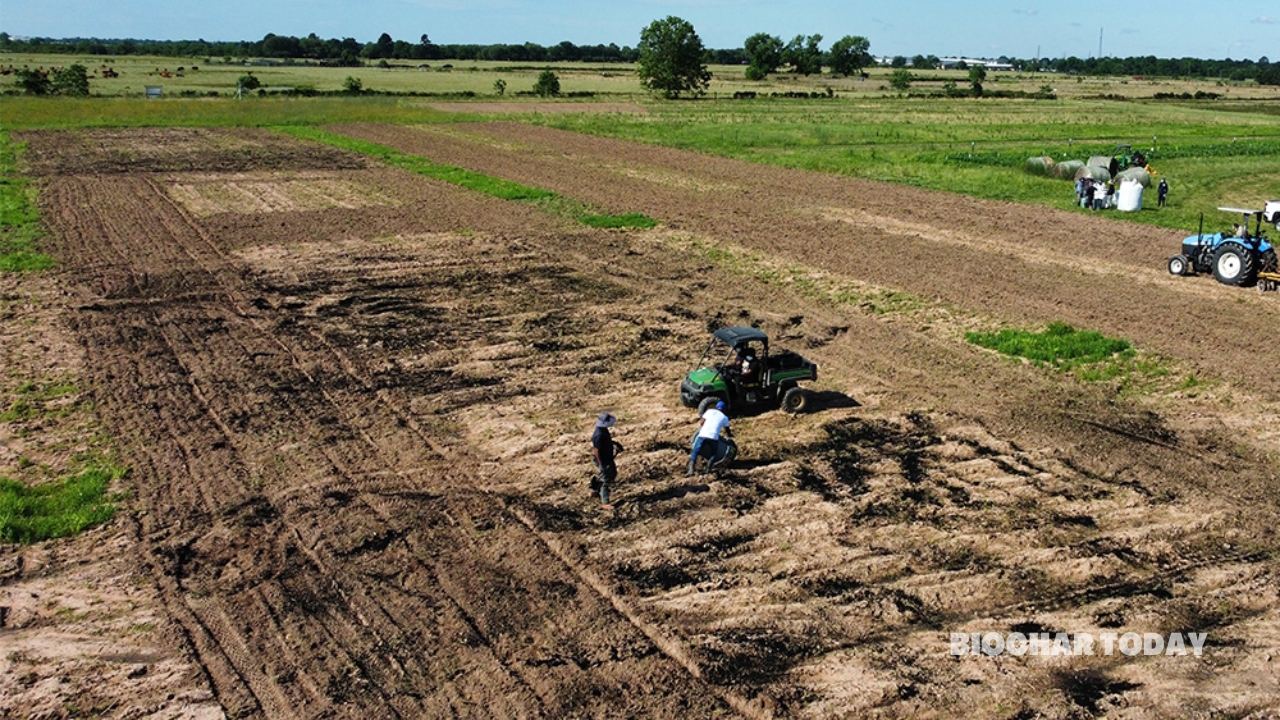
Researchers at Prairie View A&M University, a historically Black land-grant university located in Texas, United States, have launched an initiative utilizing an innovative automated biocharBiochar is a carbon-rich material created from biomass decomposition in low-oxygen conditions. It has important applications in environmental remediation, soil improvement, agriculture, carbon sequestration, energy storage, and sustainable materials, promoting efficiency and reducing waste in various contexts while addressing climate change challenges. More processing system. Led by Dr. Ram Ray, a professor within the College of Agriculture, Food, and Natural Resources, the project integrates nearly $1 million in total investment, which includes approximately $500,000 dedicated strictly to the advanced thermal conversion machinery. This initiative converts unutilized agricultural waste and crop residues into stable, carbon-rich soil amendments. By providing undergraduate and graduate students with structured, hands-on scientific training, the institution aims to scale its internal material synthesis capabilities while simultaneously delivering practical, field-ready environmental solutions to regional agricultural stakeholders.
The primary academic and environmental challenge addressed by this initiative is the general lack of specialized, high-capacity processing equipment available at public research institutions. Conventional agricultural management systems frequently treat excess post-harvest crop residues as a problematic waste burden, leading to open-field burning or passive decomposition, both of which release stored greenhouse gases back into the atmosphere. While academic sectors widely recognize the theoretical benefits of thermal stabilization, researchers and students often lack access to sophisticated, automated technological infrastructure capable of standardizing production variables. This equipment deficiency restricts high-volume experimentation, limits structural optimization studies, and slows the development of localized, practical carbon management methodologies that can be easily demonstrated and transferred to commercial producers.
To overcome these institutional and logistical constraints, Prairie View A&M University acquired a highly sophisticated, automated biochar processing unit. This state-of-the-art system operates on technical specifications distinct from standard equipment found at other public or private entities, allowing for high-efficiency, standardized biomassBiomass is a complex biological organic or non-organic solid product derived from living or recently living organism and available naturally. Various types of wastes such as animal manure, waste paper, sludge and many industrial wastes are also treated as biomass because like natural biomass these More conversion. The technology utilizes controlled thermochemical processing to transform variable plant matter into an uniform, high-quality, charcoal-like substance. By establishing this dedicated processing infrastructure on campus, the university has integrated advanced engineering tools directly into its agricultural curriculum, enabling researchers to process diverse local feedstocks under precise thermodynamic controls while training underrepresented student cohorts in automated system operations.
The deployment of this automated processing unit establishes measurable benchmarks for academic development and community outreach. Agronomically, the university-produced biochar improves regional soil architecture, facilitating enhanced nutrient retention and structural stability over extended timelines compared to traditional chemical fertilizers. Educationally, the initiative provides students with technical competencies in environmental management and carbon accounting, preparing them for leadership roles within emerging green economies. Furthermore, the university plans to launch cooperative outreach programs, establishing a closed-loop exchange where local farmers supply raw agricultural waste residues and receive processed biochar in return, thereby advancing sustainable land management and regional soil health.





Leave a Reply