
Key Takeaways
- Adding charcoalCharcoal is a black, brittle, and porous material produced by heating wood or other organic substances in a low-oxygen environment. It is primarily used as a fuel source for cooking and heating. More made from organic waste into concrete can massively reduce the carbon footprint of the building industry.
- This eco-friendly ingredient acts as a physical sponge, absorbing water and shortening the time it takes for fresh concrete to harden.
- Blending higher amounts of organic charcoal into the mixture makes the finished material lighter but less structurally strong.
- High-carbon charcoal particles can generate microscopic bonding gaps inside the mix that change the final density and stiffness.
- While less sturdy for heavy support beams, this green concrete is ideal for sidewalks, architectural features, and low-load masonry.
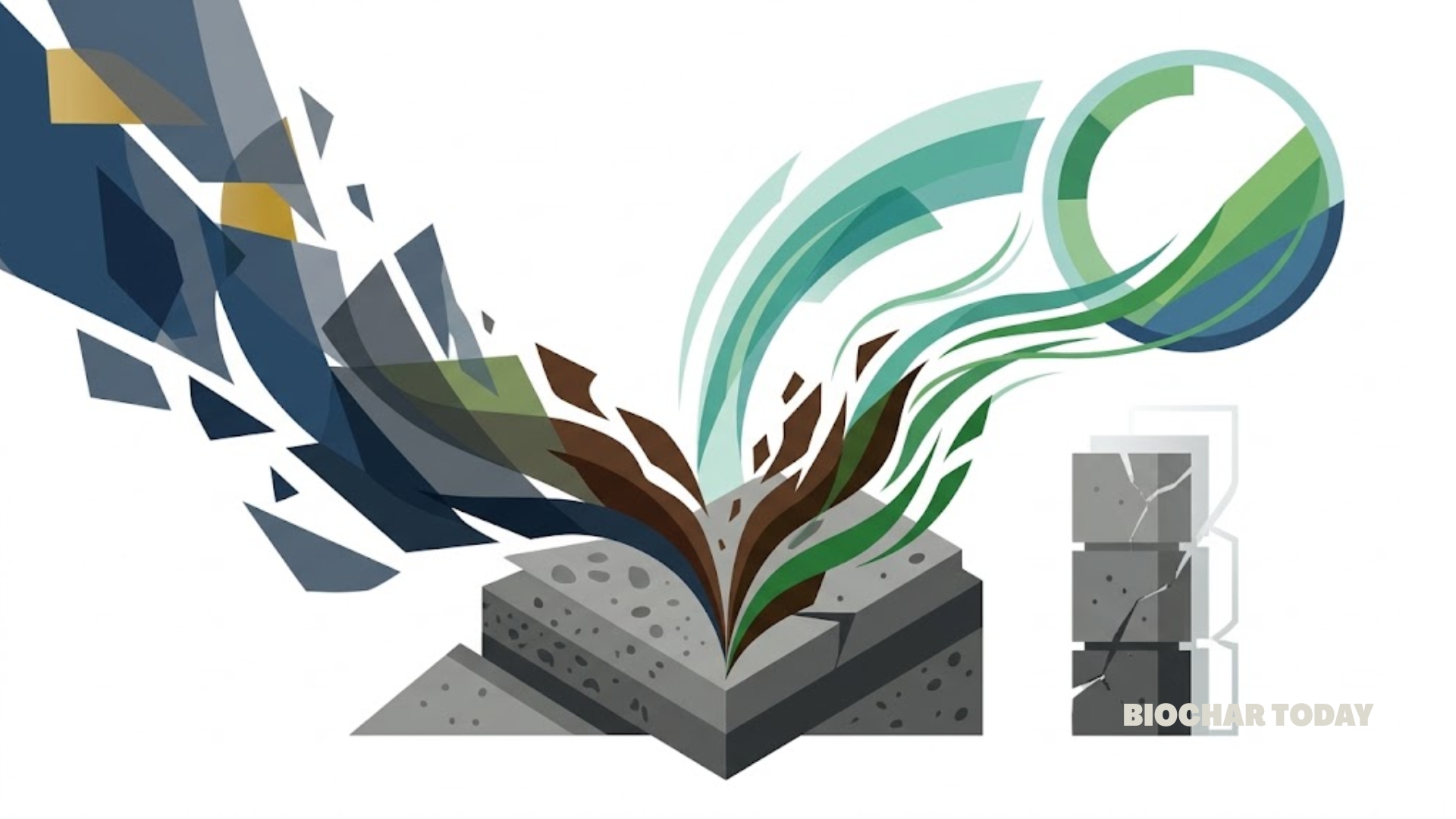
Modern infrastructure relies heavily on Portland cement, but its production is highly energy-intensive and accounts for a substantial portion of global carbon dioxide emissions. Seeking a sustainable alternative to mitigate the construction industry’s carbon footprint, a study published in the journal Discover Concrete and Cement by authors Ali Abbas and Sagar Gwachha evaluates the potential of biocharBiochar is a carbon-rich material created from biomass decomposition in low-oxygen conditions. It has important applications in environmental remediation, soil improvement, agriculture, carbon sequestration, energy storage, and sustainable materials, promoting efficiency and reducing waste in various contexts while addressing climate change challenges. More as a green concrete component. Biochar acts as a highly effective medium for carbon sequestration. The research team explored how dividing this charcoal-like by-product into distinct particle sizes to function simultaneously as a fine cement replacement and a slightly coarser structural filler modifies the fresh, hardened, and environmental properties of high-strength concrete mixes.
The most striking finding from the investigation centers on the dramatic environmental benefits achieved through this material substitution. By incorporating biochar powder into the structural design, the researchers achieved an exceptional reduction in the total embodied carbon of the concrete material, maximizing emissions savings at nearly eighty-nine percent compared to a traditional control mix. Because conventional cement manufacturing releases vast amounts of greenhouse gases, reducing the raw cement content yields immediate environmental dividends. Furthermore, the biochar itself possesses a negative carbon emission factor because it physically locks stable carbon within its porous framework, preventing it from entering the atmosphere. This dual advantage turns the modified concrete into a highly potent tool for developers striving to reach strict national carbon neutrality targets.
However, the experimental data reveals that these massive environmental gains require a distinct trade-off in the physical performance of the hardened material. As the percentage of biochar in the concrete matrix rose, both the overall compressive strength and the modulus of elasticity experienced a gradual and notable decline. At the maximum evaluated replacement level, the cube compressive strength decreased by more than sixty-one percent, while the structural density dropped by over fourteen percent. This weakening occurs because substituting cement reduces the total volume of primary binding phases available to fuse the aggregate together during the routine curing process. Additionally, biochar features a much lower specific gravity than regular cement, which naturally translates to a significantly lighter but structurally softer composite framework.
Fresh properties of the wet concrete mixture were also deeply impacted by the unique morphology of the organic additive. Freshly mixed batches demonstrated a sharp drop in workability, with structural slump values falling by up to eighty percent as more biochar was integrated. The physical explanation lies in the highly porous structure and immense surface area of the charcoal particles, which act like tiny internal sponges. These particles absorb a portion of the mixing water, leaving less free fluid available to lubricate the moving particles. This internal water absorption effectively lowers the operational water-to-cement ratio, which accelerates the hardening process and noticeably shortens both the initial and final setting times of the fresh concrete.
Advanced microstructural scanning confirmed that these internal dynamics directly alter the concrete matrix without changing its fundamental crystalline phases. Microscopic views show irregular, porous biochar structures embedded throughout the hydrated cement paste, creating extra micro-voids and weaker interfacial bonding regions that explain the reduction in stiffness. Reassuringly, chemical testing proved that the highly alkaline environment of the concrete remained stable, maintaining the elevated pHpH is a measure of how acidic or alkaline a substance is. A pH of 7 is neutral, while lower pH values indicate acidity and higher values indicate alkalinity. Biochars are normally alkaline and can influence soil pH, often increasing it, which can be beneficial More range necessary to protect steel reinforcement from long-term corrosion. While the loss in strength rules out this carbon-negative concrete for heavy load-bearing columns, the modified mixtures remain highly suitable for non-structural applications. Utilizing the material for paving stones, low-load masonry blocks, and architectural features allows builders to embrace substantial sustainability advantages while managing lower mechanical strength.
Source: Abbas, A., & Gwachha, S. (2026). Effect of biochar as filler and partial cement replacement in sustainable concrete. Discover Concrete and Cement, 2(1), 27.


![Eucalyptus Wood Waste-Derived Biochar Achieves a Ninety-Eight Percent Removal Efficiency for Benzo[ghi]perylene in Vehicle-Wash Wastewater](https://biochartoday.com/wp-content/uploads/2026/10/SCIENCE-BLOGS-2026-2026-10-19T160523.703.jpg)
Leave a Reply