
Key Takeaways
- Agricultural residues from cocoa production in Ivory Coast can be transformed into affordable materials for cleaning drinking water.
- Standard biocharBiochar is a carbon-rich material created from biomass decomposition in low-oxygen conditions. It has important applications in environmental remediation, soil improvement, agriculture, carbon sequestration, energy storage, and sustainable materials, promoting efficiency and reducing waste in various contexts while addressing climate change challenges. More produced at a lower temperature is actually more effective at removing toxic cadmium than more expensive activated versions.
- The surface chemistry of these materials, specifically their acidic functional groups, plays a more critical role in pollutant removal than their physical pore structure.
- Utilizing cocoa pod shells for water treatment provides an environmentally friendly way to manage large quantities of local agricultural waste
- This low-cost filtration method offers a practical solution for improving water quality in underserved rural communities without needing complex industrial processes
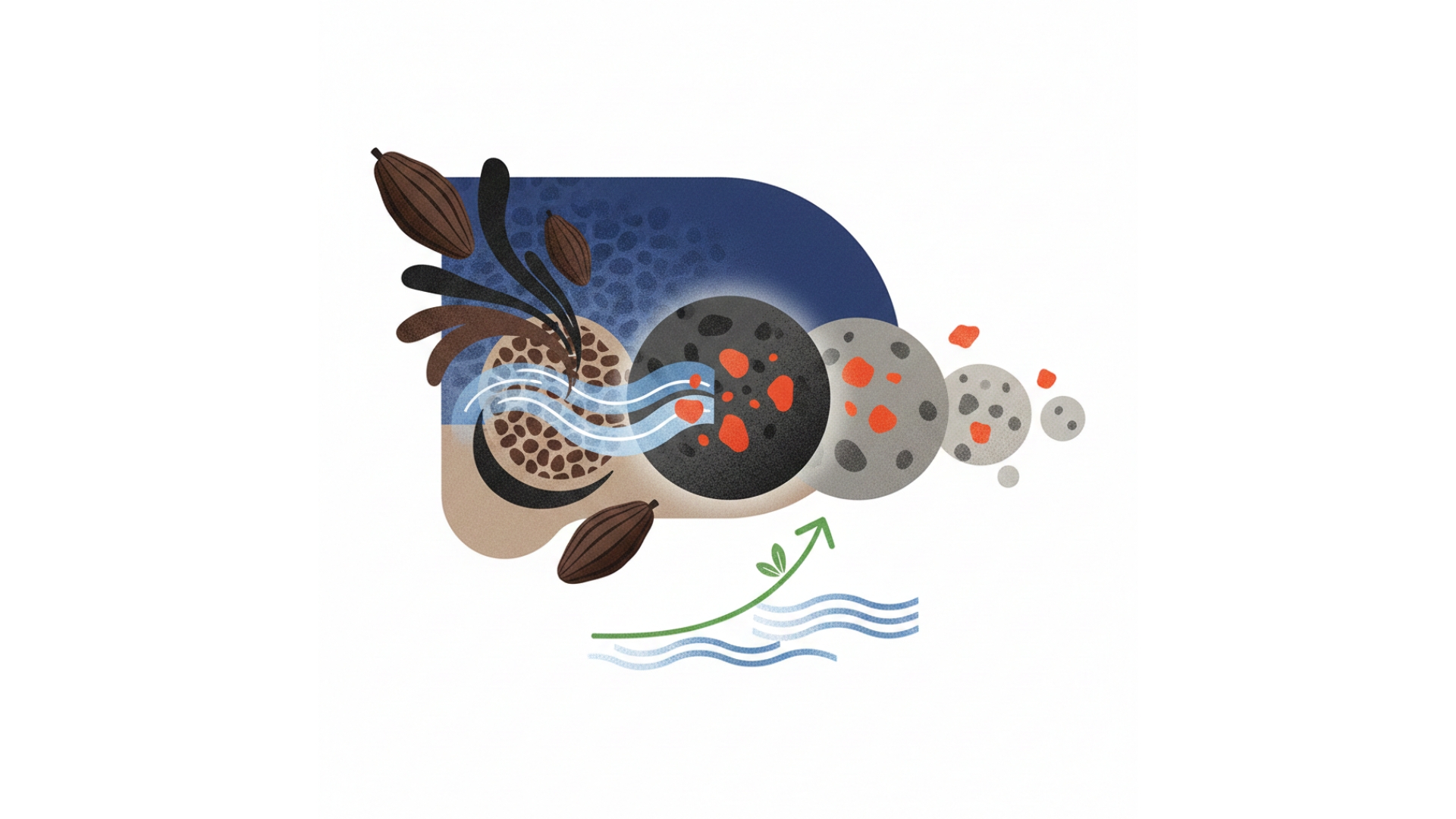
The recent study published in Bois et Forêts des Tropiques by Yao Guy Landry Koffi and a team of international researchers explores the potential of converting agricultural waste into valuable water treatment tools. Ivory Coast is the world’s leading cocoa producer, generating millions of tons of pod shells that are often left to rot or incinerated on plantations. By transforming these residues into biochar through thermochemical processes, the research aims to provide a sustainable and inexpensive method for removing heavy metals like cadmium from local drinking water sources.
The findings challenge common assumptions in water treatment technology by showing that physical activation—a process used to increase surface area—does not always improve efficiency. While activation with carbon dioxide significantly increased the material’s surface area from 3 to 178 square meters per gram, it actually reduced its ability to capture cadmium. This is because the high temperatures required for activation destroyed the specific oxygenated acidic groups on the biochar’s surface that are responsible for binding with metal ions.
Raw biochar produced at a relatively low temperature retained these essential chemical functions, allowing it to remove pollutants through complexation and ion exchange. This makes the simpler, raw biochar a superior candidate for community-scale water filtration. Beyond its high performance, this approach is highly energy-efficient and costs significantly less than producing commercial activated carbonActivated carbon is a form of carbon that has been processed to create a vast network of tiny pores, increasing its surface area significantly. This extensive surface area makes activated carbon exceptionally effective at trapping and holding impurities, like a molecular sponge. It is commonly More, making it ideal for resource-limited settings in the Global South.
From a public health perspective, the study addresses a critical need in Ivory Coast, where over half of the population lacks access to safely managed drinking water. Heavy metal contamination in wells and boreholes poses serious long-term health risks to these populations. By utilizing a locally abundant resource like cocoa pod shells, communities can implement decentralized filtration systems that are both culturally appropriate and economically viable.
Ultimately, the results provide a clear scientific basis for promoting low-tech, high-impact environmental solutions. The researchers recommend further testing in real-world conditions with water containing multiple types of metals to refine the filtration process. This work highlights the power of the circular bioeconomy, where agricultural “waste” is repurposed to protect human health and preserve natural resources.
Source: Koffi, Y. G. L., Rousset, P., Dupont, C., Sharma, S., Gyasi, A. A., & Commandre, J.-M. (2025). Is cocoa pod shell biochar activation a suitable way for water cadmium removal in the Ivory Coast? Bois et Forêts des Tropiques, 362, 1-12.



Leave a Reply