
Key Takeaways
- Agricultural waste from processed oranges can be successfully transformed into an advanced water-cleaning filter to capture synthetic industrial dyes.
- A dual-activation baking method using zinc and iron chemicals creates a highly porous carbon structure resembling a microscopic sponge.
- The newly designed biocharBiochar is a carbon-rich material created from biomass decomposition in low-oxygen conditions. It has important applications in environmental remediation, soil improvement, agriculture, carbon sequestration, energy storage, and sustainable materials, promoting efficiency and reducing waste in various contexts while addressing climate change challenges. More captures more than ninety-six percent of organic dye pollutants from wastewater within one hour.
- The cleaning material can be washed with acid and reused across seven consecutive cycles while still retaining robust dye-trapping performance.
- This engineered biochar maintains highly efficient performance across a broad acidity range and in the presence of common competing ions.
The rapid expansion of global industrial activities, particularly textile dyeing, printing, and paper manufacturing, has led to a significant increase in the discharge of synthetic organic dye wastewater into the environment. Methylene blue is a highly stable, aromatic cationic dye that resists natural degradation, reduces light penetration in aquatic ecosystems, and poses serious health risks to humans and marine organisms. Standard physical and chemical treatments often struggle with the structural stability of such persistent organic pollutants, or they require significant energy inputs and expensive specialized materials. Converting abundant agricultural residues into high-performance carbon adsorbents offers an economically viable and environmentally friendly solution. However, raw unmodified biochars typically possess limited pore networks and low chemical surface reactivity, which restricts their overall pollutant removal performance.
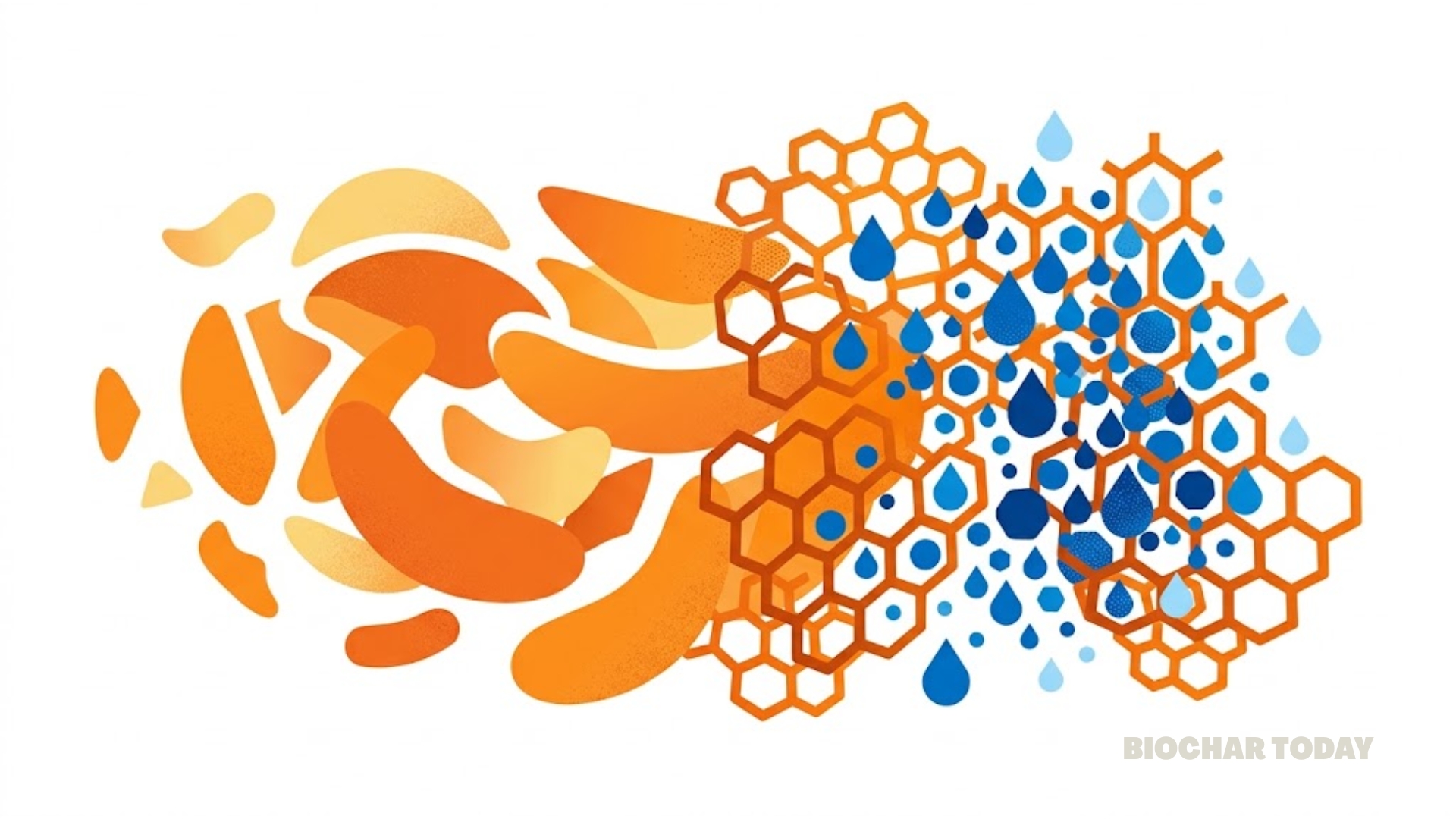
To address these limitations, researchers from Shaanxi University of Science and Technology and their co-authors designed a dual-modification strategy using citrus waste. By treating orange peel powder with a combination of zinc chloride and iron chloride prior to pyrolysisPyrolysis is a thermochemical process that converts waste biomass into bio-char, bio-oil, and pyro-gas. It offers significant advantages in waste valorization, turning low-value materials into economically valuable resources. Its versatility allows for tailored products based on operational conditions, presenting itself as a cost-effective and efficient More, they created an optimized composite material designated as Fe/Zn-OPBC500. In this synergistic system, the zinc chemical acts as a volatile pore-former and dehydrating agent, etching the carbon matrix to expand the surface area. Meanwhile, the iron chemical functions as a graphitizing catalyst and embeds metal-oxygen active sites uniformly within the resulting porous scaffold. Heating the material at a moderate temperature of 500 degrees Celsius preserves the ideal balance of highly accessible pores and reactive oxygen-containing functional groups on the biochar surface.
The physical and chemical changes resulting from this dual activation were highly pronounced. Compared to basic orange peel biochar, the engineered composite exhibited a more than sixteen-fold increase in specific surface area and a nearly six-fold rise in total pore volume, establishing a robust three-dimensional hierarchical architecture. This structural transformation drastically enhanced mass transfer and dye accessibility, enabling the biochar to capture 96.8 percent of methylene blue within just 60 minutes under optimized conditions. In batch adsorption experiments, the optimized adsorbent reached a maximum adsorption capacity of 237.53 milligrams per gram. Mathematical modeling verified that this adsorption follows a spontaneous, endothermic chemisorption process where the dye molecules bind as a single layer on a highly uniform surface.
This exceptional removal efficiency is driven by a series of complementary physical and chemical mechanisms. First, the highly developed mesopores physically trap the dye molecules through pore filling. Second, electrostatic attraction plays a major role, as the negative charge on the biochar surface strongly attracts the positive cationic dye molecules. Third, the carbon framework facilitates strong electron-sharing interactions with the aromatic structure of the dye. Finally, the nitrogen atoms in the methylene blue molecules form strong hydrogen bonds and covalent amide-like linkages with the abundant carboxyl and carbonyl groups preserved on the low-temperature biochar. Simultaneously, the nitrogen groups undergo surface complexation at the iron active centers via electron transfer.
In addition to its high capacity, the engineered biochar demonstrated superb stability and selectivity in complex environmental conditions. While common background monovalent ions like sodium had less than a five percent impact on dye capture, competing multivalent cations like calcium and iron caused more noticeable capacity reductions due to selective ion exchange with active surface sites. Furthermore, the material proved highly stable across a broad pHpH is a measure of how acidic or alkaline a substance is. A pH of 7 is neutral, while lower pH values indicate acidity and higher values indicate alkalinity. Biochars are normally alkaline and can influence soil pH, often increasing it, which can be beneficial More range and was easily regenerated using a mild acid wash. The acid successfully breaks the coordination and hydrogen bonds holding the dye, allowing the biochar to maintain a high adsorption capacity of over 113 milligrams per gram even after seven consecutive reuse cycles. This combination of sustainable synthesis, high capacity, and physical durability establishes this orange waste composite as a promising, scalable candidate for industrial wastewater treatment.
Source: Zhang, L., Liu, X., Liu, W., Du, H., & Guo, J. (2026). Hierarchical porous biochar with Fe/Zn co-activation derived from orange waste: enhanced methylene blue adsorption and mechanistic insights. Biochar X, 2, e004.


![Eucalyptus Wood Waste-Derived Biochar Achieves a Ninety-Eight Percent Removal Efficiency for Benzo[ghi]perylene in Vehicle-Wash Wastewater](https://biochartoday.com/wp-content/uploads/2026/10/SCIENCE-BLOGS-2026-2026-10-19T160523.703.jpg)

Leave a Reply