
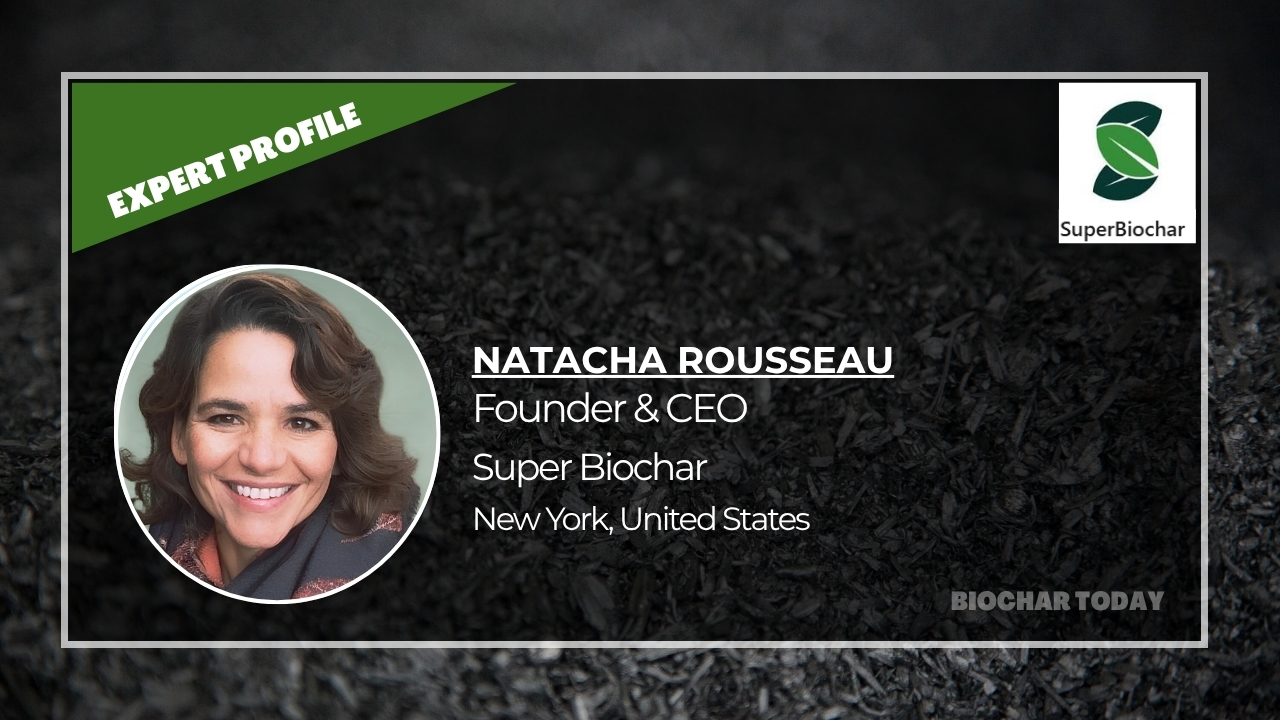
As the biocharBiochar is a carbon-rich material created from biomass decomposition in low-oxygen conditions. It has important applications in environmental remediation, soil improvement, agriculture, carbon sequestration, energy storage, and sustainable materials, promoting efficiency and reducing waste in various contexts while addressing climate change challenges. More sector pushes toward greater credibility, scalability, and real-world impact, leaders who can bridge science, technology, and market systems are becoming increasingly important. Among them is Natacha Rousseau, Founder and CEO of Super Biochar.
With over a decade of experience spanning climate technology, strategic communications, and sustainability, Natacha brings a uniquely cross-disciplinary perspective to the field. Her career has focused on advancing deep-tech and environmental solutions through media, investor relations, and policy engagement—building networks that connect climate innovation with practical implementation. She has also contributed to leading publications such as Inc. and Entrepreneur, reflecting her role as a communicator and thought leader translating complex climate challenges into actionable insights.
At Super Biochar, she is working to redefine how biochar is developed and applied. The company focuses on creating site-specific biochar blends alongside a Soil Intelligence Platform that integrates diagnostics, field data, and reporting. This approach aims to make soil outcomes more measurable, verifiable, and scalable across agriculture, land restoration, municipalities, and carbon markets. Her work is grounded in addressing a critical challenge in the sector: moving biochar beyond broad claims toward evidence-based, data-backed outcomes. By combining engineered materials with real-time insights from the ground, she is helping shape a more transparent and accountable future for soil-based climate solutions.
In this Biochar Today expert profile, I spoke with Natacha Rousseau about the future of biochar, the role of soil intelligence, and what it will take to make carbon and soil outcomes truly measurable at scale. She shares her perspective on building data-driven systems for soil, bridging science with real-world implementation, and the opportunities—and challenges—shaping the next phase of the biochar industry.
Shanthi Prabha: Natacha, it’s wonderful to have you with us today. To begin, what first inspired your journey into climate technology and ultimately led you to biochar?
Natacha Rousseau: Thank you so much for the opportunity. My journey into climate technology began when I was living in San Francisco, where I worked as a spokeswoman and press secretary for a portfolio company backed by Mark Cuban. During that time, I became deeply immersed in the carbon markets space for several years. At the same time, I had the opportunity to work closely with Michelle Li, founder of Clever Carbon and Women and Climate. Through that collaboration, I developed a strong appreciation for the importance of measuring impact, particularly when it comes to carbon accounting and CO₂.
In 2023, I returned to the East Coast for family reasons. My first role back was contributing to a market report for the International Biochar Initiative. That experience led me to dive deeply into the biochar space over the following year, and I was immediately drawn to its versatility and its roots in ancient practice. As someone who is European and now based in New England, I feel a strong connection to places shaped by history and tradition. In Connecticut, where Native American heritage remains deeply present, I found myself reflecting on the idea of honoring ancient knowledge systems. Biochar represents a powerful intersection of past and future, an opportunity to take practices developed by early civilizations, including Indigenous communities, and adapt them using modern science and technology. There is something profoundly meaningful about building on that legacy. For me, biochar is not just a climate solution, it is a way to bring forward the spirit of those earlier systems of stewardship and reimagine them for today’s world.
SP: For those discovering your work for the first time, how would you describe the mission of Super Biochar and the opportunity you saw in the market?
NR: Our mission at Super Biochar is to make soil health measurable, verifiable, and actionable, so that we can restore land and better understand the environments we depend on. Soil quality impacts many things, including the food we eat, the water we rely on, and the resilience of entire ecosystems. Yet today, there is still no clear or consistent way to measure degradation or track improvement in a way that builds trust.
That is the gap we are addressing. Biochar has already proven effective across agriculture, including vineyards, and is now being explored in areas like construction materials and water filtration. But despite its potential, it remains a niche and often misunderstood technology, largely because its impact is not visible or easy to quantify. Super Biochar combines engineered biochar, diagnostics, and AI to restore soil health and deliver measurable improvements from the ground up. We focus on both the science and the translation, building systems that monitor and verify performance in real time while making the technology more accessible and understandable to a broader audience.
At its core, this is about restoring land affected by floods, wildfires, drought, toxins, and PFAS, and doing so in a way that is transparent and credible. If we can make the impact visible, we can build trust. And if we build trust, we can accelerate adoption and bring biochar into the mainstream where it can have the greatest impact.
SP: You often speak about moving biochar beyond being simply a soil amendmentA soil amendment is any material added to the soil to enhance its physical or chemical properties, improving its suitability for plant growth. Biochar is considered a soil amendment as it can improve soil structure, water retention, nutrient availability, and microbial activity. More. What does that next phase of the industry look like, and why is it so important now?
NR: That’s such a good question. I’ll try to answer it simply.
Yes, biochar is often framed as a soil amendment, but it’s really much bigger than that. It’s stable carbon. It stores CO₂, supports the soil microbiome, improves water retention, and reduces the need for synthetic inputs. The industry’s next phase involves expanding where and how it’s used. You’re already starting to see it move into things like asphalt, construction materials, and water filtration. It’s becoming less of a niche agricultural input and more of a foundational material across different systems.
But for me, the real shift is not just new applications, it’s visibility. Right now, a lot of biochar’s impact is still hard to see. It can feel abstract. You apply it, you hope it works, you maybe see results over time, but it’s not always measurable in a clear way. What we’re trying to do, and what I think the industry needs, is to make that impact visible. To measure it, monitor it, and actually show what’s happening in real time. So it’s no longer a guessing game. If we get that right, everything changes. People understand it, they trust it, and adoption follows. To me, that’s the next phase, using modern technology to bring clarity and scale to something that’s been around for centuries.
SP: Super Biochar focuses on site-specific biochar blends. Why is a tailored approach so important when working with different soils, regions, and use cases? Tailored blends are essential because no two soils are the same.
NR: Think about it, is your soil sandy or rocky? Are you in a dry, desert-like climate or somewhere cold and wet, like parts of Europe? Are you near water, or near a polluted site like a brownfield or a former power plant? What has grown there before, and what are you trying to grow now? Are you dealing with too much water, not enough, or trying to recover after a wildfire? There are so many variables, and each one matters. It is not a one-size-fits-all solution.
Soil sits beneath our feet, which is maybe why it is so often overlooked, but it is the source of life. It holds memory. It reflects history. And if you really want to work with it, you have to understand what it needs. That is why tailored blends matter. By combining biochar with other natural, often local ingredients, we can respond to each site in a way that is specific, fluid, and grounded in its reality. For me, it is also about respect, honoring the land, its lifecycle, and the ecosystems it supports. If we get that right, the outcomes follow.
SP: Your Soil Intelligence Platform is an exciting concept. How can combining diagnostics, field data, application records, and reporting improve decisions for landowners and businesses?
NR: This question is really about clarity.
Today, most landowners and businesses make decisions using fragmented information. You might have soil test results in one place, field notes somewhere else, application records in a spreadsheet, and little visibility into what is actually changing over time. This makes it very hard to connect actions to outcomes. By bringing diagnostics, field data, application history, and reporting into one system, you start to see the full picture. You can understand what is happening beneath the surface, track how interventions are performing, and make more informed decisions over time instead of relying on assumptions.
It shifts the approach from reactive to proactive. Instead of guessing, you begin to see patterns. Instead of hoping something works, you can validate it.This is where our work with the Domo for Good program has been especially meaningful. It allows us to think more holistically about how data can be connected and translated into something practical and usable, not just for scientists, but for landowners, operators, and decision-makers on the ground.
At the end of the day, better decisions come from better visibility. And when you can clearly see what is working and why, you can act with a lot more confidence.
SP: Biochar is gaining attention across agriculture, brownfields, municipalities, and conservation. Which sectors do you believe are most ready for wider adoption today?
Biochar is gaining attention in many places, but I think agriculture is the most ready today. Farmers already understand soil. They understand water retention, crop health, fertilizer costs, drought stress and the need to improve long-term soil performance. Biochar fits naturally into that conversation, especially when paired with soil testing and clear guidance. USDA also describes biochar as a tool that can improve drainage, aeration, nutrient and water retention, and overall soil health. I think the second sector ready for implementation is stormwater and municipal land management. Cities are dealing with flooding, runoff, pollutants and aging infrastructure. Biochar has a very practical role there because it can help hold water and filter certain contaminants, including heavy metals and hydrocarbons. Brownfields and remediation are also incredibly important, but I think they will take a little longer because the regulatory and testing requirements are more complex.
The need is clearly there, especially with federal and state brownfield funding continuing in 2026, but adoption will depend on strong data, careful pilots and credible reporting. So, in simple terms, I would say agriculture is ready now, municipalities are close behind, and brownfields are the big long-term opportunity.
For Super Biochar, that is why measurement matters. The market is ready for biochar, but it also needs proof. If we can show what is happening in the soil, in the water and across the land over time, adoption becomes much easier.
SP: Measurement and verification are becoming increasingly important in carbon markets. How can the biochar sector build stronger trust through transparent and credible data?
NR: Measurement and verification are where trust is built.
Biochar has a real advantage because it can store carbon for long periods, but the sector must prove that with clear data, not just good intentions. In 2026, leading registries and standards will emphasize durability, storage pathways, greenhouse gas accounting and MRV because buyers want confidence that credits represent real removal. For Super Biochar, this is what we’ve been working toward, and it is the point we wish to make. We believe the industry needs to move from “biochar works” to “here is what happened, here is how we measured it, and here is the result over time.”
That means transparent baselines, soil and field data, application records, monitoring, third-party verification and reporting that a landowner, buyer or regulator can actually understand. The carbon market has been hurt by vague claims. Biochar can be different if we make the data visible, credible and practical. That is how we build trust: not by overselling the promise, but by showing the proof.
SP: For business leaders watching today, what are the biggest commercial opportunities you see emerging in the biochar industry over the next five years?
Such a good question. The biggest opportunities are where biochar solves an immediate problem, soil degradation, water stress, and land remediation.
Agriculture, brownfields, and infrastructure are all moving, but the real shift is this: biochar is no longer just a material, it is becoming an outcome.
Whoever can tie it to clear, measurable results is going to win.
SP: What are some common mistakes companies make when entering the biochar sector, and how can they position themselves more effectively?
NR: Yes. The biggest mistake is treating biochar like a trend instead of an industry.
A lot of companies lead with the material: “We make biochar.” But that is not enough anymore. The stronger companies will lead with the problem they solve.
The other mistake is overpromising. Biochar is powerful, but it is not magic. The companies that earn trust will be those that stay specific, show the data, understand the site, and build practical business models around real needs.
SP: Super Biochar combines science, technology, and business strategy. How do you balance innovation with the practical realities of scaling a climate-tech company?
NR: It’s definitely like walking a fine line.
On one side, you have innovation: all the excitement, the technology, the vision of what this could become. On the other, you have reality: the team, partners, mentors, advisors, travel, cost, logistics, timing, and people actually using it on the ground.
You cannot ignore any of it. You are constantly asking yourself: What is priority, what is critical, what is urgent?
I tend to think of it like cooking. You can have the most beautiful idea, but if the ingredients are not right, the timing is off; or if it does not work in a real kitchen, it does not matter.
Its about getting the balance right. Then you can build something that is both elegant and real.
SP: Partnerships are often essential in this industry. What kinds of collaborations—with farmers, municipalities, researchers, or corporations—will shape the future of biochar most strongly?
NR: The strongest collaborations will connect the whole chain. Farmers and landowners are essential because they show what actually works in the field. Researchers bring credibility and testing. Municipalities matter because biochar has a real role in stormwater, brownfields and public land. And corporations, especially carbon buyers, can help create the demand that makes projects financially viable.
What I find encouraging in 2026 is that the industry is starting to organize around partnerships, from ABI and the U.S. Biochar Coalition joining forces for the North American market to new public-sector interest in biochar for stormwater and remediation.
For Super Biochar, the future is collaborative by design. No one scales this alone. The best partnerships will be practical, local, science-backed and built around measurable outcomes.
SP: As Founder and CEO, what has been the most exciting milestone so far in building Super Biochar?
NR: It’s hard to choose just one, because there have been a few moments that really mattered.
Being accepted into the Domo for Good program was a big one. That partnership has been incredibly meaningful for us, especially in how we think about data, visibility, and impact. Joining the Bauer Innovation Center and ClimateHaven were also important milestones. They give us the environment, structure, and support to build thoughtfully and stay grounded as we grow. But honestly, the team is what I am most proud of. I ask a lot, I move quickly, and I can push hard to stay on timeline, but they continue to show up with so much commitment and integrity. Bluvin, Ananth, Sara, Nivi, Jett, they are exceptional. I probably sound like a broken record, but without them, none of this would be possible.
And then there is our advisory board. That was a turning point. Their level of brilliance and generosity has been just increddible. They keep us accountable, challenge us, ask the hard questions, and ensure we are building this the right way. It was very important to me to have an independent, expert group that could push and guide us. At at the end of the day, the foundation is everything. If you get that right, you can build something that lasts.
SP: If a traditional agriculture, sustainability, or environmental company is curious about entering the biochar market, where would you advise them to begin?
NR: I would start with the problem.
In 2026, companies gaining traction are not just producing biochar, they are solving specific issues: water stress, soil degradation, waste management, contamination, or carbon compliance. So first, look at your existing operations. Where are the inefficiencies? Where are the costs? Where is the pressure coming from? Then test it in the real world. Use small pilots, real sites, and gather real feedback.
SP: On a personal level, what keeps you motivated while working in a field that carries both major challenges and long-term potential?
NR: Phew, it has not been easy.
The beginning was especially tough. I made a few decisions I would not make again, and there were moments where I felt genuinely disappointed. But I picked myself up, and my team played a big role in that. They have been incredibly supportive from the start. So, honestly, what keeps me going is the people around me. My team, my advisory board, and now the Domo for Good community. The team there has been remarkable. I remember telling one of their senior AI leaders that we were “small peanuts,” and he looked at me and said, “You are anything but small.” That stayed with me.
Their belief, combined with my team’s commitment, is what drives me. And beyond that, it is a very deep conviction in the problem we are solving. This is hard work, but it is also much bigger than me. That is what motivates me.
SP: And to end on a lighter note—if you could fast-forward ten years and read one headline about Super Biochar, what would you hope it says?
NR: If in ten years we can say that we helped make biochar understandable, measurable, and trusted, and that we honored both the science and the origins of the practice, then that’s the headline I would want to read.

![Eucalyptus Wood Waste-Derived Biochar Achieves a Ninety-Eight Percent Removal Efficiency for Benzo[ghi]perylene in Vehicle-Wash Wastewater](https://biochartoday.com/wp-content/uploads/2026/10/SCIENCE-BLOGS-2026-2026-10-19T160523.703.jpg)

Leave a Reply