
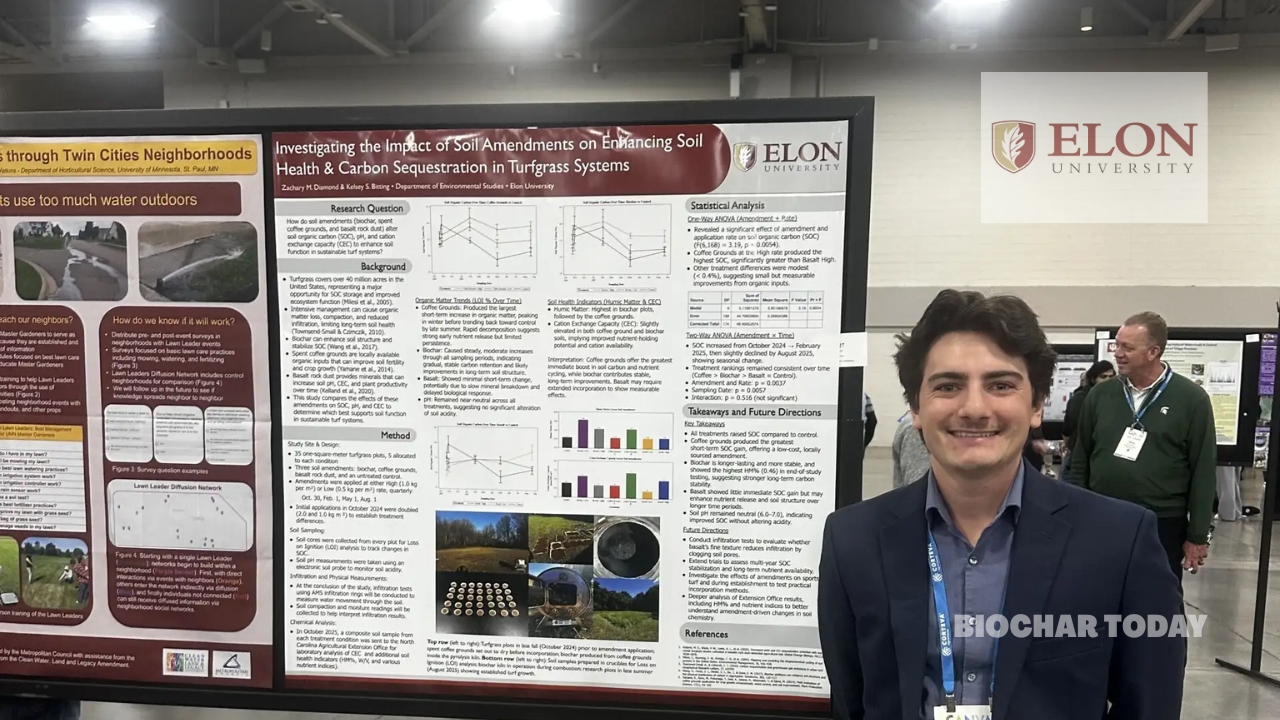
Elon University in the United States has announced the opening of applications for its Sustainability Research Grants, administered through the Sustainability Research Scholars program. Each academic year, the university awards a $1,000 grant, initiated by a gift from the Class of 2010, to a student engaged in faculty-mentored undergraduate research. This funding cycle targets projects that address the interdependence of ecological and socioeconomic systems or focus on significant sustainability challenges as outlined by the United Nations Sustainable Development Goals. A prominent example of this initiative is the work of senior Zachary Diamond, who has utilized the grant to investigate the efficacy of various soil amendments including biocharBiochar is a carbon-rich material created from biomass decomposition in low-oxygen conditions. It has important applications in environmental remediation, soil improvement, agriculture, carbon sequestration, energy storage, and sustainable materials, promoting efficiency and reducing waste in various contexts while addressing climate change challenges. More in managed landscapes.
The primary challenge addressed by this research involves the high environmental costs associated with conventional turfgrass management in locations such as golf courses and residential lawns. These managed landscapes often require significant chemical inputs to maintain aesthetic and functional standards, which can negatively impact soil health and limit carbon sequestration. There is a critical industry need to evaluate whether lower-input soil amendments can effectively improve soil function and carbon storage. Without empirical field data, transitioning these high-maintenance areas toward more sustainable, carbon-negative management practices remains a difficult hurdle for the industry.
To address these challenges, Diamond conducted a three-year sustainability-focused research project evaluating how biochar, basalt rock dust, and used coffee grounds influence soil properties. The methodology specifically examined changes in soil organic carbon, pHpH is a measure of how acidic or alkaline a substance is. A pH of 7 is neutral, while lower pH values indicate acidity and higher values indicate alkalinity. Biochars are normally alkaline and can influence soil pH, often increasing it, which can be beneficial More levels, and cation exchange capacity. The grant provided the necessary capital to purchase materials for soil sample testing as part of a field experiment. This systematic evaluation allowed for a direct comparison between traditional management and alternative amendments, seeking to determine if these materials can maintain turfgrass health while reducing the overall ecological footprint of the landscape.
The outcomes of this grant-funded research include the development of technical skills in experimental design and the dissemination of data to the broader scientific community. Diamond presented his findings at the ASA-CSSA-SSSA CANVAS Annual Meeting in Salt Lake City, Utah, facilitating professional connections within the field of soil science. Furthermore, the practical experience gained led to a professional appointment at Vineyard Golf Club, a nationally recognized organic facility. For the biochar industry, these results provide evidence of how academic grants can support the validation of charred biomassBiomass is a complex biological organic or non-organic solid product derived from living or recently living organism and available naturally. Various types of wastes such as animal manure, waste paper, sludge and many industrial wastes are also treated as biomass because like natural biomass these More as a viable agronomic tool for improving soil function and long-term carbon storage. This represents a tangible opportunity for students to advance sustainability research and gain professional industry experience.




Leave a Reply