
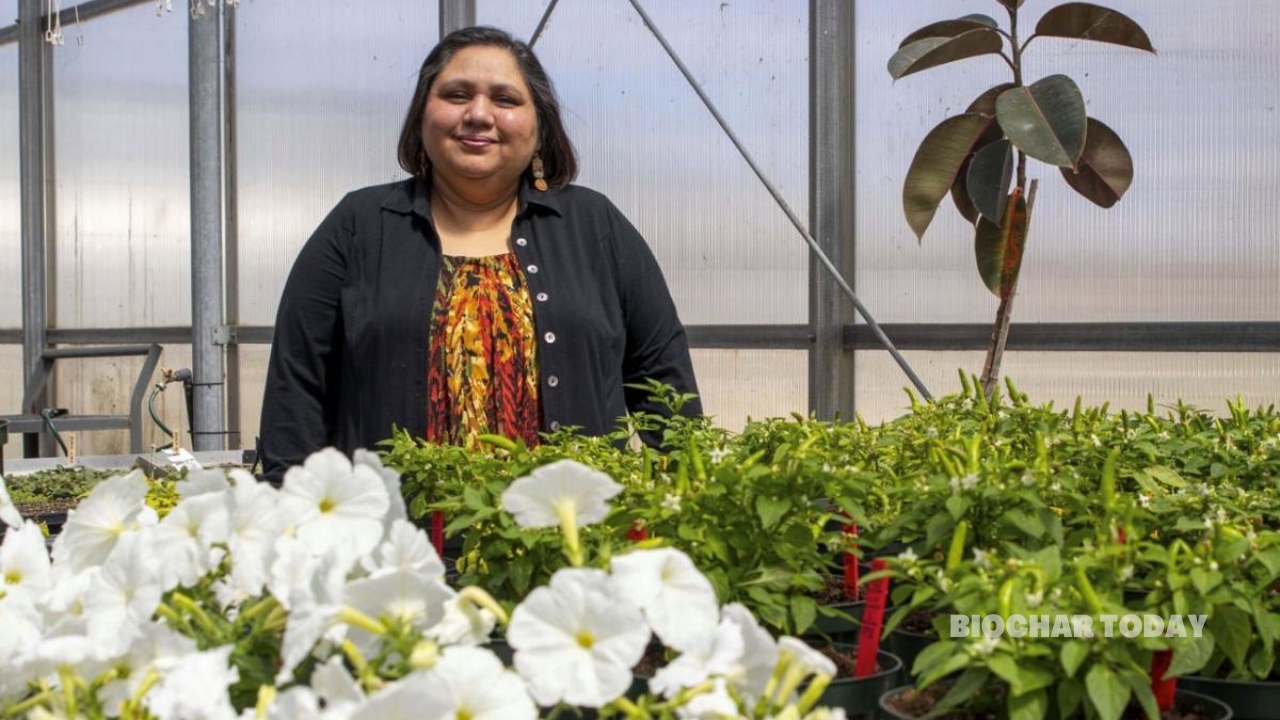
A new horticultural research initiative based in Canada aims to transition commercial greenhouses toward enhanced environmental sustainability by evaluating alternative growing media. Dr. Poonam Singh, a faculty researcher at Assiniboine College’s Russ Edwards School of Agriculture & Environment, has secured $99,000 through the Sustainable Canadian Agricultural Partnership, along with nearly $20,000 in industry investment. The project will evaluate whether biocharBiochar is a carbon-rich material created from biomass decomposition in low-oxygen conditions. It has important applications in environmental remediation, soil improvement, agriculture, carbon sequestration, energy storage, and sustainable materials, promoting efficiency and reducing waste in various contexts while addressing climate change challenges. More can partially replace peat moss in container growing systems for ornamental and nursery plant production. By moving laboratory-scale sustainability research into commercial production conditions, the initiative attempts to establish practical, scalable options for the greenhouse sector.
The major challenge addressed by this initiative is the heavy reliance of the horticultural industry on sphagnum peat moss despite growing environmental concerns regarding its extraction. Peat moss is highly favored in commercial greenhouse systems due to its material consistency, exceptional moisture retention, and high nutrient-holding capacity. However, harvesting peat bogs degrades critical ecosystems that serve a vital global function in carbon storage, biodiversity preservation, and watershed retention. Because peat bogs sequester immense quantities of carbon, mining them releases greenhouse gases and disrupts regional biodiversity, making the reduction of peat consumption an environmental priority for global agriculture.
To resolve this issue, the research project focuses on evaluating locally sourced, sustainable organic waste materials as partial peat substitutes without sacrificing crop yield or quality. Specifically, Singh’s project will study biochar produced from cattails as a viable peat extender in soilless growing mixes. The production process involves heating the harvested cattail biomassBiomass is a complex biological organic or non-organic solid product derived from living or recently living organism and available naturally. Various types of wastes such as animal manure, waste paper, sludge and many industrial wastes are also treated as biomass because like natural biomass these More and other agricultural waste residues under low-oxygen conditions to form a stable, carbon-rich material. Additionally, the researchers will examine the integration of sheep wool waste into container systems, leveraging its natural capacity to retain moisture and slowly release plant nutrients.
The anticipated outcomes of this applied research project center on defining realistic parameters for integrating these alternative materials into existing commercial production lines. Early trials utilizing these inputs have demonstrated promising results, including robust plant growth and a decreased operational reliance on synthetic chemical fertilizers. By validating cattail biochar and wool waste under commercial conditions, the project provides a pathway to minimize the horticultural carbon footprint through fractional peat replacement. Assiniboine College is executing this initiative alongside key industry and community stakeholders, including Carbon Lock Tech, Vanderveen Greenhouse, the Manitoba Nursery Landscape Association, Canadian Co-operative Wool Growers Ltd., and the Sioux Valley Dakota Nation.



Leave a Reply