
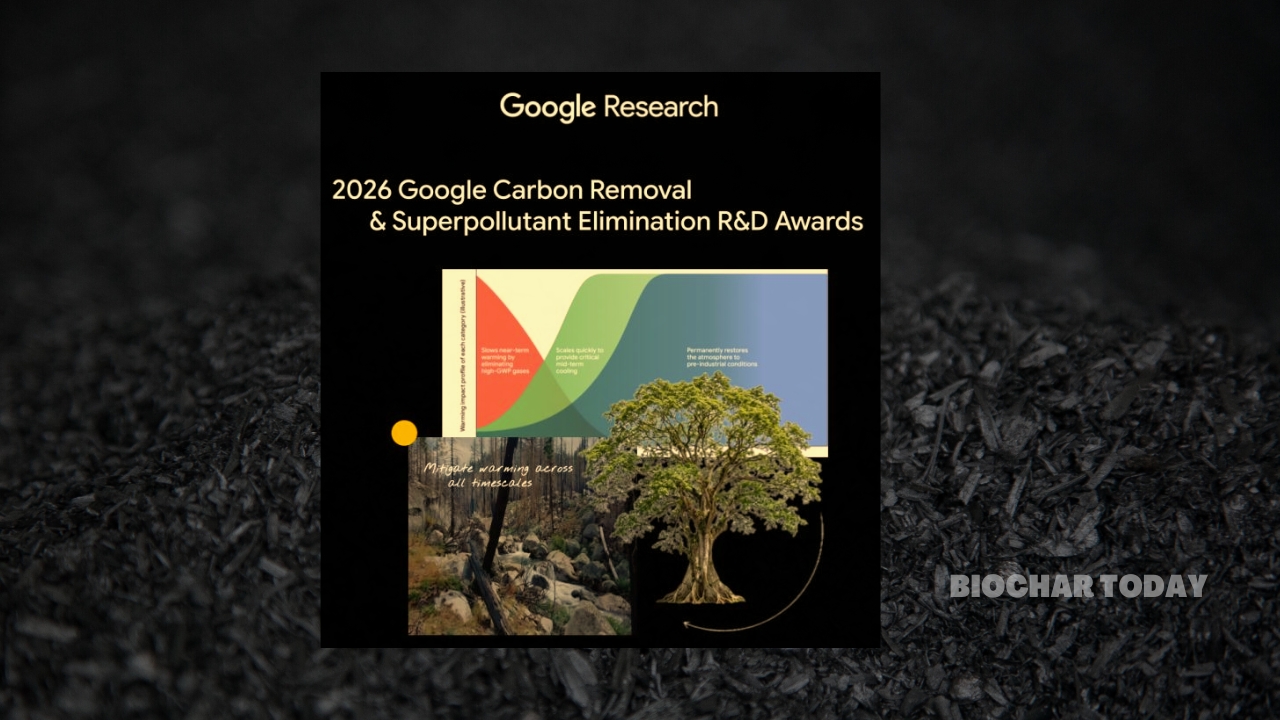
Google Research has announced its 2026 Carbon Removal and Superpollutant Elimination R&D Awards, targeting critical scientific and engineering challenges to scale durable carbon dioxide removal technologies worldwide. Operating as an international initiative, the awards program provides targeted grant funding across key carbon removal pathways, including bioenergy with carbon capture and storage, ocean alkalinity enhancement, blue carbon restoration, and biocharBiochar is a carbon-rich material created from biomass decomposition in low-oxygen conditions. It has important applications in environmental remediation, soil improvement, agriculture, carbon sequestration, energy storage, and sustainable materials, promoting efficiency and reducing waste in various contexts while addressing climate change challenges. More production. By backing targeted research initiatives, the company aims to advance fundamental carbon removal mechanics from laboratory concepts into validated, real-world deployment frameworks.
A major barrier to scaling global biochar production involves the current operational reliance on homogeneous, low-moisture woody biomassBiomass is a complex biological organic or non-organic solid product derived from living or recently living organism and available naturally. Various types of wastes such as animal manure, waste paper, sludge and many industrial wastes are also treated as biomass because like natural biomass these More, which restricts the expansion of pyrolysisPyrolysis is a thermochemical process that converts waste biomass into bio-char, bio-oil, and pyro-gas. It offers significant advantages in waste valorization, turning low-value materials into economically valuable resources. Its versatility allows for tailored products based on operational conditions, presenting itself as a cost-effective and efficient More operations. Existing industrial pyrolysis equipment struggles to efficiently process heterogeneous, high-moisture organic feedstocks such as municipal solid waste, sewage sludge, non-woody agricultural residues, and distributed waste streams. Processing these non-standard feedstocks frequently introduces high ashAsh is the non-combustible inorganic residue that remains after organic matter, like wood or biomass, is completely burned. It consists mainly of minerals and is different from biochar, which is produced through incomplete combustion. Ash Ash is the residue that remains after the complete More content, moisture friction, and volatile contaminants that foul reactor infrastructure and undermine the chemical stability and long-term carbon permanence of the resulting biochar.
To address these feedstockFeedstock refers to the raw organic material used to produce biochar. This can include a wide range of materials, such as wood chips, agricultural residues, and animal manure. More constraints, Google Research is offering up to $450,000 in dedicated research funding for a single project focused on unlocking underutilized organic biomass. The targeted research initiative prioritizes innovations in advanced feedstock preprocessing, specialized pyrolysis reactor design, and low-cost processing solutions for distributed waste sources. To ensure high carbon removal integrity, supported projects must align with recognized biomass accounting modules and utilize advanced aging or reflectance testing techniques to confirm the multi-century stability of biochar produced from non-woody and high-moisture inputs.
The awards program aims to deliver peer-reviewed techno-economic assessments, life-cycle analyses, and empirical pilot data establishing the viability of non-standard feedstocks for carbon sequestration. Successful applicants, selected following a September 2026 deadline with funds disbursed by year-end, will produce open research to derisk novel biochar production methods. By establishing processing standards for complex organic waste, the initiative seeks to expand global biomass sourcing capacity and accelerate the deployment of gigatonne-scale carbon dioxide removal.




Leave a Reply