
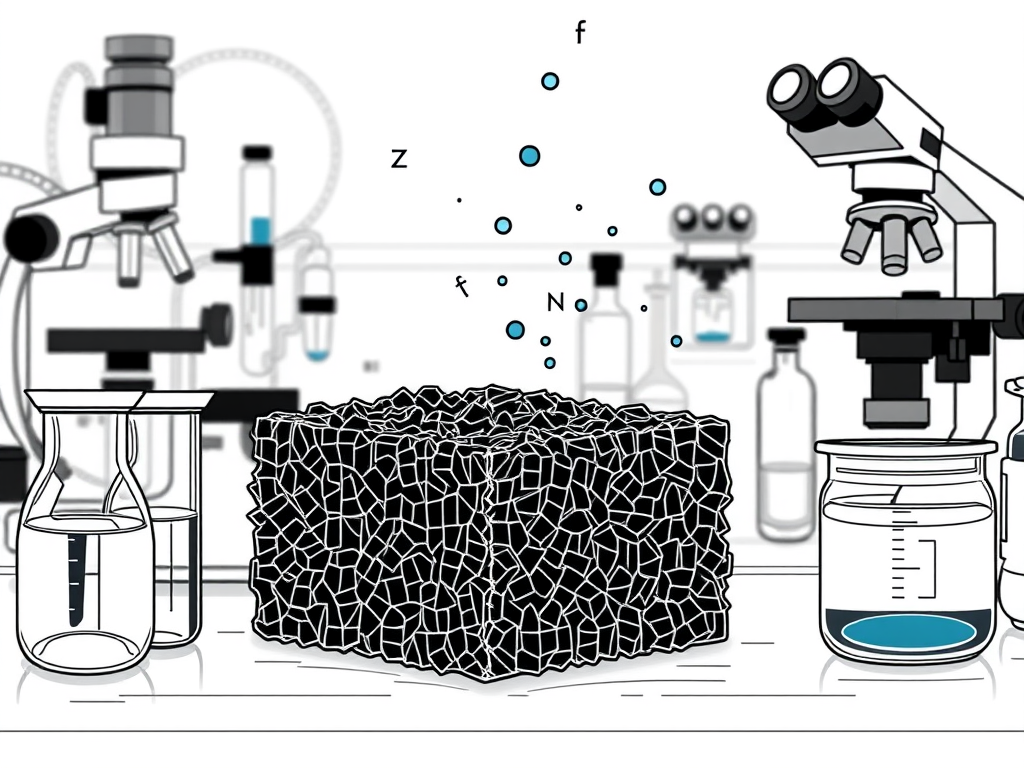
High fluoride (F) concentrations in drinking water, particularly in Ethiopia’s Rift Valley, pose a significant public health risk, causing skeletal and dental fluorosis. The World Health Organization (WHO) recommends a fluoride limit of 1.5 mg/L in potable water. To address this, Tessema Derbe, Teketel Girma Gindose, Taju Sani, and Enyew Amare Zereffa developed a novel zeolite-A/Fe3O4/biochar/MOF-5 (Z-A/Fe3O4/BC/MOF-5) composite adsorbent. Their study, published in Applied Water Science, explores the synthesis and application of this composite for defluoridation, highlighting its high efficiency and reusability.
The researchers synthesized the Z-A/Fe3O4/BC/MOF-5 composite using a solvothermal method. This innovative composite combines the benefits of zeolite-A (Z-A) and biocharBiochar is a carbon-rich material created from biomass decomposition in low-oxygen conditions. It has important applications in environmental remediation, soil improvement, agriculture, carbon sequestration, energy storage, and sustainable materials, promoting efficiency and reducing waste in various contexts while addressing climate change challenges. More (BC) for stability and cost-effectiveness, with magnetite (Fe3O4) enhancing recovery and defluoridation efficiency, and MOF-5 providing active sites for fluoride adsorption. The synthesized adsorbent was thoroughly characterized using various techniques, including XRD, BET, FT-IR, and SEM-EDX, to confirm its structure, surface area, and elemental composition. The quaternary composite (Z-A/Fe3O4/BC/MOF-5) exhibited a high surface area of 756.79 m²/g and a pore volume of 0.1249 cm³/g, notably higher than its constituent Z-A/Fe3O4/BC material (496.17 m²/g), which is crucial for enhanced defluoridation.
The adsorption study focused on optimizing several parameters to achieve maximum defluoridation. The composite achieved an impressive maximum defluoridation efficiency of 96.20% and a defluoridation capacity of 28.86 mg/g. These optimal conditions were observed at an initial fluoride concentration of 10 mg/L, an adsorbent dose of 0.6 g/L, a contact time of 12 hours, and a pHpH is a measure of how acidic or alkaline a substance is. A pH of 7 is neutral, while lower pH values indicate acidity and higher values indicate alkalinity. Biochars are normally alkaline and can influence soil pH, often increasing it, which can be beneficial More of 3. The study found that the defluoridation efficiency was significantly high under both acidic (pH 3) and alkaline (pH 11 and 13) conditions, reaching 95.40%, 84.10%, and 91.10% respectively. This is attributed to electrostatic attraction in acidic conditions and flocculation of fluoride by Al-OH-BC under basic conditions. The defluoridation efficiency generally decreased with increasing initial fluoride concentration, but the adsorption capacity increased, suggesting greater mass transfer at higher concentrations.
Kinetic studies showed that the defluoridation process best fit the pseudo-second-order model with an R² value of 0.99722, indicating that chemisorption, including acid-base interactions, ion exchange, and electrostatic forces, primarily controls the mechanism. The Freundlich isotherm model also provided a good fit (R²=0.98338), suggesting that adsorption occurs through multilayer formation on the adsorbent’s heterogeneous surface.
The effectiveness of the Z-A/Fe3O4/BC/MOF-5 composite was validated using real groundwater samples from Kenteri and Ziway, Ethiopia. It successfully removed 91.92% of fluoride from water with an initial concentration of 12.25 mg/L and 93.29% from water with an initial concentration of 8.5 mg/L. These reductions brought the fluoride concentrations down to 0.99 mg/L and 0.57 mg/L, respectively, well within the WHO’s permissible limit for drinking water.
Furthermore, the composite demonstrated excellent recyclability. After five successive cycles, the Z-A/Fe3O4/BC/MOF-5 composite maintained high defluoridation efficiencies of 93.60%, 91.10%, 89.00%, 86.00%, and 74.80% for the first, second, third, fourth, and fifth cycles, respectively. This indicates its strong potential for reuse, making it a feasible and sustainable option for drinking water defluoridation in affected areas.
Source: Derbe, T., Gindose, T. G., Sani, T., & Zereffa, E. A. (2025). Synthesis of zeolite-A/Fe3O4/biochar/MOF-5 composite for the defluoridation of drinking water. Applied Water Science, 15(161).



Leave a Reply