
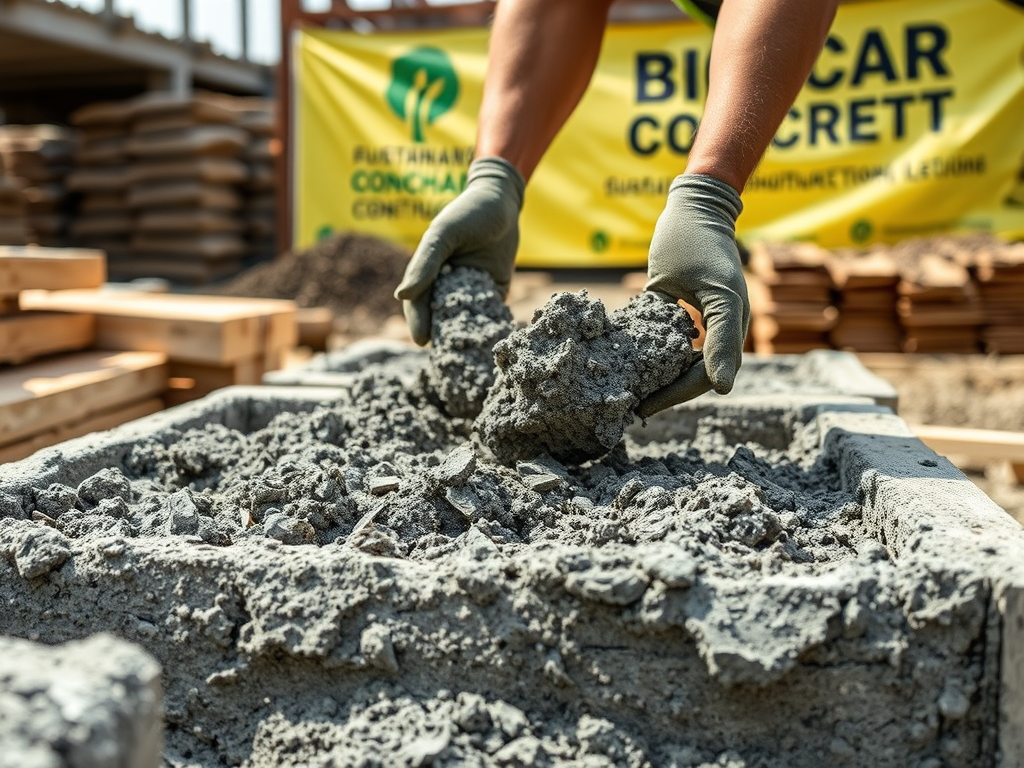
A study published in Innovative Infrastructure Solutions by Khadiga M. Mekky, Mahmoud Nasr, and colleagues introduces a new framework for evaluating the sustainability of concrete that integrates biocharBiochar is a carbon-rich material created from biomass decomposition in low-oxygen conditions. It has important applications in environmental remediation, soil improvement, agriculture, carbon sequestration, energy storage, and sustainable materials, promoting efficiency and reducing waste in various contexts while addressing climate change challenges. More derived from sludge. The researchers explored the use of sludge biochar as a partial replacement for cement, evaluating its impact on mechanical properties, environmental burdens, and alignment with Sustainable Development Goals (SDGs). The findings demonstrate that a 5% sludge biochar concrete mixture achieved a compressive strength of 32 MPa while significantly reducing environmental impacts compared to traditional concrete.
Biochar has shown promise in reducing environmental pollution and carbon dioxide (CO2) emissions. The construction industry is a major contributor to carbon footprints, so researchers are exploring ways to use biochar as a sustainable concrete additive. While previous studies have shown that biochar can improve concrete’s mechanical properties, there has been a gap in comprehensive research that also considers environmental, social, and economic factors across the product’s life cycle.
To address this gap, the researchers developed a novel framework that integrates biochar-concrete properties, life cycle assessment (LCA) criteria, and economic considerations with the achievement of SDGs. They prepared a control mix (C mix) with 100% cement and compared it to mixtures with different sludge biochar (SB) replacement levels ranging from 5% to 20%. The study used a “cradle-to-gate” LCA model to analyze two scenarios: the C mix with sludge landfilling and the sludge biochar mix (SB mix).
The mechanical tests revealed that the 5% SB mixture performed best among the biochar mixes, providing a compressive strength of 32 MPa at 28 days, which exceeded the target of 30 MPa and was nearly identical to the C mix’s 33.5 MPa. The 5% SB mixture also showed impressive durability, with a water penetration depth of 2.8 mm at 28 days and enhanced abrasion resistance, improving by 7.1% and 7.7% at 28 and 90 days, respectively. These improvements are attributed to the fineness of the biochar particles, which fill voids and enhance the concrete’s ability to resist water penetration.
From an environmental standpoint, the results were even more compelling. The LCA model showed that the C mix scenario, which included sludge landfilling, had the worst environmental profile. This scenario had a global warming potential (GWP) of 10.5×10³ kg CO2 eq, due to cement production and methane emissions from landfills. In contrast, the 5% SB mix scenario, by partially replacing cement and diverting sludge from landfills, reduced the GWP by 33.3% to 7×10³ kg CO2 eq. This scenario also reduced respiratory inorganic impacts by preventing landfill surface gas emissions and showed an approximate 34% reduction across all main LCA endpoint categories, including human health, ecosystem quality, climate change, and resource use.
The study also evaluated how the two scenarios aligned with the United Nations’ Sustainable Development Goals. The SB mix scenario could fulfill 11 SDGs. For instance, it contributes to SDG 3 (“Good Health and Well-being”) by reducing mortality from air and soil pollution. It supports SDG 6 (“Clean Water and Sanitation”) by preventing the disposal of sludge into water bodies. It advances SDG 7 (“Affordable and Clean Energy”) by reducing the energy-intensive processes required for cement production. The framework demonstrated that the SB mix scenario maintained a better financial effect and a higher proportion of social-related SDGs, aligning with SDG 12 (“Responsible Consumption and Production”) and SDG 17 (“Partnership for the Goals”).
In conclusion, this research provides a holistic, quantitative framework that validates the use of sludge biochar in concrete production. The 5% sludge biochar mix not only performs comparably to traditional concrete but also offers significant environmental benefits, including a 33% reduction in global warming potential and a 34% reduction in overall environmental impacts. This approach promotes a circular economy, turning waste into a valuable resource and paving the way for a more sustainable and resilient construction industry worldwide.
Source: Mekky, K. M., Nasr, M., Sharobim, K., Fujii, M., & Ibrahim, M. G. (2025). Sludge valorization towards sustainable concrete: a biochar-based framework integrating life cycle assessment, and socio-economic impacts. Innovative Infrastructure Solutions, 10(413), 1–14.




Leave a Reply