
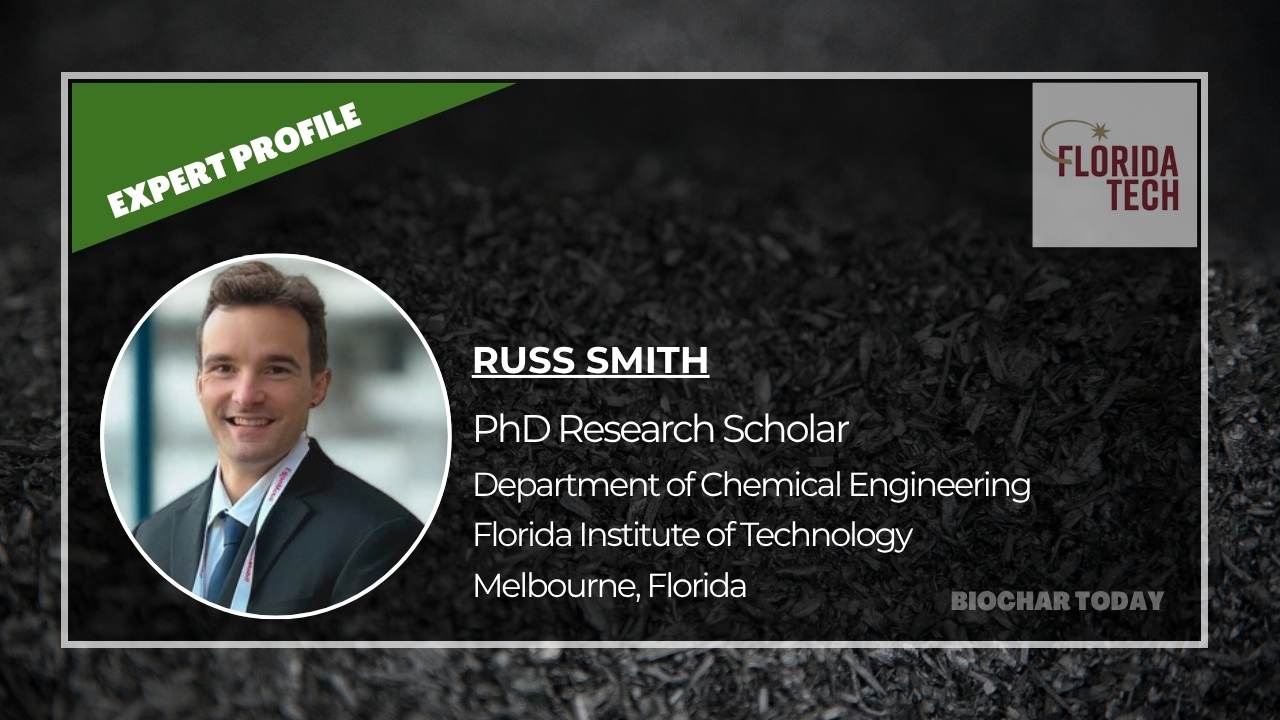
As biocharBiochar is a carbon-rich material created from biomass decomposition in low-oxygen conditions. It has important applications in environmental remediation, soil improvement, agriculture, carbon sequestration, energy storage, and sustainable materials, promoting efficiency and reducing waste in various contexts while addressing climate change challenges. More research continues to evolve beyond its traditional role in agriculture and carbon sequestration, a new generation of researchers is exploring its broader potential in environmental remediation, thermochemical engineering, resource recovery, and circular economy applications. Among them is Russ Smith, a first-year Chemical Engineering PhD researcher at the Florida Institute of Technology, whose work integrates biomassBiomass is a complex biological organic or non-organic solid product derived from living or recently living organism and available naturally. Various types of wastes such as animal manure, waste paper, sludge and many industrial wastes are also treated as biomass because like natural biomass these More thermochemical conversion, biochar science, adsorption technologies, process safety, and data-driven research approaches. His research spans diverse biomass feedstocks—from terrestrial lignocellulosic materials to marine biomass such as sargassum—and investigates how thermochemical processes influence biochar properties, environmental performance, and practical applications. His interests also extend to machine learning for biomass process optimization and the recovery of critical minerals from biomass-derived systems, reflecting the increasingly interdisciplinary nature of modern biochar research.
In this edition of the Biochar Today Expert Profile, Russ shares his research journey, discusses the science behind biochar production and characterization, and offers his perspectives on emerging opportunities in thermochemical conversion, adsorption, biomass valorization, and sustainable resource recovery. I am excited to have this dialogue with Russ and invite our readers to explore his thoughtful insights into the evolving landscape of biochar research and its growing role in addressing environmental and resource sustainability challenges.

Shanthi Prabha: Every researcher has a story behind their scientific journey. What first sparked your interest in biomass and thermochemical conversion technologies, and what motivated you to pursue this field at the doctoral level?
Russ Smith: My path into biomass and thermochemical conversion was not something I had fully planned from the beginning. It developed gradually as I became exposed to research problems involving waste conversion, biochar production, and environmental remediation. What first caught my attention was the idea that materials often viewed as waste could be transformed into functional products with real environmental value. That concept made the field feel both scientifically challenging and practically important. As I continued working in this area, I became more motivated by the complexity of biomass itself. Every feedstockFeedstock refers to the raw organic material used to produce biochar. This can include a wide range of materials, such as wood chips, agricultural residues, and animal manure. More behaves differently, and small changes in thermal treatment can strongly affect the chemistry, structure, and performance of the final material. That combination of applied engineering, materials science, and environmental impact is what encouraged me to pursue this field at the doctoral level. My goal is to help develop biochar and thermochemical conversion technologies that are not only effective in the laboratory but also scalable, safe, and economically realistic.

SP: You’ve worked extensively with both terrestrial biomass and marine biomass systems. How has working with such diverse feedstocks shaped your understanding of biochar production and biomass valorization?
RS: Working with both terrestrial and marine biomass has helped me understand that biochar production is not a one-size-fits-all process. Terrestrial biomass often behaves more predictably because it is usually dominated by lignocellulosic components such as cellulose, hemicellulose, and lignin. Marine biomass, on the other hand, can be much more complex because of its high ashAsh is the non-combustible inorganic residue that remains after organic matter, like wood or biomass, is completely burned. It consists mainly of minerals and is different from biochar, which is produced through incomplete combustion. Ash Ash is the residue that remains after the complete More content, salt content, and diverse inorganic composition. This has shown me that the mineral fraction is not just a byproduct of pyrolysisPyrolysis is a thermochemical process that converts waste biomass into bio-char, bio-oil, and pyro-gas. It offers significant advantages in waste valorization, turning low-value materials into economically valuable resources. Its versatility allows for tailored products based on operational conditions, presenting itself as a cost-effective and efficient More; it can strongly influence thermal behavior, char yield, pHpH is a measure of how acidic or alkaline a substance is. A pH of 7 is neutral, while lower pH values indicate acidity and higher values indicate alkalinity. Biochars are normally alkaline and can influence soil pH, often increasing it, which can be beneficial More, surface chemistry, and the final application of the biochar. One of the biggest lessons I have learned is that the type of ash matters just as much as its amount. Different feedstocks can contain potassium in forms such as carbonates, chlorides, sulfates, or organically bound species, while phosphorus may be present as calcium, magnesium, or potassium phosphates. Other minerals, such as calcium, magnesium, sodium, silica, sulfur, and trace metals, can also affect how biomass decomposes and how the resulting biochar performs. Because of this, working with diverse feedstocks has shaped my view of biomass valorization as both a carbon-conversion and a mineral-transformation process. It has motivated me to look more carefully at how feedstock chemistry can be used to design biochars for specific applications rather than treating all biomass materials the same way.
SP: Biochar is often associated with agriculture and carbon sequestration, but your work explores a much broader range of applications. What are some lesser-known opportunities for biochar that you believe deserve greater attention from researchers and industry?
RS: One of the most exciting things about biochar is that its applications extend far beyond agriculture and carbon sequestration. Those areas are very important, but I think biochar also deserves more attention as a platform material for resource recovery. For example, biochar can be engineered or modified to adsorb critical materials from water, waste streams, or industrial process liquids. This includes rare earth elements, lithium, cobalt, nickel, copper, and other metals important to energy, electronics, and defense-related technologies. In that sense, biochar can act not only as a soil amendmentA soil amendment is any material added to the soil to enhance its physical or chemical properties, improving its suitability for plant growth. Biochar is considered a soil amendment as it can improve soil structure, water retention, nutrient availability, and microbial activity. More, but also as a low-cost sorbent for recovering valuable materials from dilute or complex solutions. Another lesser-known opportunity is the recovery of critical or near-critical materials from the biomass feedstocks themselves. Some biomass sources, especially marine biomass, agricultural residues, and waste-derived feedstocks, contain meaningful amounts of minerals such as potassium, phosphorus, magnesium, calcium, silica, and trace metals. During thermochemical conversion, these inorganic species can concentrate in the char or ash fraction, creating opportunities for nutrient recovery, fertilizer production, or even selective extraction of valuable elements. I also think nutrient-gas interactions deserve more attention, such as using biochar to capture ammonia or nitrogen-containing gases and convert them into enhanced fertilizer products. Similarly, potassium-rich biochars or ashes could be better understood and utilized in nutrient applications. These approaches could help connect biochar research to circular-economy goals, critical material recovery, and more efficient fertilizer use.
SP: Your research on modified biochars for harmful algal bloom mitigation and toxin adsorption demonstrates a strong environmental focus. What findings from these studies have been particularly surprising or encouraging for you?
RS: One of the most encouraging findings from this work was that biochar showed strong potential for removing saxitoxin from water, even without the use of highly engineered or expensive adsorbents. Harmful algal bloom toxins are difficult to manage because they can occur at low concentrations yet pose serious environmental and public health concerns. Seeing biochar achieve high levels of toxin removal under relatively simple adsorption conditions was very encouraging, suggesting that biomass-derived materials could play a practical role in HAB remediation. What surprised me most was how strongly the biochar’s surface chemistry influenced toxin adsorption. Higher pyrolysis temperatures increased surface area and porosityPorosity of biochar is a key factor in its effectiveness as a soil amendment and its ability to retain water and nutrients. Biochar’s porosity is influenced by feedstock type and pyrolysis temperature, and it plays a crucial role in microbial activity and overall soil health. Biochar More, but the lower-temperature biochar still performed extremely well because it retained more oxygen-containing functional groups and a stronger negative surface charge. This showed me that adsorption performance is not solely determined by surface area. For saxitoxin, electrostatic attraction, hydrogen bonding, ion exchange, and π–π interactions appear to be important. That was an important lesson because it means we can design modified biochars more intentionally for specific toxins, rather than simply trying to maximize surface area.
SP: Marine biomass, especially problematic feedstocks such as sargassum, has become a growing global challenge. From your perspective, how can biochar and other biomass-derived carbon materials help transform such environmental problems into valuable resources?
RS: Marine biomass such as Sargassum is a good example of how an environmental problem can also become a resource opportunity. Large Sargassum blooms pose major challenges for coastal communities by affecting tourism, ecosystems, water quality, and waste management. However, from a biomass valorization perspective, Sargassum is interesting because it contains both organic carbon and a complex inorganic fraction. Through processes such as pyrolysis or hydrothermal carbonization, the carbon portion can be converted into biochar, hydrochar, or other carbon materials, while many inorganic elements can become concentrated in the resulting char or ash fraction. From my perspective, one of the most exciting opportunities is to evaluate marine biomass not only as a biochar feedstock, but also as a potential source or preconcentration pathway for DOE-relevant critical materials. Depending on the feedstock and location, elements of interest could include rare-earth elements, magnesium, manganese, nickel, cobalt, lithium, and other energy-relevant metals present at trace levels. Thermochemical conversion can reduce the organic fraction and concentrate these inorganic species in the biochar, hydrochar, or ash, making downstream extraction more feasible. In this way, problematic biomass, such as sargassum, could be transformed into both a carbon material and a mineral-rich intermediate for critical material recovery. The key challenge is to carefully characterize these feedstocks, understand where the critical materials partition during processing, and develop safe, selective, and economically realistic extraction methods.
SP: A significant portion of your work focuses on the fundamental science of thermochemical conversion. Looking back at your research on pyrolysis, gasificationGasification is a high-temperature, thermochemical process that converts carbon-based materials into a gaseous fuel called syngas and solid by-products. It takes place in an oxygen-deficient environment at temperatures typically above 750°C. Unlike combustion, which fully burns material to produce heat and carbon dioxide (CO2), gasification More, and combustion, has there been a finding that challenged your previous assumptions about biomass conversion processes?
RS: One finding that challenged my assumptions was the importance of carrier gas flow rate during pyrolysis. Early on, I thought of nitrogen flow mostly as a way to maintain an inert environment, while heating rate and temperature were the main variables controlling biomass conversion. However, when we studied loblolly pine pyrolysis across different nitrogen flow rates and heating rates, it became clear that gas flow rate is not just a background condition. It can change how quickly volatiles are removed from the biomass, how much time those vapors have to undergo secondary reactions, and how the char-forming region behaves at higher temperatures. What was especially interesting was that the effect of gas flow rate depended strongly on the heating rate. At slower heating rates, lower nitrogen flow created a longer vapor residence timeResidence time refers to the duration that the biomass is heated during the pyrolysis process. The residence time can influence the properties of the biochar produced. More, which encouraged secondary reactions such as char formation, repolymerization, tar cracking, and prolonged phase III mass loss. At higher nitrogen flow rates, volatiles were swept away more quickly, which reduced some of those secondary reactions. However, at faster heating rates, the influence of gas flow became less obvious because thermal lag and rapid heating began to dominate the behavior. That finding reminded me that biomass conversion is not controlled by a single variable. Heat transfer, mass transfer, vapor residence timeThis refers to the amount of time that the biomass is heated during the pyrolysis process. The residence time can influence the characteristics of the biochar, such as its porosity and surface area. More, mineral content, and reaction kinetics all interact, and even small experimental parameters can change how we interpret pyrolysis, gasification, and combustion behavior.
SP: Your recent study on pine pyrolysis kinetics highlighted how factors such as heating rates and nitrogen flow rates can significantly influence biomass decomposition behavior. What do these findings teach us about the challenges of translating laboratory-scale research into commercial-scale biochar and biomass conversion systems?
RS: One of the main lessons from this work is that laboratory-scale pyrolysis results must be interpreted carefully before they are translated to larger biochar or biomass conversion systems. In a small thermogravimetric analysis experiment, variables such as heating rate and nitrogen flow rate can be controlled very precisely. However, even under those controlled conditions, we observed that changing the heating rate and purge gas flow rate affected biomass decomposition behavior, volatile removal, secondary reactions, and the apparent kinetic parameters. This shows that pyrolysis is not only a chemical reaction problem; it is also strongly influenced by heat transfer, mass transfer, vapor residence time, and reactor environment. For commercial-scale systems, these effects become even more important because the biomass particles, bed depth, gas flow patterns, residence times, and temperature gradients are much larger and more complex than in laboratory experiments. A condition that appears optimal in TGA may not directly translate to a fixed-bed, rotary kiln, auger, or fluidized-bed reactor without considering scale-up effects. For example, slower heating or poor vapor sweeping can promote secondary reactions, tar cracking, repolymerization, and additional char formation, while faster heating and stronger gas flow can shift the system toward more rapid volatile removal. These findings taught me that kinetic studies are extremely valuable, but they should be viewed as a guide for reactor design rather than a direct operating recipe. Successful scale-up requires connecting fundamental kinetics with transport phenomena, reactor configuration, feedstock variability, and the desired final product properties.
SP: In another recent publication, you examined the process and environmental safety aspects of thermochemical biomass conversion technologies. As biochar production and biomass utilization continue to scale globally, what safety and environmental considerations do you think the sector needs to prioritize more seriously?
RS: As biochar production and biomass utilization continue to scale, I think the sector needs to treat safety and environmental management as core design requirements rather than secondary considerations. Many thermochemical conversion processes operate under high temperature, high pressure, or reactive gas environments, which create risks such as overpressure, flammable gas accumulation, tar condensation, dust explosions, and exposure to gases such as CO, H2, CH4, NH3, and H2S. These hazards can be manageable, but they require proper reactor design, pressure relief systems, gas monitoring, ventilation, inerting, emergency shutdown systems, and clear operating procedures from the beginning. The environmental side is equally important. Biochar is often viewed as a sustainable product, but its safety depends heavily on the feedstock and process conditions. Contaminants such as PAHs, dioxins/furans, persistent free radicals, VOCs, and potentially toxic elements can form or concentrate in biochar, hydrochar, bio-oil, syngasSyngas, or synthesis gas, is a fuel gas mixture consisting primarily of hydrogen and carbon monoxide. It is produced during gasification and can be used as a fuel source or as a feedstock for producing other chemicals and fuels. More, or ash fractions. Therefore, I think the industry needs to prioritize standardized product testing, leachability testing, emissions control, and responsible management of liquid and solid byproducts. This is especially important when using waste-derived or contaminated feedstocks. For biochar to scale responsibly, the field needs to connect carbon benefits and product performance with process safety, worker protection, environmental compliance, and long-term stewardship of the materials we produce.
SP: Machine learning is increasingly being integrated into biomass and biochar research. How do you see data-driven approaches helping researchers uncover hidden relationships and accelerate innovation in thermochemical conversion and biochar science?
I think machine learning and artificial intelligence can play a major role in accelerating biomass and biochar research because the field has become increasingly data rich. It is now much easier to access public datasets from published literature, government databases, supplementary files, and open repositories. When these datasets are organized properly, researchers can begin to connect feedstock properties, pyrolysis conditionsThe conditions under which pyrolysis takes place, such as temperature, heating rate, and residence time, can significantly affect the properties of the biochar produced. More, activation methods, surface chemistry, and final biochar performance in ways that are difficult to see from individual experiments alone. One of the most exciting opportunities is using these data-driven tools to build domain-specific software for biomass and biochar applications. For example, machine learning models could be used to screen thousands of feedstocks, pyrolysis temperatures, residence times, activation conditions, or modification strategies before entering the laboratory. This does not replace experimental testing, but it helps narrow the experimental space and identify the most promising directions faster. I see these tools being especially useful for predicting adsorption performance, nutrient recovery, carbon stability, surface functional groups, and even process economics. In the long term, machine learning can help researchers move from trial-and-error experimentation toward more targeted material design.
SP: Your current interests also extend into critical mineral and rare earth element recovery from biomass-derived systems. What opportunities do you see emerging at the intersection of biochar, biomass valorization, and strategic resource recovery?
RS: I see a major opportunity at the intersection of biochar, biomass valorization, and strategic resource recovery because biochar can potentially be designed as a low-cost platform for capturing valuable elements from complex waste streams. Many critical minerals and rare earth elements are present in dilute concentrations or mixed with many competing ions, which makes recovery difficult. Biochar-based materials could help by selectively adsorbing certain classes of elements, such as rare earth elements, transition metals, or nutrient-associated minerals, while limiting the uptake of less desirable or interfering species. If this can be achieved, biochar could become more than an environmental adsorbent; it could become part of a circular strategy for recovering energy-relevant and defense-relevant materials. At the same time, one of the current challenges is that most unmodified biochars are not naturally selective enough for specific critical elements. They may adsorb many metals at once, and in complex real-world solutions, competing ions can reduce performance. Achieving true selectivity often requires significant engineering, such as surface functionalization, mineral modification, activation, or coupling biochar with chelating groups. I see this challenge as a major research opportunity. There is room for researchers to develop biochars that target specific element groups, understand which surface chemistries control selectivity, and use machine learning or high-throughput screening to identify promising feedstock-treatment combinations. This could help connect biochar science with critical material recovery, waste valorization, and future domestic resource security.
SP: Looking ahead over the next decade, what scientific, technological, or market developments do you believe could most significantly influence the future role of biochar in environmental management, carbon removal, and circular economy systems?
RS: Over the next decade, I think the future role of biochar will be shaped by how well the field connects carbon removal, environmental performance, and product value. Biochar has strong potential in carbon sequestration, soil amendment, remediation, and nutrient recovery, but its long-term growth will depend on better standardization, stronger carbon markets, reliable certification, and clearer demonstrations of environmental safety. I also think technological advances in reactor design, emissions control, feedstock preprocessing, and product characterization will be critical because the industry needs to produce biochar that is consistent, safe, and tailored for specific applications. Another major development will be the integration of biochar into broader biomass conversion and bio-refinery systems. Instead of viewing biochar as the only product, future systems may produce biochar for carbon removal while also generating bio-oil, syngas, biochemicals, or recovered minerals from the same feedstock. This is especially important as many regions, including the European Union, are investing in bio-based materials and chemicals that can replace traditional fossil-oil-derived products. Bio-oil and other biomass-derived liquids could become renewable intermediates for fuels, resins, adhesives, plastics, or specialty chemicals, while the solid biochar or ash fraction may support carbon storage, nutrient recycling, or resource recovery. If these markets continue to develop, biochar could become part of a much larger circular economy platform that replaces portions of the petroleum-based economy while also managing waste and storing carbon.
SP: For students and early-career researchers entering the biochar field today, what skills, perspectives, or research approaches would you recommend they cultivate to make meaningful contributions in this rapidly evolving area?
RS: For students and early-career researchers entering the biochar field, I would first recommend developing a strong respect for feedstock variability. Biomass is naturally heterogeneous, and two samples from the same general feedstock category can behave very differently depending on location, season, handling, ash content, mineral composition, and preprocessing. Because of that, careful experimental design, high replicate sampling, and strong characterization are extremely important. Replicates are not just a statistical requirement; they help researchers understand the full picture of the material they are studying and avoid drawing conclusions from a sample that may not represent the broader feedstock. I would also encourage young researchers to become comfortable with coding, data analysis, and machine learning. The biochar field now has a growing number of published datasets on pyrolysis conditions, feedstock properties, adsorption performance, nutrient recovery, and carbon stability. Learning how to organize these datasets and use machine learning or artificial intelligence as a screening tool can help researchers identify patterns that are not obvious from individual studies. These tools can be used to screen large numbers of feedstocks, process conditions, and potential applications before experimental testing. In my view, the most impactful researchers will be those who can combine strong laboratory skills with data-driven methods, while still thinking critically about mechanisms, scalability, and environmental safety.
Closing Vision Question
SP: If funding, infrastructure, and time were no limitation, what is the one biochar-related research challenge or opportunity you would most like to pursue, and why?
RS: If funding, infrastructure, and time were no limitations, the research challenge I would most like to pursue would be developing a biochar-based material that is highly selective for a specific DOE-relevant critical material. Many wastewaters, industrial process streams, mine drainage waters, and biomass-derived liquids contain valuable elements, but they are usually mixed with many competing ions. The major challenge is not just adsorption; it is selective adsorption. I want to identify a low-cost feedstock and apply a simple, environmentally friendly, economical, and scalable treatment that yields biochar strongly targeting one critical material or one class of critical materials while minimizing the uptake of unwanted elements. This would be exciting because it could connect biochar science directly with strategic resource recovery and domestic supply-chain resilience. In an ideal system, the feedstock would be abundant, the treatment chemistry mild, the process scalable, and the final material reusable or regenerable. That type of work could move biochar beyond traditional environmental applications and into a new role as a selective recovery platform for critical minerals. It is a difficult challenge because biomass and biochar surfaces are naturally complex and often not selective enough on their own, but that is exactly why I think it is such an important opportunity for future research.
To follow Russ’s latest research, publications, and professional updates, connect with him on LinkedIn: Russ Smith.

![Eucalyptus Wood Waste-Derived Biochar Achieves a Ninety-Eight Percent Removal Efficiency for Benzo[ghi]perylene in Vehicle-Wash Wastewater](https://biochartoday.com/wp-content/uploads/2026/10/SCIENCE-BLOGS-2026-2026-10-19T160523.703.jpg)

Leave a Reply