
Key Takeaways
- Washing biomassBiomass is a complex biological organic or non-organic solid product derived from living or recently living organism and available naturally. Various types of wastes such as animal manure, waste paper, sludge and many industrial wastes are also treated as biomass because like natural biomass these More with water before heating drastically changes its internal structure and yields a much more porous carbon product.
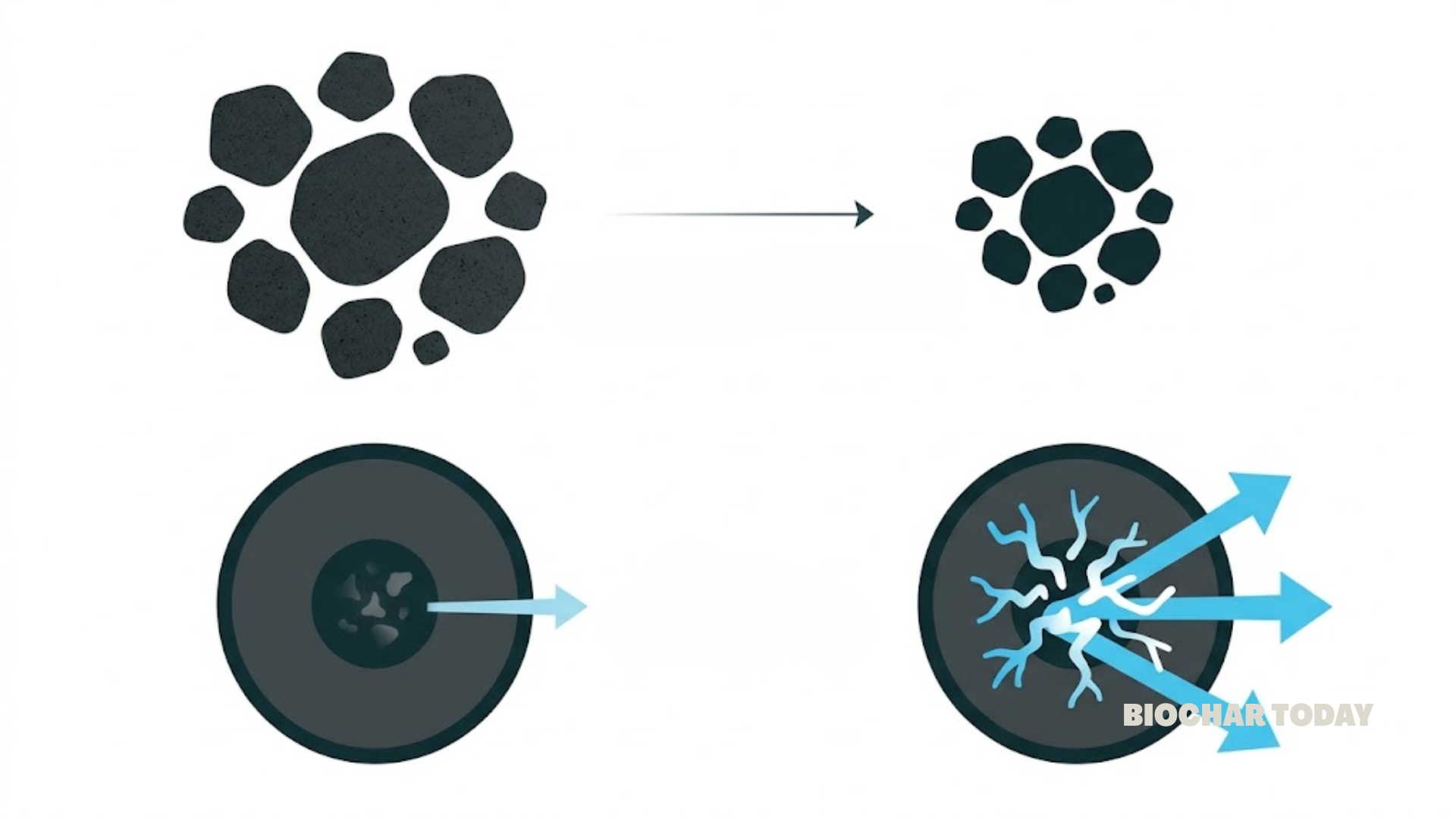
- Pre-washed particles shrink more than twice as much as untreated particles when heated to high temperatures.
- Untreated particles swell and expand early in the heating process due to the softening of native components like lignin.
- Pores open up toward the center of pre-washed particles several times faster than they do in untreated ones.
- This new tracking method helps engineers design highly specific carbon materials for filtering water and absorbing environmental pollutants.
The scientific journal BiocharBiochar is a carbon-rich material created from biomass decomposition in low-oxygen conditions. It has important applications in environmental remediation, soil improvement, agriculture, carbon sequestration, energy storage, and sustainable materials, promoting efficiency and reducing waste in various contexts while addressing climate change challenges. More recently published a study by Luis Salinas-Farran, Maryanne Chelangat Mosonik, Rhodri Jervis, Shashidhara Marathe, Christoph Rau, and Roberto Volpe detailing how water pre-treatment impacts the structural evolution of biomass during thermal decomposition. Biomass pyrolysisPyrolysis is a thermochemical process that converts waste biomass into bio-char, bio-oil, and pyro-gas. It offers significant advantages in waste valorization, turning low-value materials into economically valuable resources. Its versatility allows for tailored products based on operational conditions, presenting itself as a cost-effective and efficient More, the process of heating organic material in the absence of oxygen, produces a highly porous carbon material known as biochar. This material has garnered significant environmental interest due to its capacity to capture carbon dioxide, filter contaminants from polluted water, and serve as a stable foundation for chemical catalysts. To optimize biochar for these critical jobs, scientists must understand exactly how the internal pathways and microscopic voids change as the temperature rises. Until now, researchers relied on computer models that assumed biomass particles were perfectly uniform shapes, which fails to capture the true, irregular complexity of real organic waste materials.
To bridge this gap, the research team utilized advanced three-dimensional imaging to watch individual walnut shell particles transform in real time. They monitored single grains measuring one to two millimeters in diameter as a specialized furnace ramped the temperature up to five hundred seventy-five degrees Celsius. By gathering over a quarter-million continuous scanned images, the scientists tracked the shifting architecture of both raw, unwashed walnut shells and samples that had been thoroughly rinsed with purified water. The imaging revealed that water washing completely alters how the particle behaves under extreme heat, removing specific inorganic elements and organic compounds to create a far more open internal network that allows gases to escape with ease.
PDF+ 4
The most visible difference emerged in how much the particles physically shriveled during the baking process. The untreated walnut shells lost about thirty percent of their total volume, whereas the pre-washed shells experienced a far more dramatic seventy percent volume loss. Interestingly, the unwashed samples actually swelled and expanded when temperatures hovered between two hundred and three hundred degrees Celsius. This temporary bubbling occurs because the natural biopolymers associated with lignin soften and melt, a phenomenon that is physically suppressed when the biomass is washed beforehand. In the washed samples, the onset of major shrinkage is delayed until about four hundred fifty degrees Celsius, but it culminates in a much more compact carbon skeleton once peak temperatures are reached.
Beyond surface shrinkage, the study introduced a new mathematical parameter to measure how pores redistribute throughout the interior of the moving matrix. The researchers discovered that the core of the pre-washed biomass is far more susceptible to thermal breakdown at high temperatures. Pores opened and migrated toward the geometric center of the washed walnut shells roughly three and a half times faster than they did in the untreated equivalents. By the time the washed biochar reached its peak temperature, it achieved a remarkably uniform distribution of internal voids, ensuring that the final material boasts an accessible core with maximum surface area for environmental filtering.
The direct imaging also yielded an important theoretical discovery regarding the chemical physics of biomass decay. The rate at which the internal pores opened up followed a strict linear trajectory rather than an exponential, accelerating curve. This steady, linear progression tells engineers that the chemical reactions inside the walnut shell are heavily bottlenecked by physical constraints, specifically how fast heat can move inward and how quickly vaporized gases can escape through the tight matrix. Understanding these structural boundaries provides modelers with the precise data needed to engineer custom biochars with tuned pore configurations, paving the way for targeted water remediation and advanced green technologies.
Source: Salinas-Farran, L., Mosonik, M. C., Jervis, R., Marathe, S., Rau, C., & Volpe, R. (2024). Tracked evolution of single biochar particle’s morphology during pyrolysis in operando x-ray micro-computed tomography. Biochar, 6(1), 86.


Leave a Reply