
Key Takeaways
- Toxic pharmaceutical waste and persistent antibiotic compounds are frequently excreted into municipal wastewater, avoiding conventional treatment setups and damaging aquatic ecology.
- Uniformly anchoring a cobalt oxide transition catalyst onto the surface of porous rice husk biocharBiochar is a carbon-rich material created from biomass decomposition in low-oxygen conditions. It has important applications in environmental remediation, soil improvement, agriculture, carbon sequestration, energy storage, and sustainable materials, promoting efficiency and reducing waste in various contexts while addressing climate change challenges. More prevents molecular clumping and uncovers vast numbers of active breakdown zones.
- Initiating a specialized water treatment process activates the chemical peroxymonosulfate to achieve a perfect one hundred percent elimination efficiency of refractory antibiotics in just minutes.
- Advanced chemical observation techniques verify that lattice oxygen within the composite structure transforms to create highly active intermediate sites that accelerate internal electron exchanges.
- Long-term testing using automated fixed-bed water filters maintains high extraction stability and eliminates the environmental toxicity of lingering antibiotic byproducts.
Emerging organic contaminants, particularly persistent pharmaceutical substances and fluoroquinolone antibiotics, are accumulating in modern municipal wastewater systems due to their incomplete metabolism inside living organisms. Traditional municipal sewage processing installations remain structurally insufficient for isolating these recalcitrant pollutants, meaning that widespread pharmaceutical residues regularly leak into regional aquatic ecologies. Levofloxacin represents a major share of the total fluoroquinolone antibiotic volume detected in public drinking supplies, presenting long-term threats to human biological health and natural ecosystem sustainability. Advanced oxidation systems that utilize transition metal oxides to activate peroxymonosulfate show tremendous remediation promise by producing highly reactive sulfate and hydroxyl radicals. Cobalt oxide is highly regarded for this persulfate activation process, yet standard cobalt-based particles suffer from severe structural clustering due to high surface energy, which restricts the availability of active catalyst sites and leads to the dangerous leachingLeaching is the process where nutrients are dissolved and carried away from the soil by water. This can lead to nutrient depletion and environmental pollution. Biochar can help reduce leaching by improving nutrient retention in the soil. More of metal ions into filtered water streams.
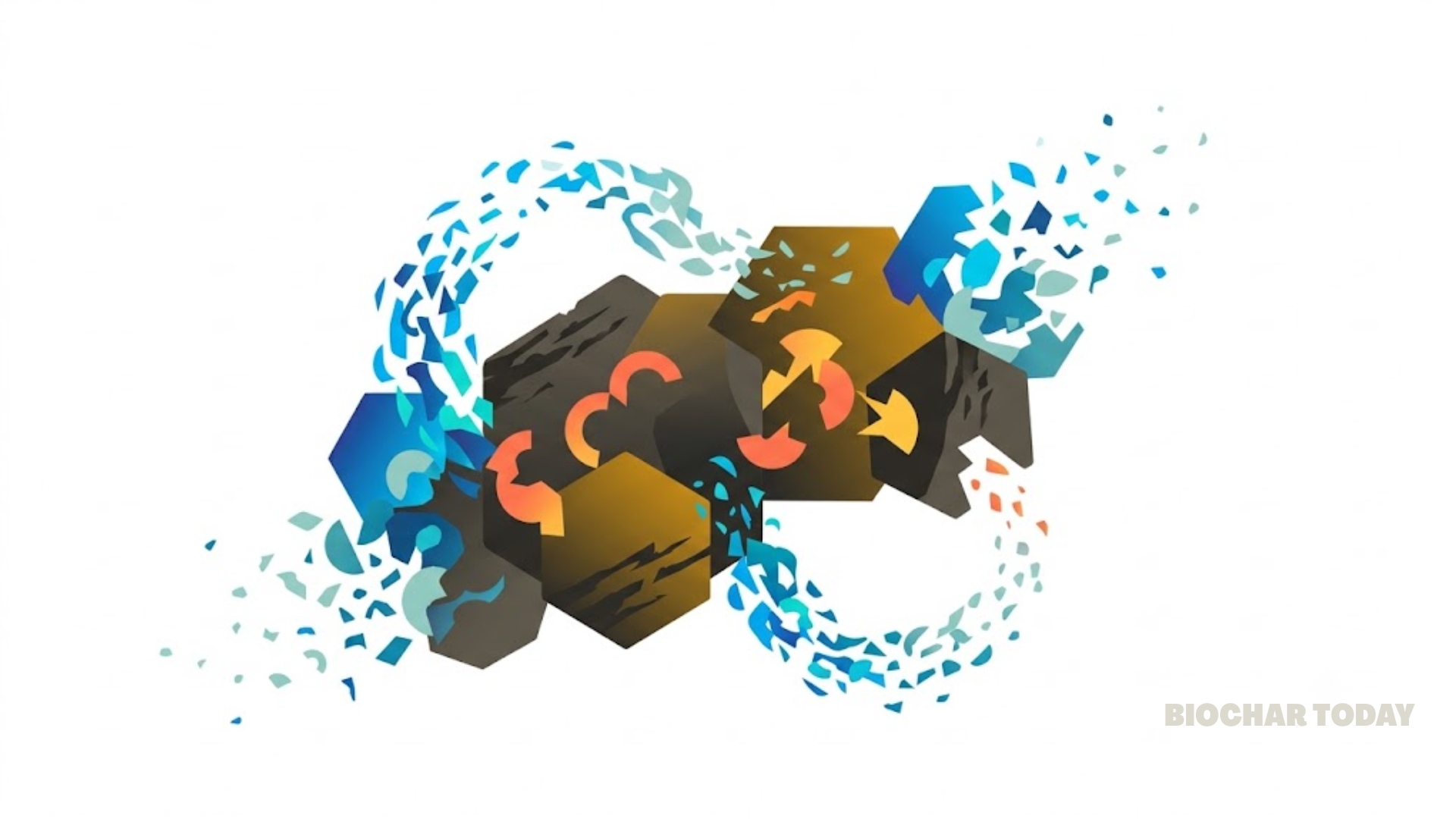
To overcome these aggregation limitations and optimize surface chemical characteristics, investigators synthesized a mesoporous composite material by dispersing tiny cobalt oxide structures onto an optimized rice husk biochar base activated with potassium hydroxide at different temperature ranges. High-resolution microscopic analysis and elemental mapping verified that thin, flower-like cobalt oxide nanoflakes were successfully and uniformly attached across the carbonaceous biochar sheet, creating a structural framework that exposed an abundance of active catalytic centers. Surface analysis demonstrated that the internal carbonization temperature altered the ratio of functional groups, with processing at eight hundred degrees Celsius producing a high proportion of surface carbonyl groups. This specific formulation, designated as RHBA800@25Co3O4, achieved complete one hundred percent degradation of refractory levofloxacin within a brief four-minute reaction window when combined with a low chemical persulfate dosage under neutral environmental conditions.
Detailed kinetic models confirmed that the optimized biochar configuration surpassed pure cobalt oxide catalysts and alternative carbon substrates, showing a superior first-order degradation rate constant of one point four two four per minute. Chemical scavenging experiments and electron paramagnetic resonance capturing protocols mapped out the reactive pathways, verifying that the advanced treatment platform concurrently generated abundant sulfate radicals, hydroxyl radicals, and singlet oxygen to destroy the target organic molecules. Crucially, the surface-active carbonyl groups from the biochar base worked in harmony with the cobalt structure to drive singlet oxygen pathways continuously. In situ Raman and Fourier-transform infrared spectroscopy tracked the active interface interactions, showing that electron transfers occurred intensively between the asymmetric sites of the peroxymonosulfate molecules and the catalyst surface.
The insightful catalytic mechanism was proven to rely on structural self-activation driven by lattice oxygen shifts inside the cobalt crystals, rather than simple metal redox cycles. Temperature-programmed desorption and surface scans revealed that internal lattice oxygen induced a transformation to generate a highly active hydroxylated cobalt intermediate layer across the catalyst boundary. Quantum-mechanical density functional theory modeling confirmed that the absolute adsorption energy of peroxymonosulfate dropped precipitously when interacting with this newly formed hydroxylated surface compared to original cobalt oxide. This electronic rearrangement reduced the activation energy barriers, accelerated internal charge transfers, and sustained the rapid production of reactive oxygen species to fuel the breakdown process.
The practical real-world feasibility of this engineered biochar system was demonstrated by achieving high removal rates for multiple distinct antibiotic groups, including ciprofloxacin, tetracycline, and sulfadiazine. The composite catalyst maintained high breakdown efficiency across varied real aquatic backgrounds, overcoming potential chemical interferences from background organic matter and mineral salts present in actual lake water and secondary municipal sewage effluents. Furthermore, a self-developed, continuous-flow fixed-bed reactor packed with the biochar catalyst showed stable and uninterrupted antibiotic extraction over seventy-two continuous hours of operation. The total metal leaching in the running effluent remained well below international limits for safe drinking water, confirming the structural security of the matrix. Mass spectrometry data mapped three prominent molecular breakdown pathways, involving piperazine ring cleavage, defluorination, and quinolone transformation. Biological culturing experiments using live Escherichia coli confirmed that the comprehensive antibacterial potency of the effluent was completely removed, validating the ecological safety of this advanced biochar remediation system.
Source: Zhang, J., Xie, J., Zhu, S., Yang, J. E., Weng, B., & Zheng, Y. (2026). In situ observation of Co3O4-δ-OH formation on optimized biochar for peroxymonosulfate activation and ultrafast antibiotics degradation. Biochar, 8(113), 1-17.




Leave a Reply