
Key Takeaways
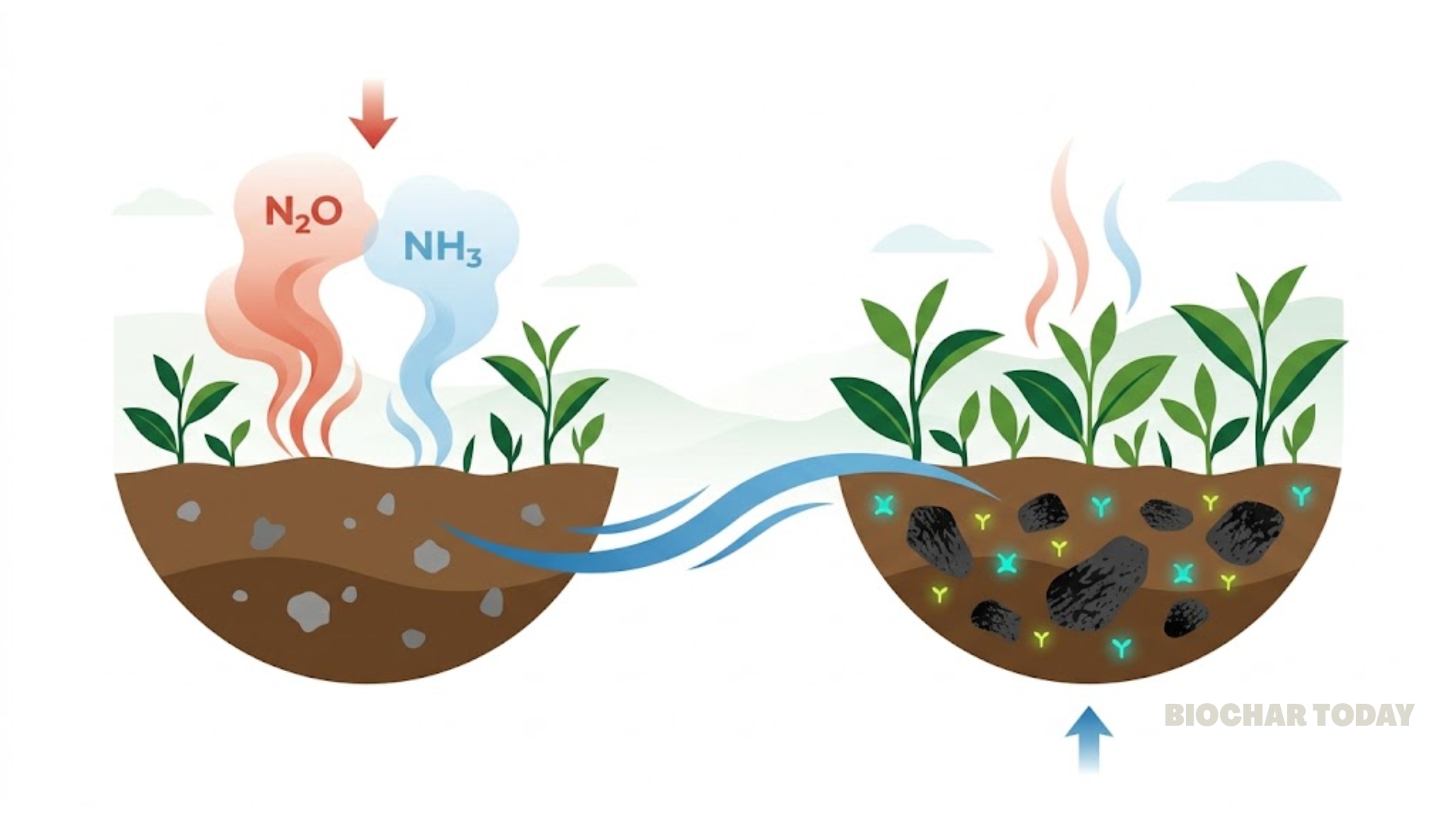
- Traditional chemical fertilizer application in tea orchards releases massive amounts of nitrogen gases that degrade regional air quality and intensify climate warming.
- Incorporating a dual-chemical inhibitor blend directly into standard fertilizers reduces nitrous oxide gas losses by roughly half and ammonia gas vaporization by one-fifth.
- Introducing specialized crop residue biocharBiochar is a carbon-rich material created from biomass decomposition in low-oxygen conditions. It has important applications in environmental remediation, soil improvement, agriculture, carbon sequestration, energy storage, and sustainable materials, promoting efficiency and reducing waste in various contexts while addressing climate change challenges. More alongside these chemical inhibitors increases harvested fresh tea leaf weights while locking excess nitrogen securely in the soil matrix.
- Microscopic observations confirm that the combined management plan works by lowering critical soil nitrogen compounds and directly turning off the genes of gas-producing soil bacteria.
- Utilizing this integrated management system provides farmers with superior overall environmental and economic rewards without causing any trade-offs in yield performance.
Excessive usage of traditional nitrogen chemical fertilizers across global tea plantations frequently generates considerable ecological damage, releasing extensive volumes of nitrous oxide into the atmosphere and fueling heavy ammonia gas volatilization. In intensive tea orchard operations located throughout the subtropical hilly zones of central China, seasonal chemical applications are traditionally kept remarkably high to preserve optimum foliage growth, yet this management style severely amplifies reactive nitrogen losses. Nitrous oxide operates as a powerful long-lived greenhouse gas that exacerbates global warming trends, while secondary ammonia vapor losses remain intimately linked to ambient fine particulate matter pollution, widespread regional soil acidification, and the destructive chemical eutrophication of neighboring aquatic habitats. To address these expanding environmental concerns, scientists have looked toward stabilizing agents like urease inhibitors and nitrification inhibitors, as well as highly porous carbon soil amendments, though the combined field-scale efficiencies and real-world soil microbial mechanics within these unique acid-soil systems have historically remained unquantified.
The two-year field experiment conducted at the Changsha Agro-Environmental Observation and Research Station evaluated the individual and combined mitigation impacts of specific dual inhibitors consisting of the urease-blocking compound N-(n-butyl) thiophosphoric triamide, commonly called NBPT, and the nitrification-repressing compound 3,4-dimethylpyrazole phosphate, known as DMPP. These specialized chemical formulations were carefully monitored alongside rice straw biochar under local conventional splitting treatments using combined chemical urea and organic rapeseed cake inputs. The scientific findings verified that standard conventional farming routines generated high absolute cumulative gaseous losses totaling twenty-five point eight kilograms of nitrous oxide and seventy-five point eight kilograms of ammonia per hectare over the monitoring timeline. Implementing the dual inhibitors alone succeeded in dropping the cumulative nitrous oxide emission factors by fifty-four point five percent and trimming ammonia losses by twenty percent, successfully modifying the temporal dynamics of the nitrogen pool.
When the investigators mixed the chemical dual inhibitors together with twenty-eight tonnes per hectare of alkaline straw biochar, the resulting ecosystem treatment maintained similarly high mitigation performances, lowering total nitrous oxide emission values by forty-nine point eight percent and cutting ammonia losses by twenty point two percent. Genetic sequencing tracking the underlying microscale mechanisms demonstrated that both intervention strategies dramatically decreased the absolute abundance of dominant nitrogen-cycling functional genes in the red soil matrix. This structural suppression was particularly pronounced within the communities of ammonia-oxidizing bacteria and the key nitrite reductase gene known as nirS, which effectively paralyzed the biological pathways responsible for generating reactive gaseous compounds. Spatial profiling additionally mapped these gas fluxes across the plantation landscape, confirming that the vast majority of gaseous nitrogen emissions leaked directly from the fertilized tea plant rows rather than from the unfertilized inter-row ridges.
Advanced structural equation modeling and random forest analytical configurations clarified that the observed dual-gas reduction was directly controlled by altered soil mineral nitrogen concentrations and constrained microbial substrate availability. The chemical inhibitor NBPT successfully retarded early-stage urea hydrolysis, thereby minimizing short-term soil ammonium concentrations during the crucial two-month post-fertilization window when the vast majority of ammonia volatilization normally takes place. Simultaneously, the companion chemical inhibitor DMPP successfully deactivated the active enzymatic binding sites of regional ammonia-oxidizing bacteria, keeping the local soil nitrate pool systematically depleted by fifty-nine percent over the two-year period and starving the subsequent denitrification-driven nitrous oxide production pathways.
Importantly, the data proved that combining the chemical inhibitors with a biochar amendment successfully avoided the common pollution trade-offs where lowering one specific nitrogen gas unintentionally spikes the secondary compound. Beyond stabilizing these volatile environmental leaks, the biochar-infused dual inhibitor treatment structurally optimized root-zone conditions by facilitating the long-term adsorption and gradual release of moisture and vital nutrients. This interactive sub-surface preservation directly translated into superior agronomic performance, increasing overall fresh tea leaf yields by six point seven percent and amplifying total plant nitrogen absorption by fourteen point four percent relative to standard conventional cultivation. Economic assessments confirmed that the total value of these elevated crop yields completely covered the initial purchasing and distribution costs of the biochar, generating the highest net environmental economic benefit of any tested strategy at over one hundred and sixteen thousand Chinese Yuan per hectare annually. Consequently, utilizing dual transformation inhibitors alongside stable carbonaceous biochar amendments delivers a highly effective, scalable, and economically lucrative path forward for achieving sustainable, low-carbon tea agriculture.
Source: Li, Y., Li, Y., Zhang, H., Liao, Q., Zhan, H., Tong, C., Li, Y., Wu, J., & Shen, J. (2026). Reduction in N₂O and NH3 emissions with combined use of dual inhibitors and biochar in a tea field soil in subtropical central China. Biochar, 8(114), 1-23.





Leave a Reply