
Key Takeaways
- Transforming underutilized agricultural residue fibers into high-value functional carbon substrates offers an environmentally friendly and low-cost path for advanced volatile organic chemical monitoring.
- Regulating the precise duration of a binary organic acid chemical washing process dictates how raw plant crystalline chain networks break apart prior to thermal carbonization.
- An optimized three-hour pretreatment balances internal pore development and structural integrity to maximize effective macro-surface areas and yield highly stable interface interaction centers.
- Built-in chemical elements naturally derived from original lavender stems work in unison with induced surface oxygen vacancies to drastically enhance molecular attachment affinity and charge movements.
- Integrated testing confirms that the resulting room-temperature diagnostic platform exhibits excellent quantitative linearity, exceptional polar gas selectivity, and highly stable long-term operational performance.
Ethylene glycol is a widespread polar organic chemical commonly utilized in regional industrial polyester synthesis and heavy automotive antifreeze production. However, because of its low vapor pressure and high toxicity, accidental human exposure or prolonged chemical inhalation can severely suppress central nervous system function, trigger extensive cellular damage, and lead to sudden multi-organ system failure. Consequently, constructing highly sensitive, low-cost diagnostic gas sensors capable of detecting trace concentrations of polar organic vapors at room temperature carries immediate practical importance for industrial workspaces and environmental safety monitoring. Plant fiber-derived nanocellulose has emerged as an exceptionally attractive biocharBiochar is a carbon-rich material created from biomass decomposition in low-oxygen conditions. It has important applications in environmental remediation, soil improvement, agriculture, carbon sequestration, energy storage, and sustainable materials, promoting efficiency and reducing waste in various contexts while addressing climate change challenges. More precursor for sensor fabrication due to its high aspect ratio, excellent thermal stability, and an abundance of surface hydroxyl groups that facilitate the assembly of open carbon networks. Lavender straw agricultural waste from the Xinjiang region represents an ideal low-cost candidate for high-value chemical conversion because its loose fibrous matrix and intrinsic mineral content avoid common structural collapsing issues during processing, yet the fundamental correlations linking acid pretreatment duration to final biochar surface defect concentrations have historically remained unquantified.
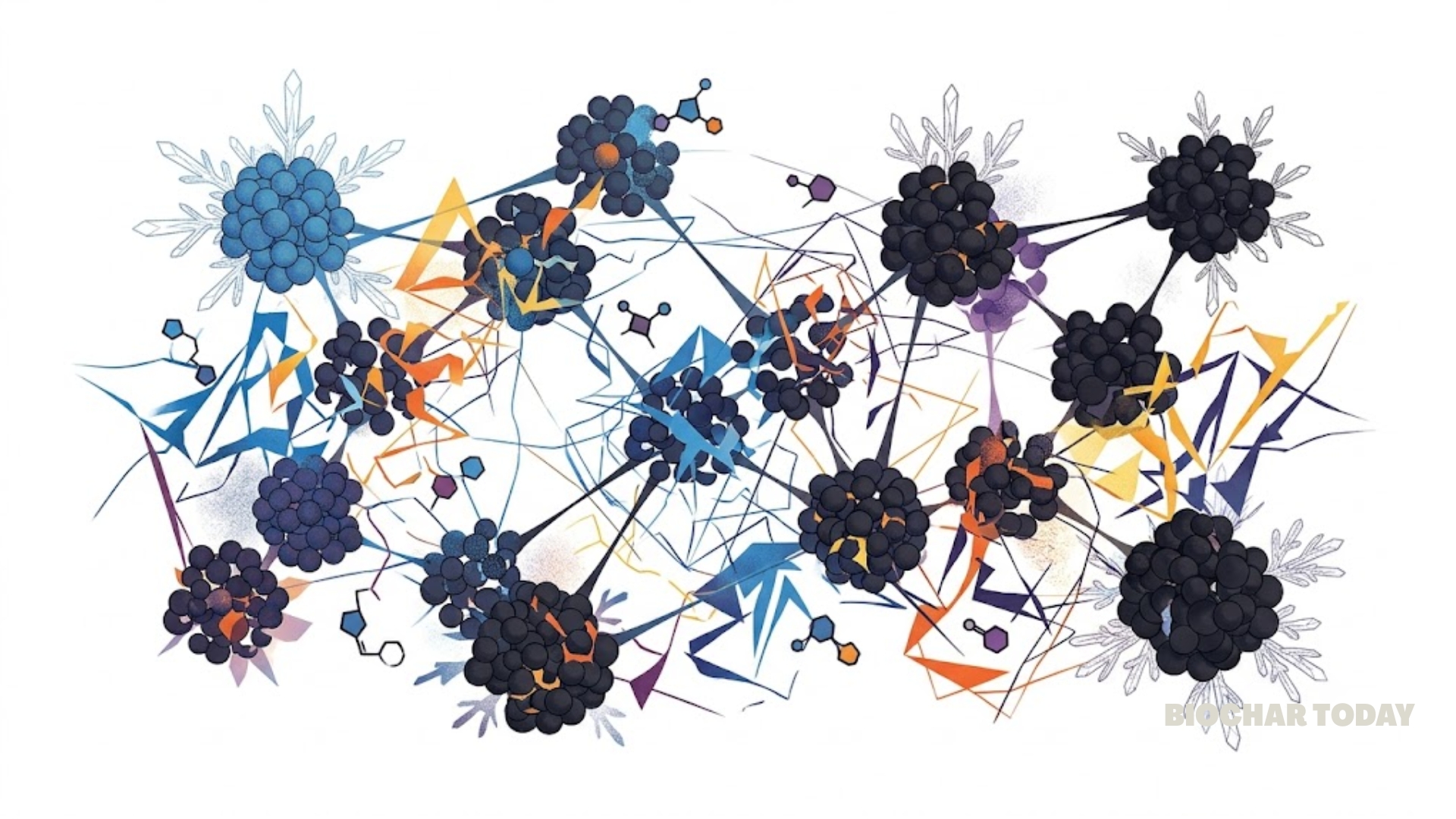
To systematically map these material structure-performance mechanics, investigators implemented a green oxalic acid and glacial acetic acid binary liquid hydrolysis system to isolate nanocellulose from raw lavender stems across varied time intervals ranging from one to five hours prior to fixed kiln carbonization. Microscopic morphology profiling tracked by high-resolution transmission electron imaging verified that a moderate three-hour acid wash completely dissociated the plant fibers into uniform, open nanofiber bundles with a well-ordered mesoporous architecture. In sharp contrast, insufficient processing durations of one to two hours left large, unrefined fiber bundles intact, whereas excessive four- to five-hour over-hydrolysis triggered severe chemical over-etching, structural fragmentation, and localized particle clumping. Upon controlled carbonization at four hundred and fifty degrees Celsius, only the three-hour pretreated precursor framework (designated as CLN-3) successfully preserved its continuous, interconnected nanofiber network to optimize physical gas diffusion pathways.
X-ray diffraction and surface chemical scanning confirmed that while all finalized biochars exhibited highly amorphous carbon configurations, the starting crystallinity of the nanocellulose precursor dictated the final material’s pore metrics and surface reactivity. Kinetic modeling proved that the three-hour window maximizes precursor crystallinity at eighty point six percent by selectively dissolving amorphous plant regions. This optimal alignment enabled CLN-3 to achieve a maximum specific surface area of forty-six point three six square meters per gram and a highly developed internal pore volume. Furthermore, high-resolution X-ray photoelectron spectroscopy tracked a distinct surface oxygen shift: as hydrolysis time advanced, the absolute density of surface-active oxygen vacancies increased, while the concentration of chemisorbed oxygen species peaked specifically within the three-hour processed matrix, providing an ideal balance for room-temperature surface redox activity.
When implemented as a chemiresistive gas-sensing layer on interdigitated ceramic electrodes, the CLN-3 biochar platform delivered a massive electrical current response of seventeen thousand five hundred and seventy-six point six seven percent when exposed to five hundred parts per million of ethylene glycol vapor at room temperature. This responsiveness vastly outmatched alternative samples and easily surpassed standard baseline reactions toward other common volatile chemicals like formaldehyde, methanol, ethanol, and ammonia, establishing outstanding target analyte selectivity. The diagnostic platform demonstrated rapid kinetic transitions, recording a response time of sixty-nine point seven five seconds and a recovery time of fifty-six point three two seconds. Across changing gas concentrations, the biochar layer maintained exceptional quantitative linearity, establishing a reliable lower detection threshold of just zero point three six parts per million.
Quantum-mechanical density functional theory calculations and partial density of states modeling clarified that this superior gas capture performance is governed by trace self-doping elements derived naturally from the raw lavender straw. Inductively coupled plasma mass spectrometry verified that the agricultural residue inherently contains roughly zero point nine eight weight percent of natural calcium. The theoretical simulations proved that this built-in calcium doping works in perfect harmony with pre-adsorbed surface oxygen to create hybrid electronic states right around the carbon Fermi level. This orbital hybridization dramatically enhanced the calculated adsorption energy of ethylene glycol molecules from a weak physical attachment value of negative zero point one three seven electron volts on pristine structures up to a strong chemical adsorption value of negative zero point three nine five electron volts on the calcium-doped, oxygen-enriched surface. This amplified chemical affinity accelerates interfacial charge transfers, while the high mesoporous surface area optimizes internal gas transport. Real-world validation setups using commercial vehicle antifreeze confirmed the sensor’s high reliability, showing consistent repeatable signals over forty continuous days of testing with no major signal decay. This controllable defect-engineering approach provides a green, scalable blueprint for transforming agricultural biomassBiomass is a complex biological organic or non-organic solid product derived from living or recently living organism and available naturally. Various types of wastes such as animal manure, waste paper, sludge and many industrial wastes are also treated as biomass because like natural biomass these More waste into high-performance chemical sensors.
Source: Gong, Y., Liang, C., Sun, Q., Hu, P., Li, Y., Cheng, J., Liu, C., Gao, B., Zhuo, H., & Wu, Z. (2026). Hydrolysis time-controlled pore and defect engineering in nanocellulose-derived biochar for enhanced ethylene glycol sensing. Biochar, 8(110), 1-17.





Leave a Reply