
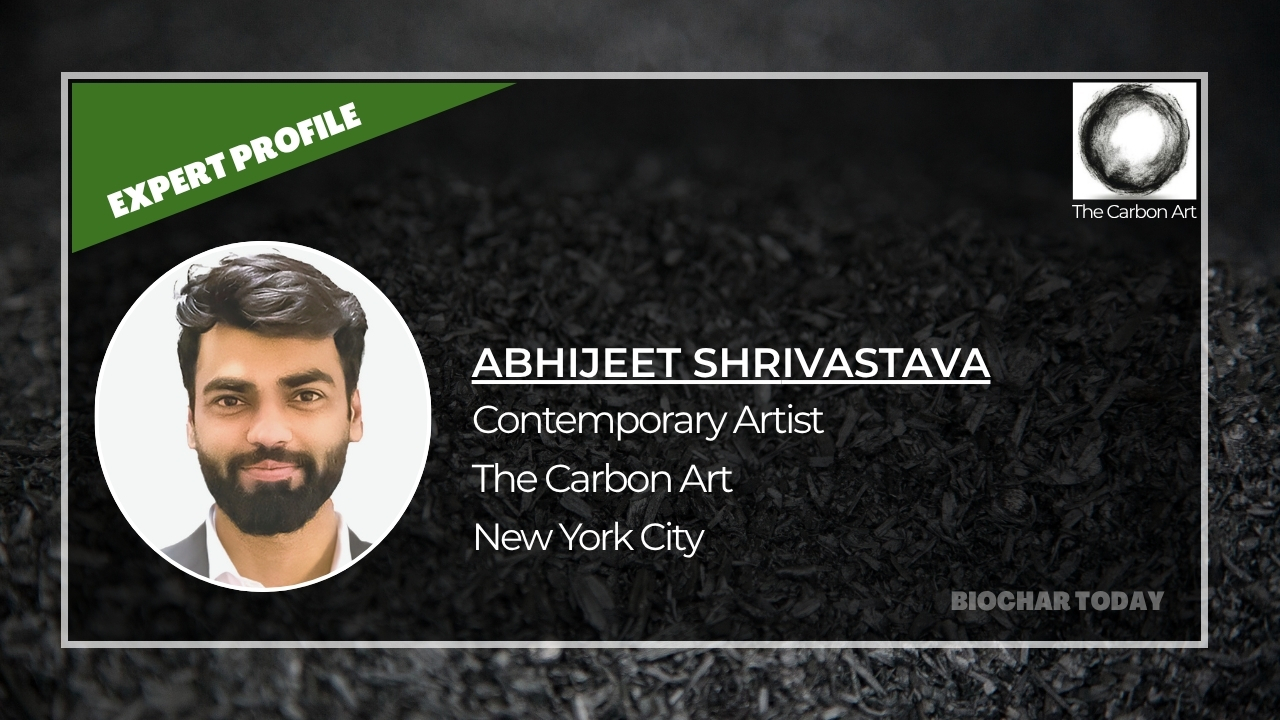
Abhijeet Shrivastava brings a distinctive perspective to the biocharBiochar is a carbon-rich material created from biomass decomposition in low-oxygen conditions. It has important applications in environmental remediation, soil improvement, agriculture, carbon sequestration, energy storage, and sustainable materials, promoting efficiency and reducing waste in various contexts while addressing climate change challenges. More community by demonstrating how art can serve as a powerful medium for climate communication. A sustainability professional and climate strategist, he currently works at Microsoft, where he contributes to data-driven sustainability, environmental impact assessment, and infrastructure planning. As the founder of The Carbon Art, Abhijeet creates fine art using verified biochar and charcoalCharcoal is a black, brittle, and porous material produced by heating wood or other organic substances in a low-oxygen environment. It is primarily used as a fuel source for cooking and heating. More, transforming carbon itself into the artistic medium to tell compelling stories of climate action, regeneration, and environmental stewardship. His work reflects the growing recognition that advancing biochar requires not only scientific innovation but also effective public engagement and meaningful storytelling.
In this edition of the Biochar Today Expert Profile, I speak with Abhijeet about his unconventional journey from sustainability consulting to climate art, the inspiration behind The Carbon Art, and the role of biochar in bridging science, culture, and public imagination. He also shares his insights on communicating carbon removal beyond technical audiences, emerging opportunities for biochar across creative and built environments, and why interdisciplinary collaboration is essential for expanding the impact of this transformative climate solution.
Shanthi Prabha: Your journey is unconventional, spanning architecture, sustainability consulting, geospatial analytics, and climate art. How did your fascination with carbon and biochar evolve into the creation of Carbon Art? What was the defining moment when you realized art could become climate action?
Abhijeet Shrivastava: I started doing charcoal art when I was around fifteen years old. Since then, I have spent years exploring different types of charcoal, wood ashAsh is the non-combustible inorganic residue that remains after organic matter, like wood or biomass, is completely burned. It consists mainly of minerals and is different from biochar, which is produced through incomplete combustion. Ash Ash is the residue that remains after the complete More, and other carbon-based materials. I was always fascinated by the texture, honesty, and depth of charcoal as a medium. Later, through my professional work in climate change, sustainability, IPCC-related models, wildfire risk assessments, and climate reports, I realized that technical information is critical, but it often does not reach local communities in an emotional or accessible way. That became a turning point for me. I wanted to use my artwork to communicate climate change in a way people could feel, not just read about in a report.
Another defining moment came when I was in Iceland and randomly met a professor connected with PlantVillage. I learned more about different types of biochar and started experimenting with biochar from places like Kenya and India. I realized biochar behaved similarly to charcoal artistically, but it carried a much deeper environmental meaning because it stores carbon and can support regenerative farming. That gave my art a stronger purpose. It was no longer just about making art or only raising awareness about climate change; it became about creating climate-positive artwork using a carbon-storing material and connecting each piece to measurable environmental impact.

SP: Carbon is both a driver of the climate crisis and one of humanity’s oldest artistic materials. How does that philosophical duality shape your decision to use biochar as an artistic medium? What have you learned about communicating climate science through materiality instead of data alone?
AS: When I first started creating charcoal artwork, I was fascinated by how honest the material felt. With one material and mostly one color, you cannot hide behind layers of paint or decoration. There is a transparency and truth in it. I also loved that carbon-based drawing is one of the oldest forms of human expression. From cave paintings to early drawings, humans have used carbon to tell stories for thousands of years. Using charcoal and biochar connects me to that historic form of art while avoiding heavily processed, oil-based, chemical materials.
At the same time, through my professional climate work, I became very aware that carbon emissions are one of the biggest drivers of global warming. That duality is powerful to me. The same element connected to the crisis is also one of humanity’s oldest storytelling tools. By using biochar, I can bring both realities together. The artwork is not only a visual message about climate change, it is also made from a material that can have a positive environmental impact. That materiality helps people understand climate science differently. Data is important, but when people can see and touch the material, the climate story becomes much more personal and memorable.
SP: Your artworks source biochar from regenerative farming communities in Kenya, India, and Iceland, and pair it with verified carbon impact. What inspired this unique model of combining art, carbon sequestration, and regenerative agriculture? What challenges did you face in bringing this vision to life?
AS: The idea came from wanting climate impact to feel visible and personal. Biochar can help restore soil, support farmers, and lock carbon away, and I wanted my artwork to carry that larger story. By sourcing biochar from regenerative farming communities in Kenya, India, and Iceland, each artwork becomes connected to the land, the people, and the environmental impact behind the material. It gives the piece a deeper meaning beyond the image itself.
I also wanted to give people a way to participate in climate action in a tangible way. Many people donate to causes or support environmental efforts, but they may not always see the outcome or have something lasting that communicates their contribution. With Carbon Art, someone can display the artwork and talk about the positive environmental impact connected to it. The piece stays with them, starts conversations, and shows that they contributed to climate action. Bringing this vision to life has required learning, partnerships, trust, sourcing materials responsibly, and thinking carefully about verification, but that challenge is also what makes the work meaningful.

SP: You have worked in sustainable infrastructure and climate resilience at organizations such as Microsoft, KPMG, and WSP. How has your professional experience in data-driven environmental decision-making influenced the themes, stories, and systems thinking in your artworks?
AS: My work at KPMG, WSP, and Microsoft has shaped how I think about climate, sustainability, and systems. I have worked on different topics related to climate change, sustainability reporting, resilience, infrastructure, and environmental decision-making. Every client, every project, and every topic helped me see a different dimension of the climate challenge. That learning directly influenced my artwork.
For example, if I worked with a food company, I started thinking about food scarcity and agriculture. If I worked on soil restoration, that became a theme in my art. If I worked on wildfire risk assessment, the message became connected to fire and climate risk. If I worked on water risk for a beverage company, I created ideas around water scarcity and resilience. My professional experience taught me that climate issues are deeply connected. That systems-thinking approach helps me create artwork that is not only aesthetic, but also grounded in real-world examples, communities, materials, and environmental impact.
SP: Carbon credits and ESG reports often remain abstract and fail to create an emotional connection. Why do you think climate action struggles to resonate with the public, and how can art and storytelling help the biochar sector communicate impact more effectively?
AS: Climate action often struggles to resonate because the language can feel distant from everyday life. Terms like carbon credits, emissions reductions, ESG reporting, and carbon markets are important, but they can feel abstract. Most people do not connect emotionally with a spreadsheet, technical report, or offset calculation. The climate challenge is real and urgent, but the way we communicate it often does not help people feel personally connected to the solution.
Art and storytelling can bridge that gap. When someone sees a piece made from biochar, the concept of carbon sequestration becomes visible. The artwork creates a physical and emotional connection to the material, the farming community, and the environmental impact behind it. For the biochar sector, this kind of storytelling can make the impact easier to understand and easier to share. It can help people see biochar not only as a technical climate solution, but as a human story about land, farmers, regeneration, and hope.
SP: As biochar enters carbon markets and climate policy discussions, what are the biggest gaps in current carbon removal frameworks around verification, accessibility, public understanding, and market design? What challenges must be addressed?
AS: One of the biggest gaps is that carbon removal frameworks are still very complex and hard for the public to understand. Verification is essential, but the systems around it can feel inaccessible. Scope 3 emissions are difficult to calculate, and there is not always a standardized way for different companies to approach them. That creates uncertainty, confusion, and concerns around double counting. There are conversations about using tools like blockchain and other technologies to improve transparency, but there is still a lot of work to do.
The technical side is important, but I think the bigger gap is visibility. Many people do not see or understand the climate action happening behind carbon markets, credits, or removal projects. We need clearer communication, stronger transparency, and market designs that people can trust. This is also where I see a role for art. My artwork can help make an invisible climate process visible. It can turn technical climate action into something people can see, discuss, and feel connected to.
SP: Your work has created a new category of ‘carbon-positive art.’ Looking ahead 10 to 20 years, how do you envision museums, galleries, architecture, and public spaces becoming active participants in carbon sequestration and climate mitigation? What might that future look like?
AS: Looking ahead, I see a future where the spaces we live, work, and gather in actively participate in carbon sequestration. Museums and galleries could display artworks that store carbon, but they could also become places for education, communication, and awareness around sustainability. Public spaces could inspire people while also using materials that reduce environmental impact. Sustainability would not just be something explained on a label; it would be built into the space itself.
As someone with a background in architecture, I also see huge potential in sustainable materials replacing high-emission materials. Biochar-based bricks, mycelium bricks, and other low-carbon or carbon-locking materials could become part of everyday buildings and public infrastructure. In 10 to 20 years, I hope we see a stronger circular economy where waste becomes material, materials store carbon, and architecture, art, museums, and public spaces all help communicate and educate people about climate solutions.
SP: Biochar is traditionally associated with agriculture and environmental remediation, but your work demonstrates its potential in the creative economy. What emerging non-traditional applications of biochar excite you most, and where do you see the next disruptive opportunities for innovation?
AS: I am not directly involved in every application of biochar, but I partner with companies and communities working on biochar-based sustainable farming, including PlantVillage, and I have a lot of trust in the innovation happening in this space. Biochar already has strong applications in soil health and regenerative agriculture, but I think its potential goes much further.
What excites me most is seeing biochar move into new sectors such as building materials, design, water filtration, animal bedding, and creative products. It can become part of architecture, public art, consumer goods, and circular economy systems. The next disruptive opportunities will come from partnerships between farmers, scientists, designers, entrepreneurs, artists, and climate professionals. When biochar moves beyond a purely technical or agricultural conversation, it can become a broader material for climate innovation.
SP: Many young professionals aspire to build careers that integrate science, technology, sustainability, and creativity. What advice would you give to researchers, entrepreneurs, and artists who want to create interdisciplinary solutions with real climate impact?
AS: I would recommend looking for opportunities at the intersections. My own journey started with architecture, then expanded into sustainable architecture and vernacular design. From there, I became interested in how buildings and cities can be more resilient to climate change. That led me into urban planning, climate policy, sustainability master plans, public sector work, and later consulting with private sector organizations on sustainability reporting and climate strategy.
At every stage, I tried to keep learning and use one opportunity to build the skills needed for the next. Over time, those experiences compound. The world is changing quickly, so we need to adapt, keep learning, and understand how different systems are connected. Being strong in one discipline is important, but systems thinking helps you create bigger impact. If you can connect science, technology, sustainability, creativity, and community needs, you can become a real change maker.
SP: If you could create one monumental biochar artwork and place it anywhere in the world, whether on a melting glacier, in a bustling city square, or beside a threatened ecosystem, where would it be, and what story would you want the artwork to tell?
AS: If I were to create one monumental biochar artwork, I would place it in a highly visible public space in a city where many people could see it. I would not want to place it in a fragile natural environment or on top of a mountain. I strongly believe in the idea that if we love nature, we should also know when to stay away from it and protect it from unnecessary disturbance.
A city square or public gathering place would allow the artwork to reach more people without putting pressure on sensitive ecosystems. The story I would want it to tell is that climate action belongs in our daily lives, not only in remote landscapes or scientific reports. It would remind people that our role is to protect the planet, reduce harm, and contribute to positive climate impact wherever we are.
SP: Complete this statement: My vision for the future of biochar is…
AS: My vision for the future of biochar is that it becomes one of the most visible and accessible climate solutions in the world. I hope it supports regenerative agriculture, improves soils, helps communities, stores carbon, and becomes part of everyday materials, architecture, public spaces, and creative expression.
For me, biochar is more than a carbon removal technology. It is a symbol of regeneration. It shows that waste can become value, that carbon can become a story, and that climate action can be something people can see, understand, and participate in.
SP: For readers who want to follow your journey, learn more about Carbon Art, or connect with you, where can they explore your work further?
AS: Readers can connect with me on LinkedIn, where I share more about my work at the intersection of climate innovation, sustainable infrastructure, biochar, and art. I also share updates on Carbon Art, exhibitions, projects, and the broader journey of using creative expression to communicate climate action.
More than anything, I hope people see Carbon Art as part of a larger movement. This work connects farmers, scientists, artists, entrepreneurs, and climate professionals who are all trying to build a more regenerative future. I would love for people to follow the journey, engage with the work, and be part of that conversation.


Leave a Reply