
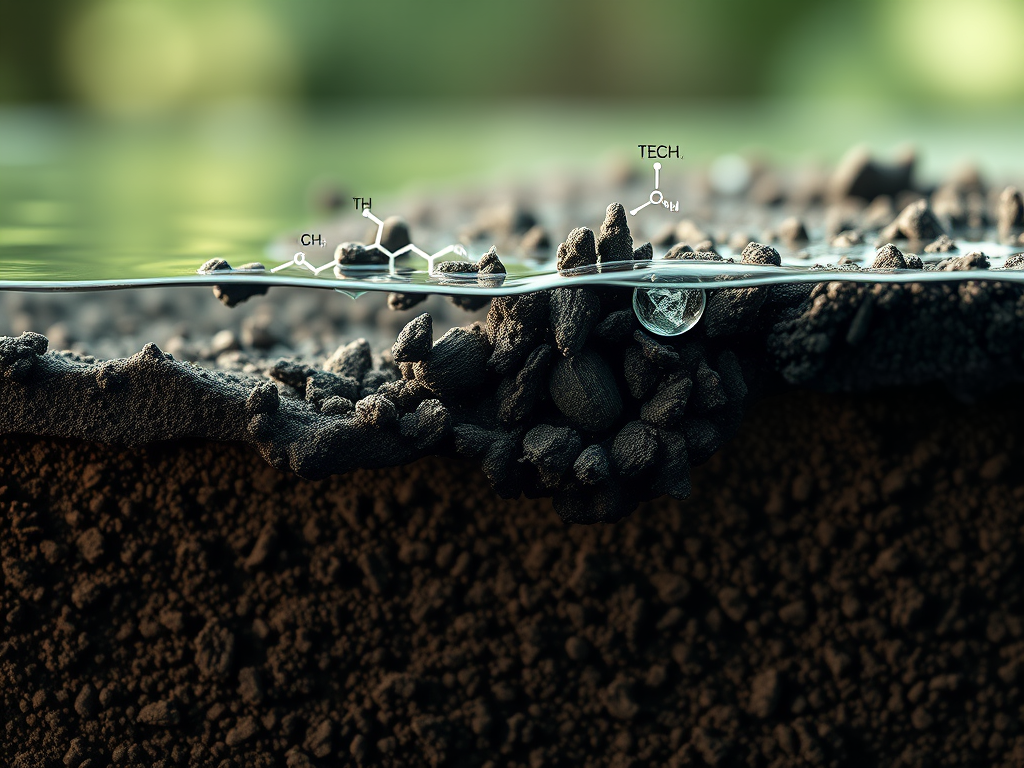
Groundwater contamination by persistent chlorinated solvents is a widespread and challenging environmental problem, impacting ecosystems and human health globally. While aggressive remediation methods exist, they are often not cost-effective for long-term management of low-concentration contaminants. In a study published in the journal BiocharBiochar is a carbon-rich material created from biomass decomposition in low-oxygen conditions. It has important applications in environmental remediation, soil improvement, agriculture, carbon sequestration, energy storage, and sustainable materials, promoting efficiency and reducing waste in various contexts while addressing climate change challenges. More, Lin Duan, Zicui Gong, Yang Li, Tianchi Cao, Tong Zhang, and Wei Chen investigated a more viable, long-term approach: using biochar to both sequester and transform contaminants in situ. Their work shows how tailoring biochar’s composition can significantly improve its ability to clean up polluted groundwater.
The research focused on 1,1,2,2-tetrachloroethane (TeCA), a common chlorinated solvent, and tested pine wood biochars prepared at different pyrolysisPyrolysis is a thermochemical process that converts waste biomass into bio-char, bio-oil, and pyro-gas. It offers significant advantages in waste valorization, turning low-value materials into economically valuable resources. Its versatility allows for tailored products based on operational conditions, presenting itself as a cost-effective and efficient More temperatures, ranging from 300°C to 700°C. It was found that biochars produced at higher temperatures (600°C and 700°C) were surprisingly more effective at catalyzing the dehydrochlorination of TeCA than those prepared at lower temperatures. This finding was counterintuitive, as conventional wisdom suggests that a biochar’s catalytic activity comes from its surface carboxyl and phenolic groups, which are more abundant at lower temperatures.
The key to this unexpected efficacy, the researchers discovered, was the biochar’s carbonate content. While low-temperature biochars (300°C and 400°C) had minimal carbonate content, accounting for only 5–7% of their total alkalis, the high-temperature biochars (600°C and 700°C) were composed of 52–55% carbonates. It was these inorganic carbonates that served as the primary nucleophiles, or reactive components, driving the TeCA hydrolysis reaction. A multi-step kinetic model revealed that the hydrolysis rate constant on the surface of the 600°C and 700°C biochars was 2.6 to 3.0 times higher than in a homogeneous aqueous solution alone. This confirms that the high-temperature biochars don’t just act as a passive filter; they actively enhance the chemical degradation of the contaminant.
The study also found a critical, synergistic relationship between this chemical transformation and contaminant sequestration. The product of the hydrolysis reaction, trichloroethylene (TCE), was significantly more adsorptive to the biochar than its parent compound, TeCA. This is likely due to TCE’s planar molecular shape, which allows it to fit more easily into the rigid micropores of the biochar, a phenomenon known as pore-filling. In contrast, the nonplanar TeCA molecules are hindered by steric effects and are less likely to enter these pores. This enhanced binding capacity means that as TeCA is converted to TCE, it becomes more effectively trapped within the biochar.
The practical implications of this research are significant for long-term groundwater management, particularly for “rebounding,” where contaminant concentrations rise again after an initial cleanup. The study simulated a permeable reactive barrier (PRB) filled with biochar, a common in-situ remediation technique. The results showed that by converting TeCA to the more adsorptive TCE, the required wall thickness of the PRB to maintain a clean effluent could be reduced by a factor of 3.6 to 5.8 times. This reduction in material would substantially lower the capital and maintenance costs associated with site remediation.
This research highlights that for certain contaminants, the inorganic components of biochar, which have been largely overlooked, may be more valuable than the traditional carbonaceous structure. Biochar, a low-cost material made from biomassBiomass is a complex biological organic or non-organic solid product derived from living or recently living organism and available naturally. Various types of wastes such as animal manure, waste paper, sludge and many industrial wastes are also treated as biomass because like natural biomass these More, holds great promise as an effective and readily available tool for addressing persistent groundwater contamination. Future research should investigate how co-existing substances in groundwater might affect biochar’s performance and explore methods for regenerating its capacity to ensure long-term sustainability.
Source: Duan, L., Gong, Z., Li, Y., Cao, T., Zhang, T., & Chen, W. (2025). Modulating biochar compositions to maximize synergy between contaminant binding and transformation: the critical role of carbonates and implications for in situ groundwater remediation. Biochar, 7(1), 78.



Leave a Reply