
Liu, et al (2024) Soil carbon sequestration increment and carbon-negative emissions in alternate wetting and drying paddy ecosystems through biocharBiochar is a carbon-rich material created from biomass decomposition in low-oxygen conditions. It has important applications in environmental remediation, soil improvement, agriculture, carbon sequestration, energy storage, and sustainable materials, promoting efficiency and reducing waste in various contexts while addressing climate change challenges. More incorporation. Agricultural Water Management. https://doi.org/10.1016/j.agwat.2024.108908
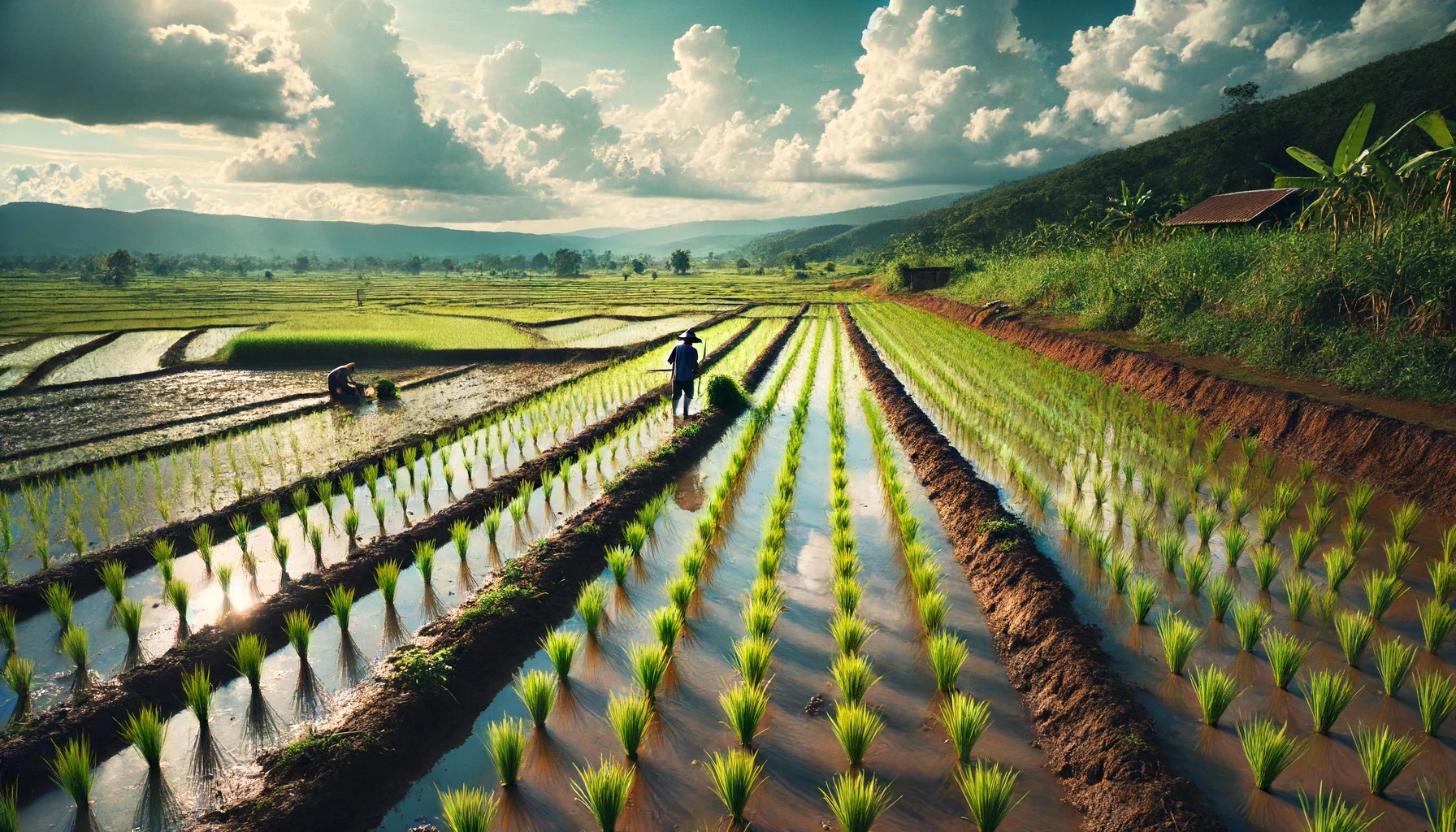
Biochar has garnered significant attention as a potent negative emission technology capable of indirectly removing atmospheric carbon dioxide. A recent study delves into how biochar can convert rice paddies into carbon-negative ecosystems and enhance soil carbon sequestration, particularly under alternate wetting and drying irrigation (IAWD). The study conducted a three-year field experiment to explore the impact of biochar on greenhouse gas emissions, soil properties, and crop yields under IAWD compared to continuous flooding irrigation (ICF).
The experiment used a split-plot design with ICF and IAWD as main plots and biochar incorporation at rates of 0 t ha−1 (B0) and 20 t ha−1 (B20) as sub-plots. The results showed that IAWD significantly reduced methane (CH4) emissions by 73% and global warming potential (GWP) by 69% on average, though it increased nitrous oxide (N2O) emissions by 109% over three years. Biochar addition mitigated N2O emissions by 31% and increased grain yield by 5% and 11% in the second and third years, respectively, despite a 6% yield reduction in the first year. Additionally, biochar reduced CH4 emissions by 22% and 38% in the second and third years.
Soil carbon sequestration (SOCS) and SOCS rates were significantly higher under IAWD than ICF when biochar was applied. The highest SOCS (56.9 t C ha−1) and the lowest net GWP (-23.0 t CO2-eq ha−1) were achieved with biochar incorporation under IAWD. This combination effectively counteracted the increase in N2O emissions caused by IAWD alone. Compared to ICFB0, the ICFB20 and IAWDB20 treatments decreased net GWP by approximately four and eight times, respectively, primarily due to substantial increases in SOCS.
Rice fields are major sources of anthropogenic CH4 and N2O emissions. IAWD, a water-saving irrigation technique, has been widely adopted to reduce CH4 emissions by improving soil aeration and redox potential, which conserves water and improves water use efficiency (WUE). However, IAWD can also lead to increased N2O emissions due to enhanced soil nitrification and denitrification processes. Biochar, made from rice straw through pyrolysisPyrolysis is a thermochemical process that converts waste biomass into bio-char, bio-oil, and pyro-gas. It offers significant advantages in waste valorization, turning low-value materials into economically valuable resources. Its versatility allows for tailored products based on operational conditions, presenting itself as a cost-effective and efficient More, has been shown to stabilize soil carbon and reduce GHG emissions over time. Its impact, however, varies with soil properties and irrigation practices.
The study’s findings highlight the complex interplay between biochar, irrigation methods, and soil properties in influencing greenhouse gas emissions. The reduction in CH4 emissions under IAWD was attributed to improved soil aeration, which inhibited methanogenic activity. Biochar further reduced CH4 emissions by increasing soil organic carbon and enhancing methanotrophic activity, which oxidizes CH4. The increased N2O emissions under IAWD were mitigated by biochar’s ability to adsorb NH4+-N, reducing nitrification substrates and thus N2O emissions.
In terms of crop yield, biochar incorporation showed varying effects over the years. While initial biochar application led to a slight yield reduction due to increased soil alkalinity, subsequent years saw yield improvements as soil conditions stabilized. This yield boost was linked to biochar’s ability to enhance soil fertility and structure, promoting better crop growth.
Overall, the study suggests that combining biochar with IAWD offers a sustainable strategy for reducing net greenhouse gas emissions and enhancing soil carbon sequestration in rice paddies. This approach not only helps in mitigating climate change but also supports sustainable agricultural practices by improving water use efficiency and crop yields. As such, it holds promise for broader application in rice-producing regions facing water scarcity and the need for sustainable farming solutions.



Leave a Reply