
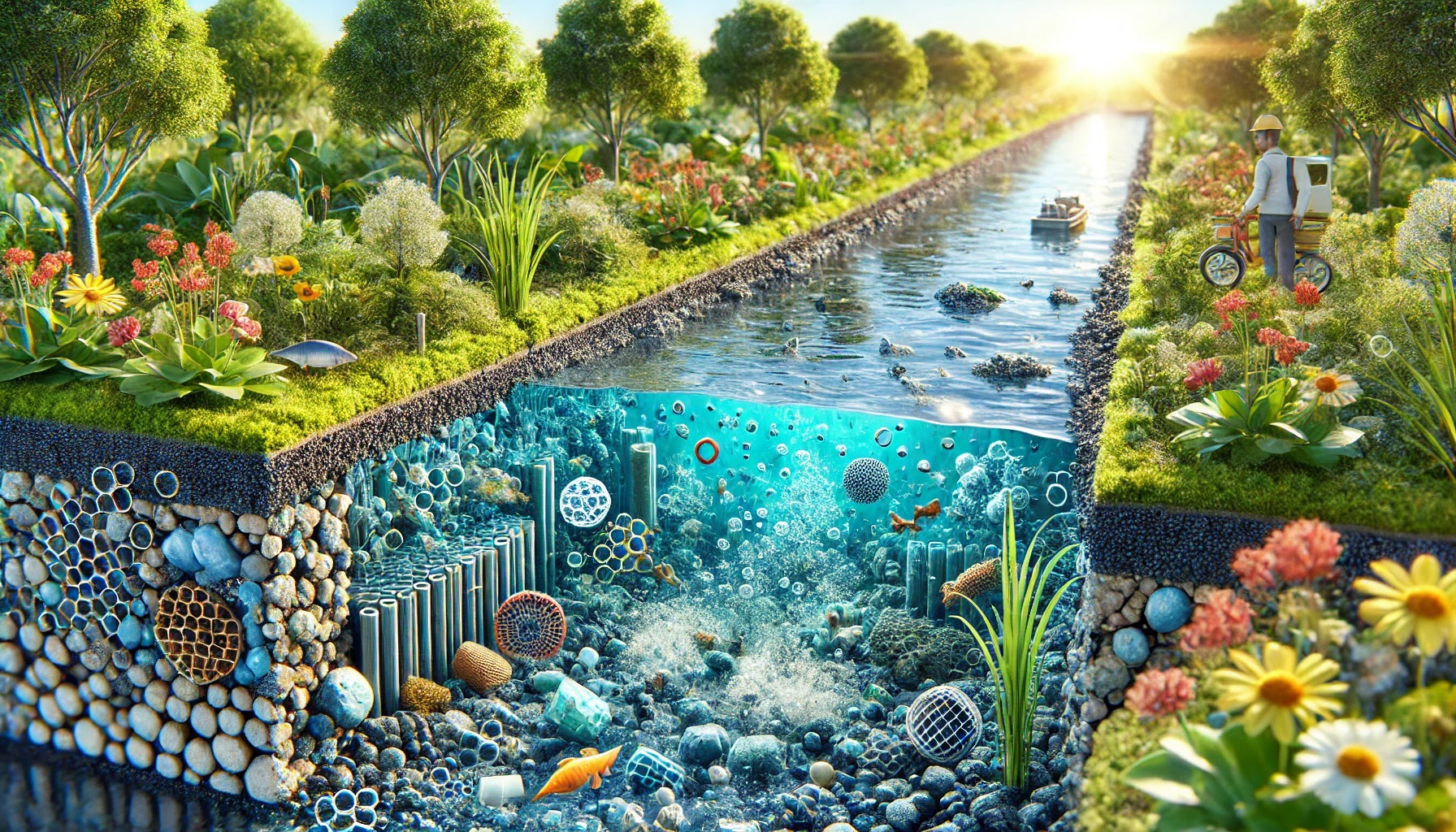
Cairns, S., Meza-Rojas, D., Holliman, P.J. et al.Interactions Between BiocharBiochar is a carbon-rich material created from biomass decomposition in low-oxygen conditions. It has important applications in environmental remediation, soil improvement, agriculture, carbon sequestration, energy storage, and sustainable materials, promoting efficiency and reducing waste in various contexts while addressing climate change challenges. More and Nano(Micro)Plastics in the Remediation of Aqueous Media. Int J Environ Res18, 87 (2024). https://doi.org/10.1007/s41742-024-00635-0
Since its rise to prominence in the 1930s, plastic has become an indispensable part of modern life. However, its widespread use has resulted in the pervasive presence of nano- and microplastics (NMPs) in natural environments, particularly affecting air, soil, and water ecosystems. NMPs, categorized as microplastics (5 mm–1 µm) and nanoplastics (< 1 µm), pose significant threats to aquatic life and human health due to their chemical additives and their ability to absorb other contaminants. Addressing this issue, recent studies have focused on using biochar as a natural adsorbent for remediating water contaminated with NMPs.
Biochar is a carbon-rich, porous material produced by pyrolyzing biomassBiomass is a complex biological organic or non-organic solid product derived from living or recently living organism and available naturally. Various types of wastes such as animal manure, waste paper, sludge and many industrial wastes are also treated as biomass because like natural biomass these More under limited oxygen conditions. It has garnered attention due to its sustainability, affordability, and effectiveness in removing both organic and inorganic contaminants from water. Despite its established use in sorbing various pollutants, the application of biochar for NMP removal is relatively new and under exploration. Studies suggest that biochar’s efficiency in removing NMPs hinges on its characteristics, which are influenced by factors such as pyrolysisPyrolysis is a thermochemical process that converts waste biomass into bio-char, bio-oil, and pyro-gas. It offers significant advantages in waste valorization, turning low-value materials into economically valuable resources. Its versatility allows for tailored products based on operational conditions, presenting itself as a cost-effective and efficient More temperature and feedstockFeedstock refers to the raw organic material used to produce biochar. This can include a wide range of materials, such as wood chips, agricultural residues, and animal manure. More type.
The pyrolysis temperature affects the biochar’s specific surface area (SSA), hydrophobicity, aromaticity, and zeta potential, all of which are crucial for effective NMP adsorption. For instance, higher pyrolysis temperatures typically increase the SSA and hydrophobicity of biochar, enhancing its ability to attract and hold NMPs. Additionally, the feedstock used in biochar production can significantly influence its texture and pore structure, which are vital for trapping NMPs.
Modifications to biochar can further improve its performance in NMP removal. Techniques such as steam activation, magnetization, and oxidation have been explored. For example, magnetized biochar, produced by incorporating iron or other metals, has shown increased NMP capture due to its rougher surface and improved complexation capabilities. Similarly, oxidizing biochar can increase its functional groups, enhancing its ability to form hydrogen bonds with NMPs, thus improving sorption.
Environmental parameters, such as pHpH is a measure of how acidic or alkaline a substance is. A pH of 7 is neutral, while lower pH values indicate acidity and higher values indicate alkalinity. Biochars are normally alkaline and can influence soil pH, often increasing it, which can be beneficial More, ionic strength, and the presence of natural organic matter (NOM), also play a significant role in the effectiveness of biochar for NMP remediation. Studies indicate that the solution pH can influence the zeta potential of both biochar and NMPs, affecting their electrostatic interactions. For instance, a higher pH can reduce the negative charge on biochar, decreasing electrostatic repulsion and enhancing NMP adsorption. Similarly, high ionic strength can lead to the aggregation of NMPs, facilitating their removal by biochar.
Despite promising laboratory results, the transition to field applications requires more research. Laboratory studies often use pristine, uniformly shaped NMPs, which do not fully represent the diversity of NMPs found in natural environments. Real-world conditions introduce variables such as naturally aged plastics, varying water chemistries, and the presence of co-contaminants, all of which can affect the efficacy of biochar. Field trials are essential to understand these dynamics and validate biochar’s practical applicability.
In conclusion, biochar presents a viable and sustainable option for remediating NMP-contaminated water. Its effectiveness depends on several factors, including its production conditions, modifications, and environmental parameters. Future research should focus on blending laboratory findings with field studies to develop comprehensive strategies for deploying biochar in diverse environmental settings. By addressing these challenges, biochar could play a significant role in mitigating the impact of NMP pollution on our ecosystems and health.





Leave a Reply