
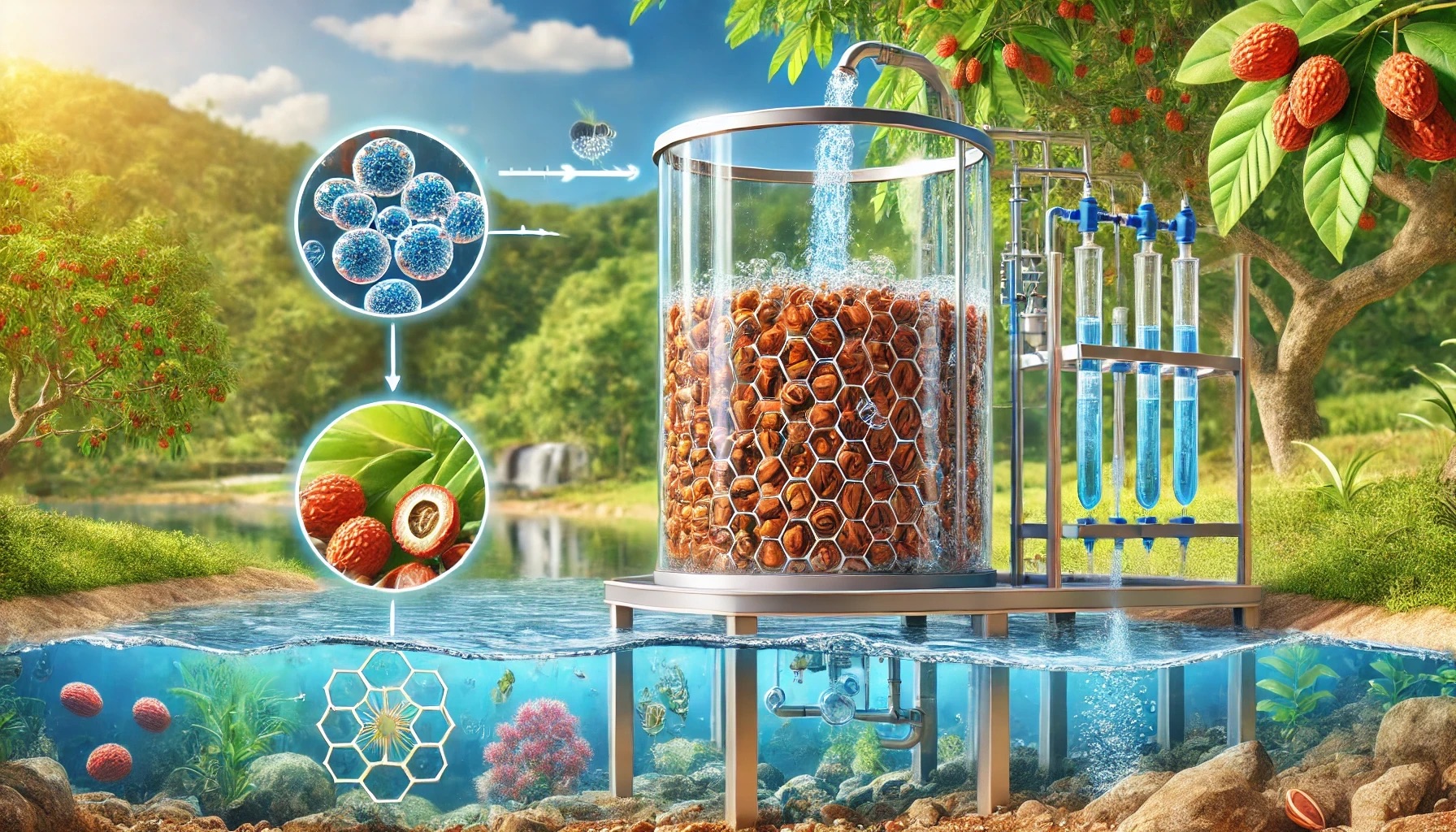
Liu, et al (2024) Rapid adsorptive removal of emerging and legacy PFASs from water using zinc chloride-modified litchi seed-derived biocharBiochar is a carbon-rich material created from biomass decomposition in low-oxygen conditions. It has important applications in environmental remediation, soil improvement, agriculture, carbon sequestration, energy storage, and sustainable materials, promoting efficiency and reducing waste in various contexts while addressing climate change challenges. More. Bioresource Technology. https://doi.org/10.1016/j.biortech.2024.131157
A recent study introduces an innovative biochar adsorbent derived from litchi seeds, modified with zinc chloride (ZnCl2), showing promising results for removing per- and polyfluoroalkyl substances (PFASs) from water. This biochar, referred to as M−L−BC, demonstrated a significant improvement in PFAS removal efficiency, achieving over 95% removal compared to less than 40% by unmodified biochar. The adsorbent exhibited a maximum capacity of 29.6 mg/g for perfluorooctane sulfonic acid (PFOS).
The study revealed that PFAS adsorption followed a pseudo-second-order model, indicating that chemical adsorption was predominant. The mechanisms for PFAS removal included surface complexation, electrostatic interactions, hydrogen bonding, and hydrophobic interactions. M−L−BC performed well across a broad pHpH is a measure of how acidic or alkaline a substance is. A pH of 7 is neutral, while lower pH values indicate acidity and higher values indicate alkalinity. Biochars are normally alkaline and can influence soil pH, often increasing it, which can be beneficial More range and in the presence of various coexisting ions, except for perfluorobutanoic acid (PFBA).
Furthermore, M−L−BC maintained its effectiveness in real water samples and demonstrated excellent reusability, retaining its adsorption capacity after five regeneration cycles. These findings suggest that M−L−BC is a sustainable and efficient option for addressing both legacy and emerging PFAS contamination in water sources.
PFASs, used since the 1940s in various industrial and consumer products, are persistent environmental pollutants with significant health risks, including cancer and liver disease. Traditional wastewater treatment methods often fail to remove PFASs effectively, necessitating new approaches like the modified biochar developed in this study.
Overall, ZnCl2-modified litchi seed biochar represents a promising and sustainable solution for PFAS removal from water, potentially improving water quality and reducing health risks associated with these persistent pollutants.


Leave a Reply