
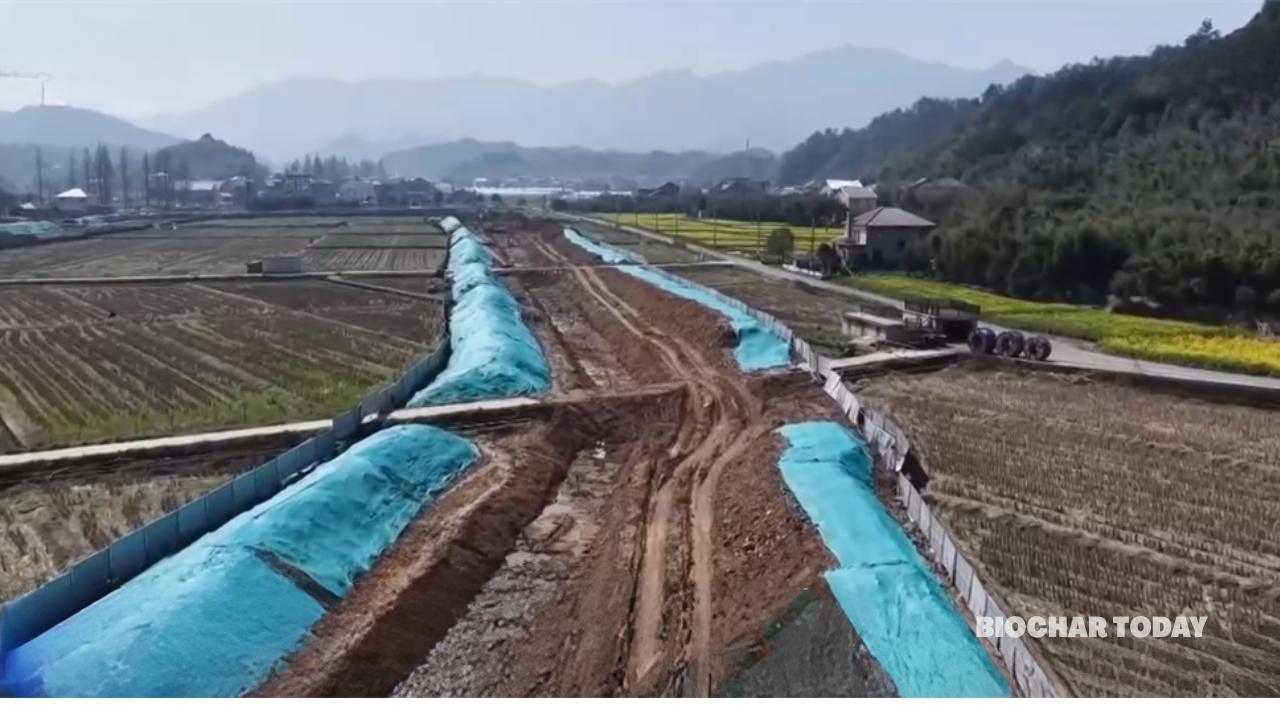
In Lin’an District, Hangzhou, Zhejiang Province, China, a major ultra-high voltage (UHV) direct current transmission project is demonstrating a novel approach to infrastructure development by prioritizing agricultural preservation. Part of the Gansu-Zhejiang 800-kilovolt UHV line, the project is designed to transport wind and solar energy from northwest China to the eastern regions. While the construction of the receiving-end grounding electrode necessitates significant land excavation, the project utilizes a dual-use model that buries energy facilities underground while preparing the surface for high-yield rice cultivation.
The primary challenge addressed by this initiative is the environmental and agricultural degradation typically associated with large-scale utility construction. The works have temporarily occupied 345 mu (approximately 23 hectares) of land, with excavation depths reaching up to five meters. Conventional construction often results in soil compaction, the loss of fertile topsoil, and the disruption of local ecological systems, which can render land unsuitable for farming for years after a project’s completion. Maintaining soil structure during such intensive industrial activity is critical to ensuring the long-term viability of the region’s food production.
To mitigate these impacts, project engineers and researchers implemented a sophisticated soil management and reclamation strategy. During the excavation phase, topsoil and subsoil were removed and stored separately to preserve their distinct biological and structural properties. Following the installation of the underground transmission infrastructure, the soil is being restored using advanced improvement techniques. Specifically, the application of biocharBiochar is a carbon-rich material created from biomass decomposition in low-oxygen conditions. It has important applications in environmental remediation, soil improvement, agriculture, carbon sequestration, energy storage, and sustainable materials, promoting efficiency and reducing waste in various contexts while addressing climate change challenges. More and beneficial microorganisms is being utilized to enhance soil fertility, improve moisture retention, and stimulate biological activity within the reclaimed layers.
The outcomes of this integrated approach suggest that infrastructure development can serve as a catalyst for environmental enhancement rather than just a cause of disruption. By utilizing biochar-based soil amendments, the project aims not only to return the land to its original state but to surpass pre-construction productivity levels. The successful implementation of this model allows for the simultaneous transmission of clean energy and the cultivation of crops. This strategy provides a scalable framework for integrating large-scale infrastructure with sustainable land use and ecological management in China’s eastern agricultural hubs.



Leave a Reply