
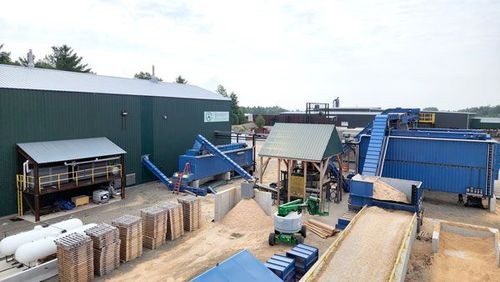
Standard Biocarbon (SBC) in Enfield, Maine, is addressing two critical challenges: the forestry sector’s decline due to the paper industry’s downturn and widespread PFAS contamination in agricultural soils. By converting sawmill residuals into high-quality biocharBiochar is a carbon-rich material created from biomass decomposition in low-oxygen conditions. It has important applications in environmental remediation, soil improvement, agriculture, carbon sequestration, energy storage, and sustainable materials, promoting efficiency and reducing waste in various contexts while addressing climate change challenges. More, SBC is revitalizing forestry and offering a promising tool for environmental remediation.
Maine’s forestry industry produces over 2 million tons of low-grade wood annually, yet market instability has limited its use. SBC’s facility, colocated with Pleasant River Lumber, exemplifies the circular economy by transforming sawmill byproducts—previously considered waste—into biochar. This approach not only generates revenue but also supports sustainable forestry practices.
The facility uses the first U.S.-based PYREG biomassBiomass is a complex biological organic or non-organic solid product derived from living or recently living organism and available naturally. Various types of wastes such as animal manure, waste paper, sludge and many industrial wastes are also treated as biomass because like natural biomass these More system, an advanced pyrolysisPyrolysis is a thermochemical process that converts waste biomass into bio-char, bio-oil, and pyro-gas. It offers significant advantages in waste valorization, turning low-value materials into economically valuable resources. Its versatility allows for tailored products based on operational conditions, presenting itself as a cost-effective and efficient More technology. Wood chips are processed at high temperatures in an oxygen-free environment, creating biochar with over 90% carbon content. The system operates autothermally, requiring no external energy after startup, and provides surplus heat for biomass drying. SBC began production in late 2024, with a goal of 50 cubic yards of biochar per day.
Biochar is particularly effective in remediating PFAS contamination, a pressing issue in Maine. Acting like activated carbonActivated carbon is a form of carbon that has been processed to create a vast network of tiny pores, increasing its surface area significantly. This extensive surface area makes activated carbon exceptionally effective at trapping and holding impurities, like a molecular sponge. It is commonly More, it binds toxins, including heavy metals and PFAS, preventing them from contaminating crops and water. Additionally, biochar sequesters carbon, with each ton produced removing three tons of CO2 from the atmosphere.
By integrating innovative technology and sustainable forestry, SBC’s model offers economic and environmental benefits, positioning biochar as a vital tool for climate action and soil restoration.
READ MORE: A New Economic Engine For Maine’s Forest Industry

Leave a Reply