
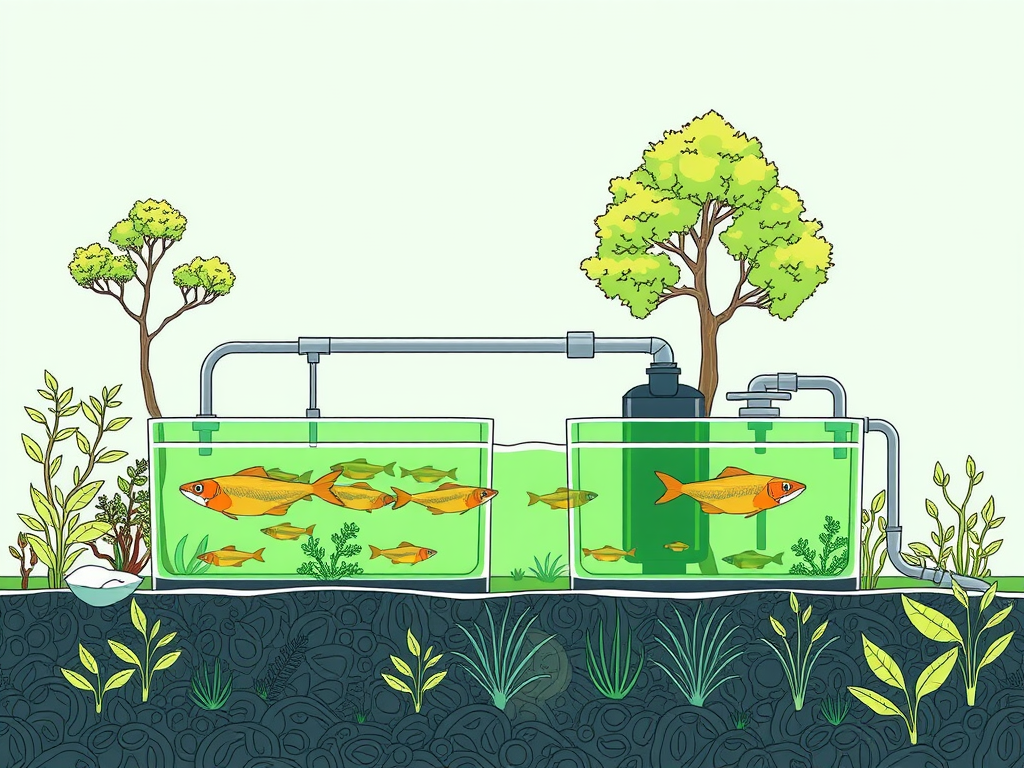
The global demand for food, coupled with increasing environmental concerns, is driving innovation in sustainable food production. Aquaculture, particularly Recirculating Aquaculture Systems (RAS), is a rapidly growing sector, but conventional RAS can lead to nutrient losses and environmental impacts. A new study in Resources, Environment and Sustainability by Marta Behjat, Magdalena Svanström, Gregory Peters, and Niklas Wennberg, explores the environmental performance of an innovative RAS that integrates a biocharBiochar is a carbon-rich material created from biomass decomposition in low-oxygen conditions. It has important applications in environmental remediation, soil improvement, agriculture, carbon sequestration, energy storage, and sustainable materials, promoting efficiency and reducing waste in various contexts while addressing climate change challenges. More filter for enhanced nutrient recirculation. This approach aims to recover carbon, nitrogen, and phosphorus, turning waste into valuable resources.
Traditional RAS often employ mechanical and biological filters. While mechanical filters remove solids and organic matter, biological filters primarily use bacteria to convert toxic ammonia into nitrogen gas , which is then released into the atmosphere. This release, though not directly harmful as N2 is abundant in air, represents a missed opportunity for nutrient recovery. The innovative RAS design proposes replacing the conventional biofilter with a biochar filter that captures and holds nutrients from fish wastewater, preventing nitrogen loss and creating a nutrient-enriched biochar suitable for agricultural use.
The study used a prospective life cycle assessment (LCA) to compare two RAS configurations: one with a conventional biofilter and another with the innovative biochar filter. The biochar filter configuration was further analyzed under two system perspectives: one where biochar production is specifically for fish farming with added nutrient and carbon benefits for agriculture (Configuration 2a), and another where biochar is already produced for agriculture but takes a “detour” through the fish farm to collect nutrients (Configuration 2b). The functional unit for comparison was the production of 1 tonne of whole African catfish (Clarias gariepinus).
The LCA revealed significant environmental impacts. For the conventional RAS (Configuration 1), the primary environmental hotspots were fish feed production and electricity consumption. However, when the biochar filter was introduced (Configuration 2a), additional large impacts arose from forestry biomassBiomass is a complex biological organic or non-organic solid product derived from living or recently living organism and available naturally. Various types of wastes such as animal manure, waste paper, sludge and many industrial wastes are also treated as biomass because like natural biomass these More production (specifically spruce tree residues in Sweden) and the construction of the pyrolysisPyrolysis is a thermochemical process that converts waste biomass into bio-char, bio-oil, and pyro-gas. It offers significant advantages in waste valorization, turning low-value materials into economically valuable resources. Its versatility allows for tailored products based on operational conditions, presenting itself as a cost-effective and efficient More plant used to produce the biochar. These impacts were particularly notable for land use (LU) and freshwater eutrophication potential (FEP) due to forestry activities, and ecotoxicity in freshwater (ETP) and human toxicity for cancer (HTPc) due to the pyrolysis plant construction.
Despite these added impacts, the biochar filter system (Configuration 2a) demonstrated considerable gains, particularly for climate impact. Carbon sequestration, achieved by storing biogenic carbon from the biochar long-term in agricultural soil, significantly contributed to a net environmental benefit, leading to overall carbon neutrality and even negative emissions. This was further aided by the recovery of excess heat from the pyrolysis process, which was used for local heating, displacing other heat sources.
When biochar was considered a “sunk cost” (Configuration 2b), meaning its production impacts were excluded, the environmental burden shifted back to fish feed production and biochar container construction. This scenario generally performed better across all impact categories except global warming potential (GWP). The study also highlighted the significant environmental benefits of substituting conventional mineral fertilizers like calcium ammonium nitrate (CAN) and triple superphosphate (TSP) with the nutrient-enriched biochar. CAN substitution, in particular, showed notable positive outcomes for abiotic depletion potential for fossil fuels (ADP_f) due to its high energy consumption during production.
Sensitivity analyses confirmed that even with varying ammonia adsorption capacities of biochar (ranging from 0.7 to 17.6 g/kg), the carbon sequestration benefit in Configuration 2a remained substantial, ensuring carbon neutrality for RAS fish production. The study emphasizes the critical role of fish feed production as a major environmental hotspot across all configurations, underscoring the need for further research into sustainable feed sources. This early-stage LCA provides valuable insights for optimizing the design of innovative RAS technologies towards greater environmental sustainability.
Source: Behjat, M., Svanström, M., Peters, G., & Wennberg, N. (2025). Life cycle assessment of recirculating aquaculture systems with innovative biochar filter for enhanced nutrient recirculation. Resources, Environment and Sustainability, 21, 100233.



Leave a Reply