
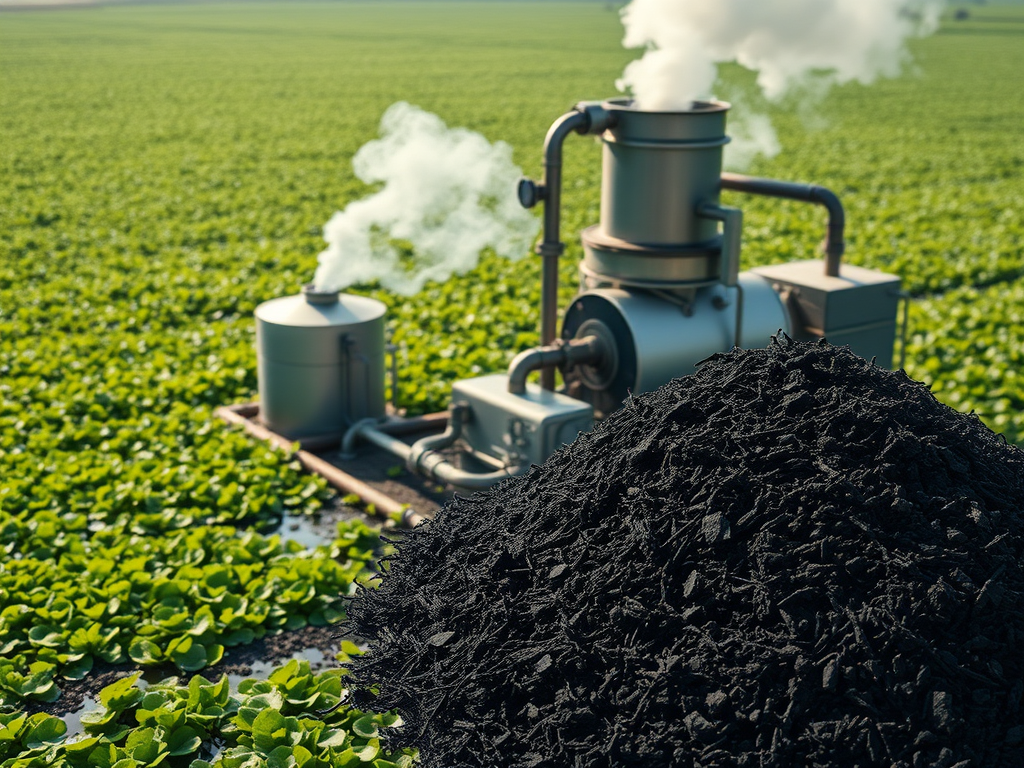
The global demand for sustainable solutions is growing, and with it, the focus on converting waste materials into valuable resources. A new study by Shushree Prachi Palai, Soumyaranjan Senapati, Sthitiprajna Muduli, Alok Kumar Panda, Tapan Kumar Bastia, and Pankaj Kumar Parhi, published in the journal BiomassBiomass is a complex biological organic or non-organic solid product derived from living or recently living organism and available naturally. Various types of wastes such as animal manure, waste paper, sludge and many industrial wastes are also treated as biomass because like natural biomass these More and Bioenergy, investigates a promising approach: transforming the abundant algal blooms from shrimp farming into high-quality biocharBiochar is a carbon-rich material created from biomass decomposition in low-oxygen conditions. It has important applications in environmental remediation, soil improvement, agriculture, carbon sequestration, energy storage, and sustainable materials, promoting efficiency and reducing waste in various contexts while addressing climate change challenges. More. Using the L9 Taguchi method to optimize the pyrolysisPyrolysis is a thermochemical process that converts waste biomass into bio-char, bio-oil, and pyro-gas. It offers significant advantages in waste valorization, turning low-value materials into economically valuable resources. Its versatility allows for tailored products based on operational conditions, presenting itself as a cost-effective and efficient More process, the authors found a strategic way to turn a common environmental problem into a beneficial material for environmental remediation and agriculture.
This research highlights that the quality and yield of biochar from algal waste are highly dependent on three key pyrolysis parameters: temperature, heating rate, and residence timeResidence time refers to the duration that the biomass is heated during the pyrolysis process. The residence time can influence the properties of the biochar produced. More. The study used an L9 Taguchi orthogonal array to test nine different combinations of these parameters, revealing how each one influences the final product. A consistent finding across the experiments was that as the pyrolysis temperature increased from 450°C to 650°C, the biochar yield decreased. This is a common trend in biomass pyrolysis, as higher temperatures promote greater decomposition and the release of volatile matterVolatile matter refers to the organic compounds that are released as gases during the pyrolysis process. These compounds can include methane, hydrogen, and carbon monoxide, which can be captured and used as fuel or further processed into other valuable products. More. The study found that one of the nine experimental combinations, labeled A7, yielded the highest percentage of biochar at 70.5%. This was achieved at the lowest temperature tested, 450°C, with a heating rate of 15°C/min and a residence timeThis refers to the amount of time that the biomass is heated during the pyrolysis process. The residence time can influence the characteristics of the biochar, such as its porosity and surface area. More of 90 minutes.
While temperature was the most influential factor for yield, the study also showed that other parameters had a significant impact on biochar properties. For instance, the research identified another optimal combination of parameters, labeled A2, that produced biochar with a significantly larger surface area. This sample, created at 550°C with a heating rate of 10°C/min and a residence time of 90 minutes, exhibited the highest surface area at 53.382 m²/g. A large surface area is a critical feature for applications like heavy metal removal, as it provides more sites for pollutants to adsorb onto.
The findings also provide insight into the unique properties of biochar derived from algal biomass compared to traditional plant-based biomass. Due to its origin from shrimp ponds, the algal biochar contains a high percentage of inorganic elements like phosphorus, potassium, calcium, and magnesium. This mineral-rich composition gives it unique advantages for applications like soil amendmentA soil amendment is any material added to the soil to enhance its physical or chemical properties, improving its suitability for plant growth. Biochar is considered a soil amendment as it can improve soil structure, water retention, nutrient availability, and microbial activity. More, where it can improve nutrient retention and microbial activity. Conversely, while the algal biochar had a lower carbon content than lignocellulosic biochar, it possessed higher pHpH is a measure of how acidic or alkaline a substance is. A pH of 7 is neutral, while lower pH values indicate acidity and higher values indicate alkalinity. Biochars are normally alkaline and can influence soil pH, often increasing it, which can be beneficial More, nitrogen, and ashAsh is the non-combustible inorganic residue that remains after organic matter, like wood or biomass, is completely burned. It consists mainly of minerals and is different from biochar, which is produced through incomplete combustion. Ash Ash is the residue that remains after the complete More content. The study’s ability to tailor biochar with specific properties, whether for high yield or high surface area, underscores the potential for this material to be customized for various applications, from wastewater treatment to soil enhancement.
SOURCE: Palai, S. P., Senapati, S., Muduli, S., Panda, A. K., Bastia, T. K., & Parhi, P. K. (2026). Sustainable biochar production from shrimp pond algal waste: Optimization of pyrolysis parameters using the L9 Taguchi method. Biomass and Bioenergy, 204, 108401.



Leave a Reply