
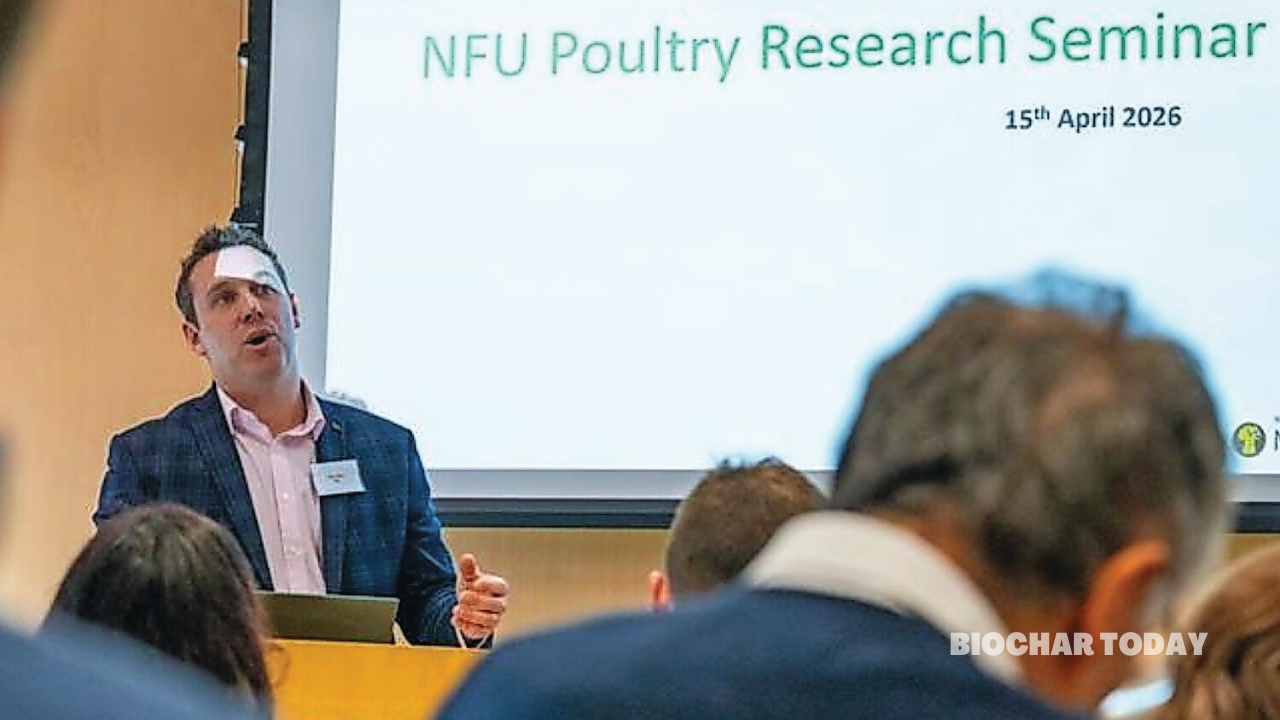
The National Farmers’ Union (NFU) hosted its eighth annual Poultry Research Seminar at its Stoneleigh headquarters in the United Kingdom, bringing together academic researchers and industry stakeholders to align scientific advancements with practical on-farm needs. Among the primary innovations discussed were emerging trials exploring the dual-benefit applications of stable, carbon-rich biomassBiomass is a complex biological organic or non-organic solid product derived from living or recently living organism and available naturally. Various types of wastes such as animal manure, waste paper, sludge and many industrial wastes are also treated as biomass because like natural biomass these More derivatives within livestock management. Specifically, a dedicated session led by researchers highlighted how integrating wood-based biocharBiochar is a carbon-rich material created from biomass decomposition in low-oxygen conditions. It has important applications in environmental remediation, soil improvement, agriculture, carbon sequestration, energy storage, and sustainable materials, promoting efficiency and reducing waste in various contexts while addressing climate change challenges. More into poultry operations serves as an effective mechanism for both environmental sustainability and practical waste management.
The prominent operational challenge addressed by this research is the environmental vulnerability associated with poultry litter management, particularly regarding nitrogen retention and chemical leachingLeaching is the process where nutrients are dissolved and carried away from the soil by water. This can lead to nutrient depletion and environmental pollution. Biochar can help reduce leaching by improving nutrient retention in the soil. More. Traditional composting of nutrient-rich poultry waste frequently results in substantial nitrogen loss through run-off and gaseous emissions, which simultaneously degrades the agricultural value of the end product and presents localized ecological hazards. Furthermore, livestock producers face mounting pressure to navigate stringent national greenhouse gas mitigation targets without compromising farm-level financial efficiency or escalating the transmission risks of antimicrobial resistance within the flock environment.
Addressing these integrated challenges, Professor Colin Snape and Associate Professor Helen West from the University of Nottingham detailed the deliberate addition of wood-based biochar to poultry litter systems. The material’s dense, highly porous structure acts as a functional storage medium that physically adsorbs and locks in chemical elements during the active composting phase. This targeted structural intervention alters the standard decomposition trajectory of the waste material, providing a stable matrix that alters how critical compounds interact within the organic pile.
The documented outcomes of this University of Nottingham study demonstrate that treating poultry litter with wood-based biochar effectively stops nitrogen from leaching out of the compost pile, preserving crucial nutrients within the organic matrix. The resulting material provides a slow-release format for potassium, maximizing its long-term viability as a high-value soil amendmentA soil amendment is any material added to the soil to enhance its physical or chemical properties, improving its suitability for plant growth. Biochar is considered a soil amendment as it can improve soil structure, water retention, nutrient availability, and microbial activity. More that improves moisture retention. Crucially, the researchers verified that this composting process did not exacerbate the proliferation of antimicrobial resistance, offering a safe path forward. From a macro perspective, scaling this application to produce two million tonnes of biochar could meet 10 percent of the United Kingdom’s overarching greenhouse gas target.



Leave a Reply