
Key Takeaways
- Adding pyrolyzed organic matter to soils reduces harmful greenhouse gas warming potential, though its mitigation efficiency is naturally lower in harsh, dry environments.
- A comprehensive analysis reveals that biocharBiochar is a carbon-rich material created from biomass decomposition in low-oxygen conditions. It has important applications in environmental remediation, soil improvement, agriculture, carbon sequestration, energy storage, and sustainable materials, promoting efficiency and reducing waste in various contexts while addressing climate change challenges. More lowers carbon dioxide emissions by 8% in drylands compared to an 18% reduction observed in wetter climates.
- Global methane emissions from soil are suppressed by 21% in arid regions and 38% in non-arid areas following the application of these carbon-rich materials.
- Nitrous oxide gas releases from agricultural fields drop by approximately 33% in arid zones and 40% in more humid global farming environments. PDF
- Matching specific manufacturing temperatures and local agricultural waste streams is essential to optimize soil health and prevent nutrient locking in alkaline fields.
The international scientific community increasingly recognizes that arid and semi-arid landscapes are uniquely vulnerable to climate change, accounting for a massive 41% of the Earth’s land surface and producing over half of the global food supply. These fragile agricultural systems suffer from severe environmental limitations, including low natural soil organic matter, high baseline salinity, alkaline pHpH is a measure of how acidic or alkaline a substance is. A pH of 7 is neutral, while lower pH values indicate acidity and higher values indicate alkalinity. Biochars are normally alkaline and can influence soil pH, often increasing it, which can be beneficial More, and highly erratic rainfall regimes. Traditional farming practices in these zones often rely on high-input synthetic nitrogen fertilizer regimes to close persistent yield gaps, which inadvertently drives up the release of potent greenhouse gases like nitrous oxide. While pyrolyzed biomassBiomass is a complex biological organic or non-organic solid product derived from living or recently living organism and available naturally. Various types of wastes such as animal manure, waste paper, sludge and many industrial wastes are also treated as biomass because like natural biomass these More, or biochar, has emerged globally as a strategic soil amendmentA soil amendment is any material added to the soil to enhance its physical or chemical properties, improving its suitability for plant growth. Biochar is considered a soil amendment as it can improve soil structure, water retention, nutrient availability, and microbial activity. More capable of locking away carbon, historically only about 3% of all scientific literature has focused directly on evaluating its performance under the harsh conditions of true drylands.
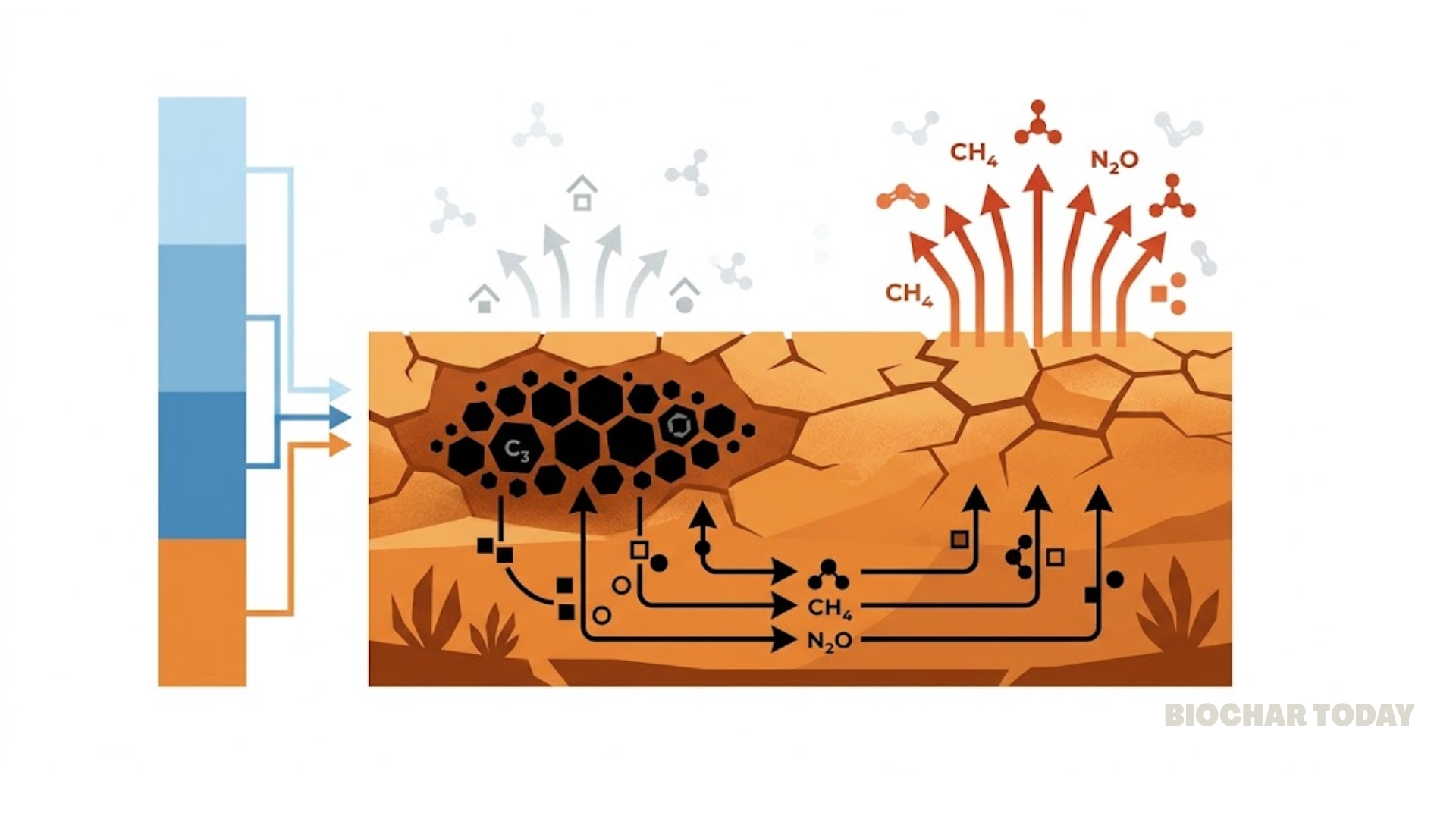
To address this severe knowledge gap, researchers synthesized data from over 120 global papers to compare how the biophysical constraints of dry soils alter carbon and nitrogen gas fluxes. The quantitative evidence confirmed that biochar successfully moderates the three primary agricultural greenhouse gases, but reveals a distinct reduction in performance when moving from humid to arid environments. Statistically, the reduction in soil carbon dioxide emissions is significantly lower in dry environments, dropping from an 18% mitigation rate down to just 8%. Similarly, net methane emissions are suppressed by 21% in drylands compared to 38% elsewhere, while nitrous oxide emissions drop by 33% in arid systems versus 40% in wetter geographical regions. These attenuated mitigation rates are directly modulated by local soil properties, application rates, and the complex chemistry of dryland soils.
The underlying physical, chemical, and biological mechanisms controlling these gas fluxes are tied directly to how biochar alters the microscopic soil structure and shifts microbial behavior. Biochars are characterized by an incredibly high surface area and large internal porosityPorosity of biochar is a key factor in its effectiveness as a soil amendment and its ability to retain water and nutrients. Biochar’s porosity is influenced by feedstock type and pyrolysis temperature, and it plays a crucial role in microbial activity and overall soil health. Biochar More, which physically improves soil aeration and enhances oxygen diffusion when mixed into compacted or sandy soils. Biochemically, this increased oxygen flow alters the local redox conditions and buffers the soil pH, creating an environment that favors the process of nitrification over denitrification. By altering these pathways, the amendment suppresses the formation of intermediate nitrous oxide gas and promotes the complete reduction of nitrogen to harmless dinitrogen gas. Concurrently, the enhanced soil drainage and aeration successfully reduce the abundance of anaerobic, methane-producing archaea while supporting aerobic methanotrophic bacteria that actively consume and oxidize methane directly within the soil matrix.
Despite these clear physical benefits, the study highlights that managing biochar in alkaline and saline dryland landscapes requires strict precision to avoid counterproductive agricultural outcomes. For example, biochars manufactured at low pyrolysisPyrolysis is a thermochemical process that converts waste biomass into bio-char, bio-oil, and pyro-gas. It offers significant advantages in waste valorization, turning low-value materials into economically valuable resources. Its versatility allows for tailored products based on operational conditions, presenting itself as a cost-effective and efficient More temperatures retain highly localized fractions of easily degradable, labile carbon. When applied to carbon-depleted arid soils, this temporary carbon source can trigger an intense surge in microbial activity known as a positive priming effect, which actually accelerates the short-term decomposition of native soil organic matter and temporarily increases carbon dioxide losses. Furthermore, if the chemical profile of the biochar is mismatched with alkaline soils, it can worsen regional crop nutrient deficiencies by locking away vital phosphorus or creating severe nitrogen limitations. Ultimately, this data-driven framework establishes that integrating high-temperature, highly stable aromatic biochars with local waste streams, such as underutilized date palm residues, provides a scalable circular economy pathway to restore soil health and lower the global warming potential of sensitive agricultural zones.
Source: Al-Ismaily, S., Lal, R., Kuzyakov, Y., Chorover, J., Ba Abood, F., Al Maghatasi, B., & Blackburn, D. (2026). Biochar raises soil health and reduces greenhouse gas emissions in arid lands. Frontiers in Soil Science, 6, 1740397.




Leave a Reply