

Key Takeaways
- BiocharBiochar is a carbon-rich material created from biomass decomposition in low-oxygen conditions. It has important applications in environmental remediation, soil improvement, agriculture, carbon sequestration, energy storage, and sustainable materials, promoting efficiency and reducing waste in various contexts while addressing climate change challenges. More improves the fertility and overall nutrient retention of agricultural soils by boosting its chemical storage capacity.
- Computer models can accurately simulate how different types of biochar alter soil properties without requiring years of field testing.
- Burning raw biomassBiomass is a complex biological organic or non-organic solid product derived from living or recently living organism and available naturally. Various types of wastes such as animal manure, waste paper, sludge and many industrial wastes are also treated as biomass because like natural biomass these More at higher temperatures creates a more porous structure that directly provides more areas to hold essential nutrients.
- Selecting biochar with a lower total surface area prevents it from sealing up the microscopic pathways that plants rely on.
- Surprisingly, adding biochar that already possesses an extremely high nutrient capacity can backfire by competing with the surrounding soil.
The study, published in the journal Scientific Reports by lead author Hang Yang and a collaborative team of Chinese researchers, addresses a critical gap in contemporary agricultural science. Biochar has long been recognized as an environmentally friendly soil amendmentA soil amendment is any material added to the soil to enhance its physical or chemical properties, improving its suitability for plant growth. Biochar is considered a soil amendment as it can improve soil structure, water retention, nutrient availability, and microbial activity. More and carbon sequestration agent capable of altering the physical and chemical properties of farmland. Specifically, it enhances the soil cation exchange capacity, which serves as the primary indicator for evaluating soil fertility and nutrient retention. However, conventional soil improvement experiments suffer from long operational cycles and wide geographic distribution, requiring a prohibitive amount of time and physical resources to evaluate systematically. By compiling a heterogeneous dataset of two hundred and twenty-one experimental groups from published literature, the authors successfully trained advanced computer algorithms to map the complex, nonlinear interactions between initial soil conditions and biochar characteristics.
The predictive findings reveal that the categorical gradient boosting model outpaces other machine learning architectures, delivering an exceptionally high predictive accuracy. While models like deep neural networks suffered from training fluctuations and poor stability on small datasets, the tree-based gradient boosting system captured subtle data relationships effectively. The statistical evaluation proved that the initial chemical state of the soil remains the primary baseline factor for determining post-amendment nutrient capacity. More importantly, the model successfully isolated how individual production variables dictate final agricultural performance. The findings confirm that the chemical composition and structural exposure of the biochar are heavily dependent on the exact thermal conditions maintained during the oxygen-depleted processing phase.
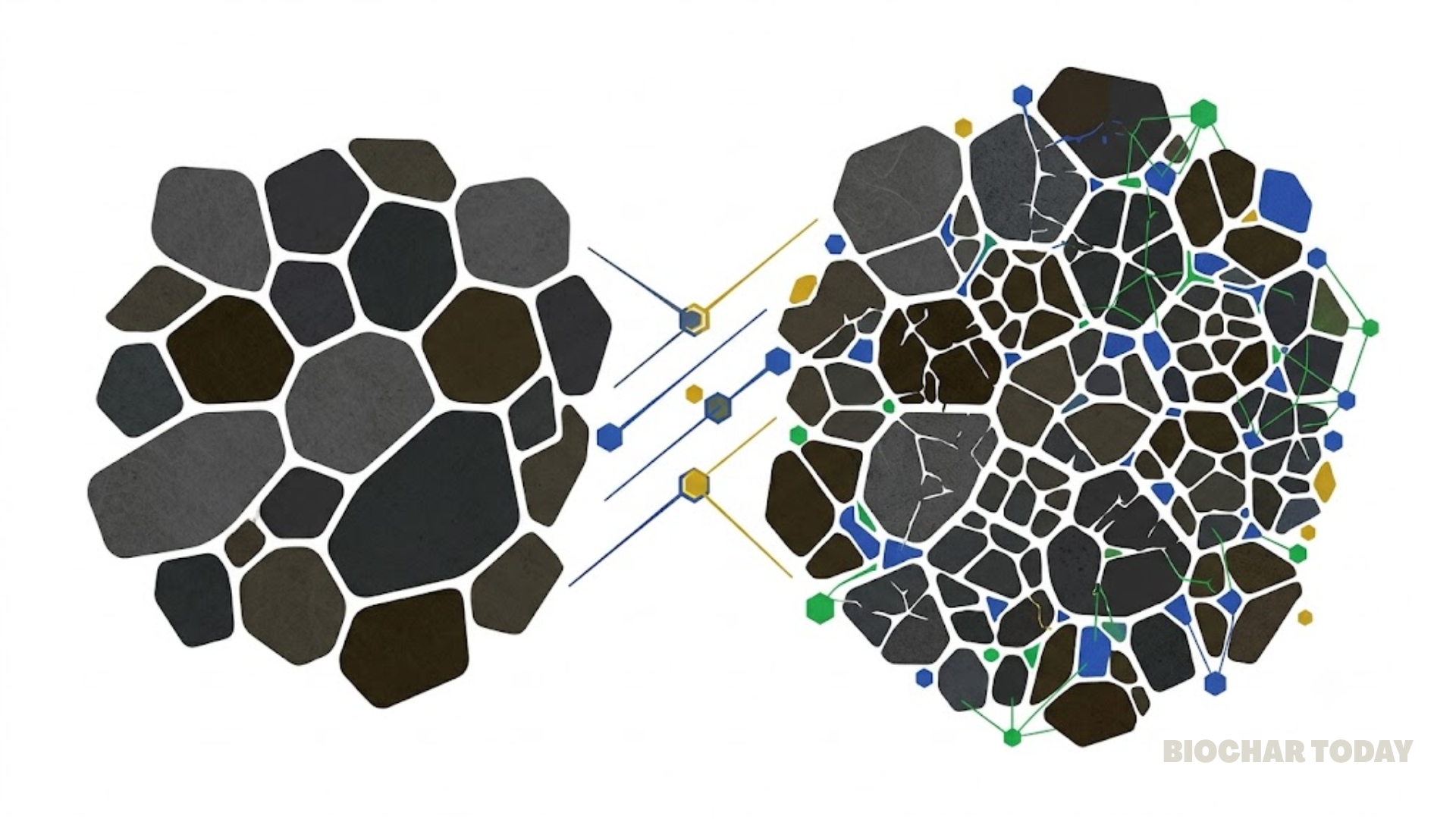
Among the primary technical revelations, the research indicates that the internal processing temperature used to burn the biomass is a key driver of positive soil changes. Raising the temperature during production facilitates the release of volatile compounds from the raw organic materials. This thermal release creates a highly developed internal pore structure, boosting the physical surface area and exposing critical oxygen-containing functional groups like carboxyl groups. These exposed molecular zones provide the necessary negative charge sites to attract and retain vital nutrients within the soil matrix. The model confirms that biochar manufactured at lower temperatures contributes almost nothing to the improvement of soil nutrient retention, whereas materials processed at higher intensities yield a substantial positive influence.
Conversely, the model identified critical physical thresholds where additional biochar application yields diminishing marginal returns or outright negative consequences. While a larger specific surface area initially helps form organic-inorganic complexes with existing soil minerals to enhance total negative charge, the trend reverses once the surface area exceeds fifty square meters per gram. Past this threshold, the extra area consists primarily of inert carbon structures that lack functional chemical groups, offering minimal added benefit. Similarly, an application rate of just one percent by weight represents a distinct inflection point for field management. Increasing the application volume beyond this one percent threshold slows the rate of improvement dramatically because excessive carbon particles aggregate together, blocking natural soil pores and reducing the active area available for nutrient interaction.
The most striking result of the data analysis is a counterintuitive relationship regarding the inherent nutrient capacity of the biochar itself. The model indicates that while biochar with a low internal capacity interacts cooperatively with soil colloids to adsorb vital nutrients, applying biochar that possesses a capacity exceeding forty centimoles per kilogram actually reduces the overall soil performance. This phenomenon occurs because an excessively charged carbon amendment competes strongly for the limited cations dissolved in the surrounding soil solution. This aggressive chemical competition displaces the nutrients that were originally bound to the natural soil particles, or alternatively prompts the material to obstruct the native exchange units of the field. Consequently, the authors conclude that maximizing soil enhancement requires a balanced selection of high-temperature biochar tailored precisely below these physical saturation limits.
Source: Yang, H., Zhao, C., He, H., Lv, X., Wang, P., Zhi, M., Ma, B., & Chen, A. (2026). Prediction of the effect of biochar on soil CEC improvement based on machine learning. Scientific Reports.




Leave a Reply