

Key Takeaways
- BiocharBiochar is a carbon-rich material created from biomass decomposition in low-oxygen conditions. It has important applications in environmental remediation, soil improvement, agriculture, carbon sequestration, energy storage, and sustainable materials, promoting efficiency and reducing waste in various contexts while addressing climate change challenges. More speeds up electron exchange during pollutant cleanup and energy production better than more conductive carbon materials.
- Its strong electron transfer abilities come directly from active chemical groups and persistent free radicals formed during biomassBiomass is a complex biological organic or non-organic solid product derived from living or recently living organism and available naturally. Various types of wastes such as animal manure, waste paper, sludge and many industrial wastes are also treated as biomass because like natural biomass these More heating.
- Testing methods show vastly different electron transfer capacities because of testing times and chemical access to deep pores.
- Natural weathering breaks biochar into tiny mobile particles and adds oxygen, which constantly changes its electron transfer behavior over time.
- Blending different organic wastes during heating, combined with computer optimization, creates high-performing biochars without costly chemical treatments.
In a comprehensive review published in the journal Biochar, researchers Shasha Li, Zimeng Zhang, Yanling Ren, Fan Lü, Xiaoying Hu, Zhenhan Duan, Lili Yang, Jianwei Du, Pinjing He, Mingyang Zhang, and Yong Wen analyzed why biochar can outperform more traditional carbon materials in driving chemical and biological electron transfer. Large-scale deployment of biochar has often been constrained by its lower specific surface area and electrical conductivity compared to synthetic activated carbonActivated carbon is a form of carbon that has been processed to create a vast network of tiny pores, increasing its surface area significantly. This extensive surface area makes activated carbon exceptionally effective at trapping and holding impurities, like a molecular sponge. It is commonly More, carbon nanotubes, or graphene. Conventional post-production modifications can offset these physical limitations, but they frequently introduce high economic costs, energy consumption, and secondary pollution risks. To resolve this dilemma, the authors evaluated how the inherent chemical structure of biochar provides a distinct operational advantage through its unique electron storage and exchange capabilities.
The synthesis showed that biochar serves as an effective electron conduit and buffer during the breakdown of hazardous pollutants and the production of biogas. Even biochars exhibiting low electrical conductivity outmatched highly conductive graphite and granular activated carbon in speeding up microbial degradation of organic contaminants. In abiotic reaction environments, biochar facilitated the chemical transformation of chlorinated compounds at efficiencies rivaling zero-valent iron while exceeding the performance of mineral reductants such as magnetite, pyrite, and mackinawite. When utilized for advanced oxidation processes, biochar produced reactive oxygen radicals at a rate of 9.5 nanomoles per minute, significantly outperforming natural dissolved organic matter and pyrite. Furthermore, its surface groups reduced activation energy barriers for photocatalytic carbon dioxide conversion, delivering carbon monoxide yields more than tenfold greater than those of advanced graphene.
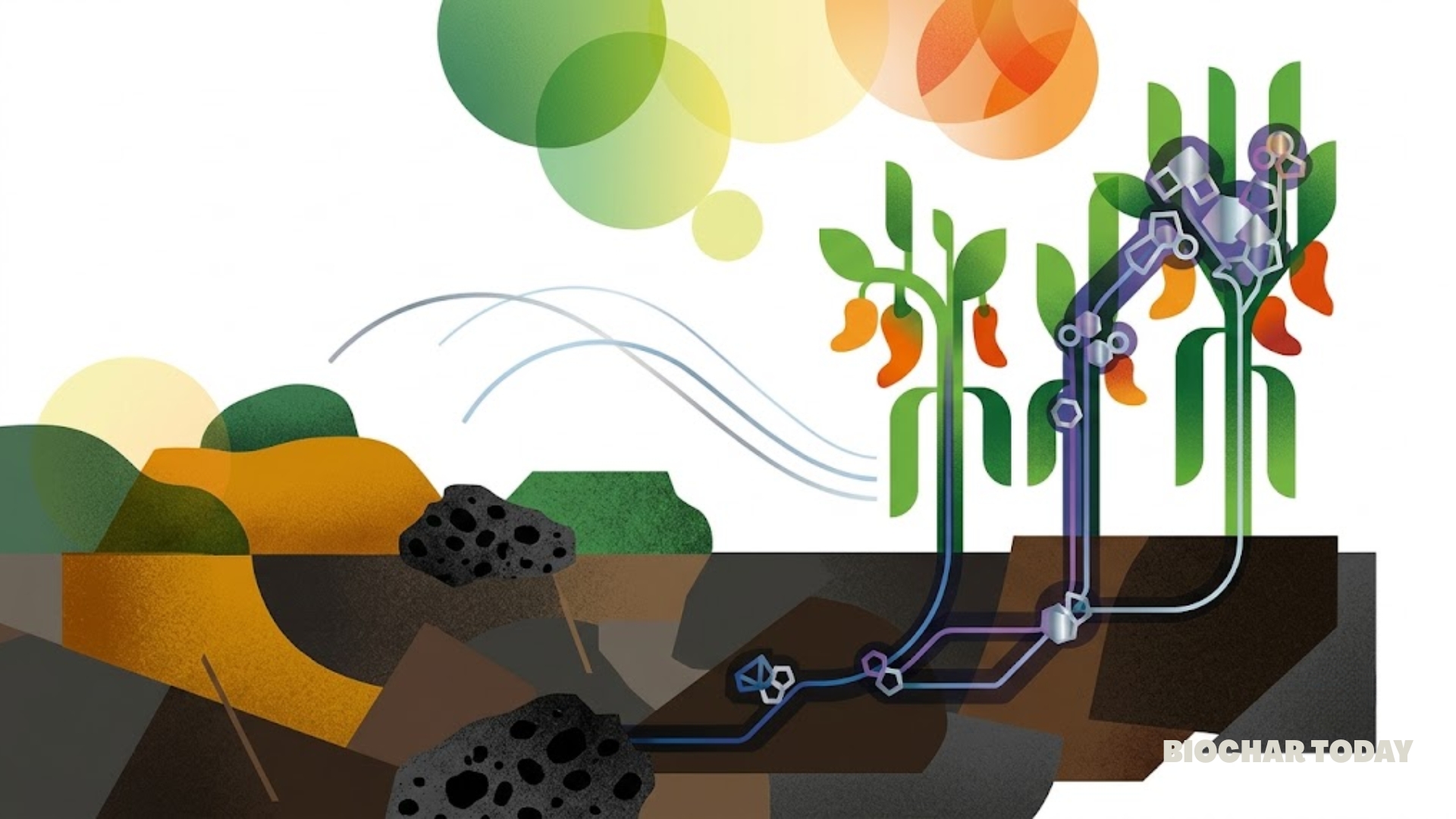
This redox superiority stems from redox-active moieties embedded within the carbon matrix during pyrolysisPyrolysis is a thermochemical process that converts waste biomass into bio-char, bio-oil, and pyro-gas. It offers significant advantages in waste valorization, turning low-value materials into economically valuable resources. Its versatility allows for tailored products based on operational conditions, presenting itself as a cost-effective and efficient More. Key functional structures include quinone and hydroquinone pairs, nitrogen-doped rings, conjugated carbon systems, mineral inclusions, and stable, long-lived free radicals. While electrical conductors simply allow current to flow through a circuit, biochar acts as a dynamic electron buffer that can accept, store, and donate electrons according to environmental demands. However, the real-world performance depends heavily on the thermodynamic redox potential differences between these chemical groups and target contaminants, as well as the physical accessibility of the inner pore walls.
The authors systematically compared current analytical methods used to quantify electron donating and accepting capacities. Chemical titration and equilibration techniques capture values up to 6.41 millimoles of electrons per gram by allowing reagents to diffuse into tiny micropores over extended timeframes. Conversely, mediated electrochemical oxidation and reduction provide rapid, real-time current measurements but yield lower apparent values, typically below two millimoles of electrons per gram, because reaction durations are too brief for complete internal penetration. Microbiological assays utilizing specialized bacteria provide a direct measure of bioavailable electron transfer, reflecting how living organisms interact with the material.
The review also tracked how biochar evolves once introduced into open environmental systems. Long-term weathering from rain, sunlight, and freeze-thaw cycles causes physical fragmentation, generating mobile colloids and dissolved black carbon that travel through soil and water. Exposure to atmospheric oxygen and microbes introduces additional oxygen-bearing groups onto the particle surfaces, altering overall charge and reactivity. Meanwhile, natural mineral coatings and microbial films can block outer pore openings, shielding interior redox sites from participating in chemical reactions.
To produce tailored materials economically, the researchers emphasized co-pyrolyzing diverse organic waste streams, such as blending agricultural biomass with sludge. Applying machine learning and multi-objective optimization algorithms enables engineers to tune internal chemical compositions and pore designs precisely, balancing environmental remediation performance against material costs and lifecycle emissions.
Source: Li, S., Zhang, Z., Ren, Y., Lü, F., Hu, X., Duan, Z., Yang, L., Du, J., He, P., Zhang, M., & Wen, Y. (2026). Driving biochar applications via intrinsic redox superiority: electron transfer mechanisms, quantification, aging effects, and design strategies. Biochar, 8, 87.



Leave a Reply