
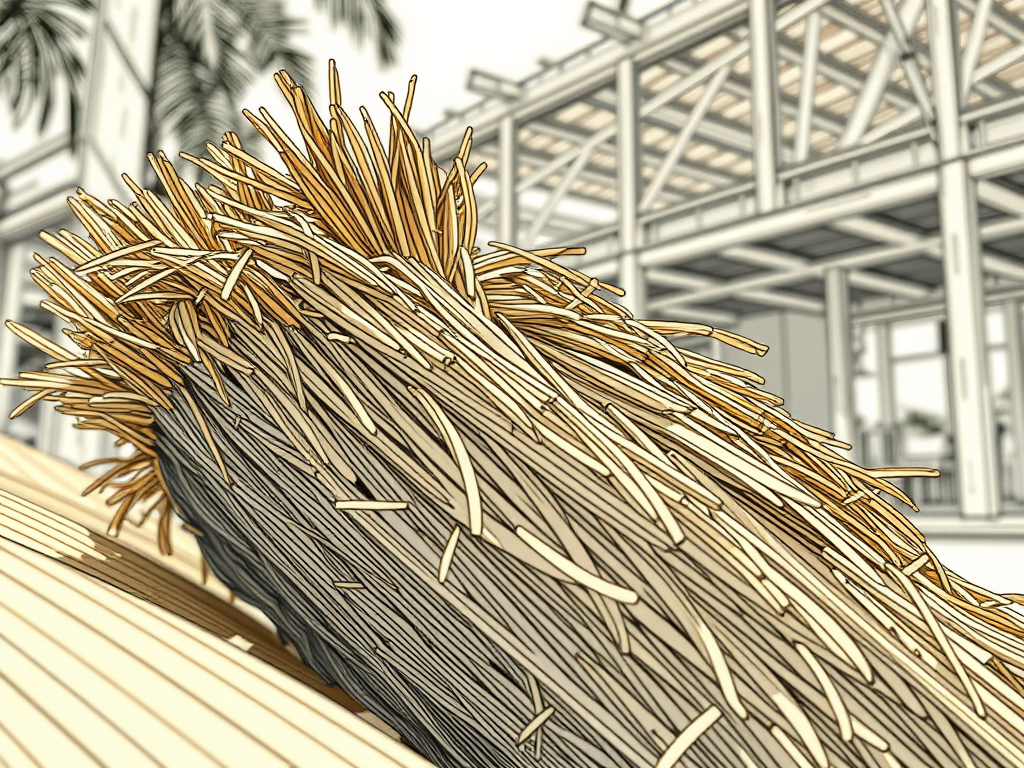
The construction industry is a major contributor to global pollution, prompting a critical need for sustainable alternative materials. Natural fibers are gaining traction as reinforcements in building materials due to their eco-friendly nature. Among these, Curauá fiber (CF), derived from the Amazonian plant Ananas erectifolius, shows significant promise, boasting a high cellulose content of 70%. However, a key challenge in using natural fibers like CF in composites is their high water absorption and incompatibility with hydrophobic polymer matrices, which can lead to reduced mechanical performance. To address these limitations, researchers often modify fiber surfaces through physical or chemical treatments. In a recent study published in Sugar Tech, Ganesan et al., explored a novel and environmentally friendly approach: treating Curauá fibers with an aqueous sodium bicarbonate (NaHCO_3) solution. This research aimed to enhance the mechanical, thermal, and morphological properties of CF when combined with sugarcane biocharBiochar is a carbon-rich material created from biomass decomposition in low-oxygen conditions. It has important applications in environmental remediation, soil improvement, agriculture, carbon sequestration, energy storage, and sustainable materials, promoting efficiency and reducing waste in various contexts while addressing climate change challenges. More (SCB) and polylactic acid (PLA) to create sustainable hybrid green composites.
The study focused on pretreating CF with a 10 wt% NaHCO_3 solution for varying durations: 0, 12, 24, 48, 60, 120, and 240 hours. The treated fibers were then incorporated into PLA-based hybrid biocomposites, along with a constant 5 wt% of sugarcane biochar derived from agricultural waste. The mechanical properties, including tensile, flexural, hardness, and impact strength, were rigorously evaluated for each treatment group.
The findings revealed that the mechanical properties of the composites improved significantly with increased treatment duration, up to 60 hours. At this optimal 60-hour mark, tensile strength peaked at 56.32 MPa, and flexural strength reached 74.69 MPa. This improvement is attributed to the effective removal of hemicellulose and other surface impurities, which enhanced the interfacial adhesion between the fibers and the PLA matrix. The researchers observed that the initial 12 and 24-hour treatments showed only minimal modification, resulting in lower tensile (36.98 MPa) and flexural (43.25 MPa) strengths. However, by 48 hours, noticeable improvements were seen, with tensile strength at 46.47 MPa and flexural strength at 62.54 MPa.
Beyond 60 hours, a decline in mechanical properties was observed. For instance, at 120 hours, tensile strength dropped to 49.85 MPa and flexural strength to 72.15 MPa, further decreasing to 47.81 MPa and 70.54 MPa, respectively, at 240 hours. This suggests that excessive treatment caused the over-removal of essential fiber constituents, leading to brittleness and reduced performance.
The study also investigated thermal properties using Differential Scanning Calorimetry (DSC) and Thermogravimetric Analysis (TGA). DSC analysis of NaHCO_3-treated CF showed a shift in the moisture loss peak from 169°C to 178°C with longer treatment durations, indicating enhanced thermal stability. While enthalpy values initially decreased at shorter durations, they stabilized at 127.2 J/g after 60 hours, confirming structural relaxation and hemicellulose depletion. TGA results further supported the reduction of hemicellulose and lignin content with NaHCO_3 treatment, leading to a lower thermal degradation temperature but significantly increasing char residue (up to 20% at 240 hours), indicating improved fire resistance.
In terms of physical properties, the density of the hybrid biocomposites increased from 1.29 g/cm³ (untreated) to a maximum of 1.44 g/cm³ at 60 hours of NaHCO_3 treatment. This enhancement indicates better fiber-matrix interaction and lower porosityPorosity of biochar is a key factor in its effectiveness as a soil amendment and its ability to retain water and nutrients. Biochar’s porosity is influenced by feedstock type and pyrolysis temperature, and it plays a crucial role in microbial activity and overall soil health. Biochar More. Water absorption significantly decreased from 9.84% (untreated) to 4.26% at 60 hours of NaHCO_3 treatment, indicating lower porosity and stronger interfacial bonding. However, prolonged treatment (120 and 240 hours) led to an increase in water absorption due to fiber degradation and enhanced void content. This comprehensive research highlights that a 48-60 hour NaHCO_3 treatment is optimal for modifying Curauá fiber surfaces, leading to improved thermal, mechanical, and moisture resistance properties.
These novel hybrid biocomposites, with their enhanced mechanical properties, lower water absorption, and better interface adhesion, hold potential for various structural and non-structural applications, including automotive interiors, furniture, household electronics casings, and eco-friendly construction materials. This sustainable approach offers a cost-effective and environmentally friendly way to utilize agricultural waste for high-performance materials.
Source: Ganesan, V., Chohan, J. S., Gengappan, K., Paramasivam, P., Maranan, R., Lakshmaiya, N., & Shanmugam, S. K. Mechanical and Structural Characterization of Curauá Fiber, Sugarcane Biochar, and Poly(Lactic Acid) Hybrid Green Composites for Sustainable BiomassBiomass is a complex biological organic or non-organic solid product derived from living or recently living organism and available naturally. Various types of wastes such as animal manure, waste paper, sludge and many industrial wastes are also treated as biomass because like natural biomass these More Utilization. Sugar Tech.



Leave a Reply