
Key Takeaways
- Bamboo properties vary across the thickness of the plant wall, with the outer layers containing the highest concentration of fibers and key chemical components.
- One specific bamboo species contains more than 30% lignin in its outer layer, which makes it ideal for conversion into stable carbon products.
- PyrolysisPyrolysis is a thermochemical process that converts waste biomass into bio-char, bio-oil, and pyro-gas. It offers significant advantages in waste valorization, turning low-value materials into economically valuable resources. Its versatility allows for tailored products based on operational conditions, presenting itself as a cost-effective and efficient More of this selected bamboo creates a highly stable, porous material with a large surface area that can hold water and nutrients in agricultural soils.
- Converting this bamboo into high-carbon biocharBiochar is a carbon-rich material created from biomass decomposition in low-oxygen conditions. It has important applications in environmental remediation, soil improvement, agriculture, carbon sequestration, energy storage, and sustainable materials, promoting efficiency and reducing waste in various contexts while addressing climate change challenges. More trapped in the soil helps capture carbon dioxide from the atmosphere over long periods to reduce environmental pollution.
- Utilizing this specific bamboo resource under a planned harvesting cycle is commercially viable and could generate significant financial profit for farmers.
In a manuscript published in Bioresources and Bioproducts, researchers Krisnna Sousa Alves, Tiago Guimarães, Angélica de Cássia Oliveira Carneiro, Ana Márcia Macedo Ladeira Carvalho, Sebastião Renato Valverde, and Marcelo Moreira da Costa evaluated how the natural variations across the plant walls of four bamboo species affect their potential for sustainable agricultural use and bioenergy generation. The team closely examined how the physical, anatomical, and chemical characteristics shift from the outermost layers to the inside parts of the plant wall. Their findings show that these structural variations are critical for choosing the right raw materials to create high-quality biochar to enhance soil health and trap carbon.
The investigation revealed that the structural properties of bamboo are not uniform and show strong gradients across the thickness of the plant wall. The outer peripheral region of the bamboo exhibits the highest fiber wall thickness and the greatest density, which helps the plant withstand natural wind loads. In contrast, the inner layers are much richer in soft storage tissues known as parenchyma cells. Chemically, the peripheral region contains the highest concentration of lignin, while the central and interior zones are dominated by carbohydrates. Among the evaluated species, Guadua chacoensis and Bambusa nutans showed the highest basic densities at the outer edges, reaching 835 and 858 kilograms per cubic meter, respectively, while Dendrocalamus asper recorded the lowest density values.
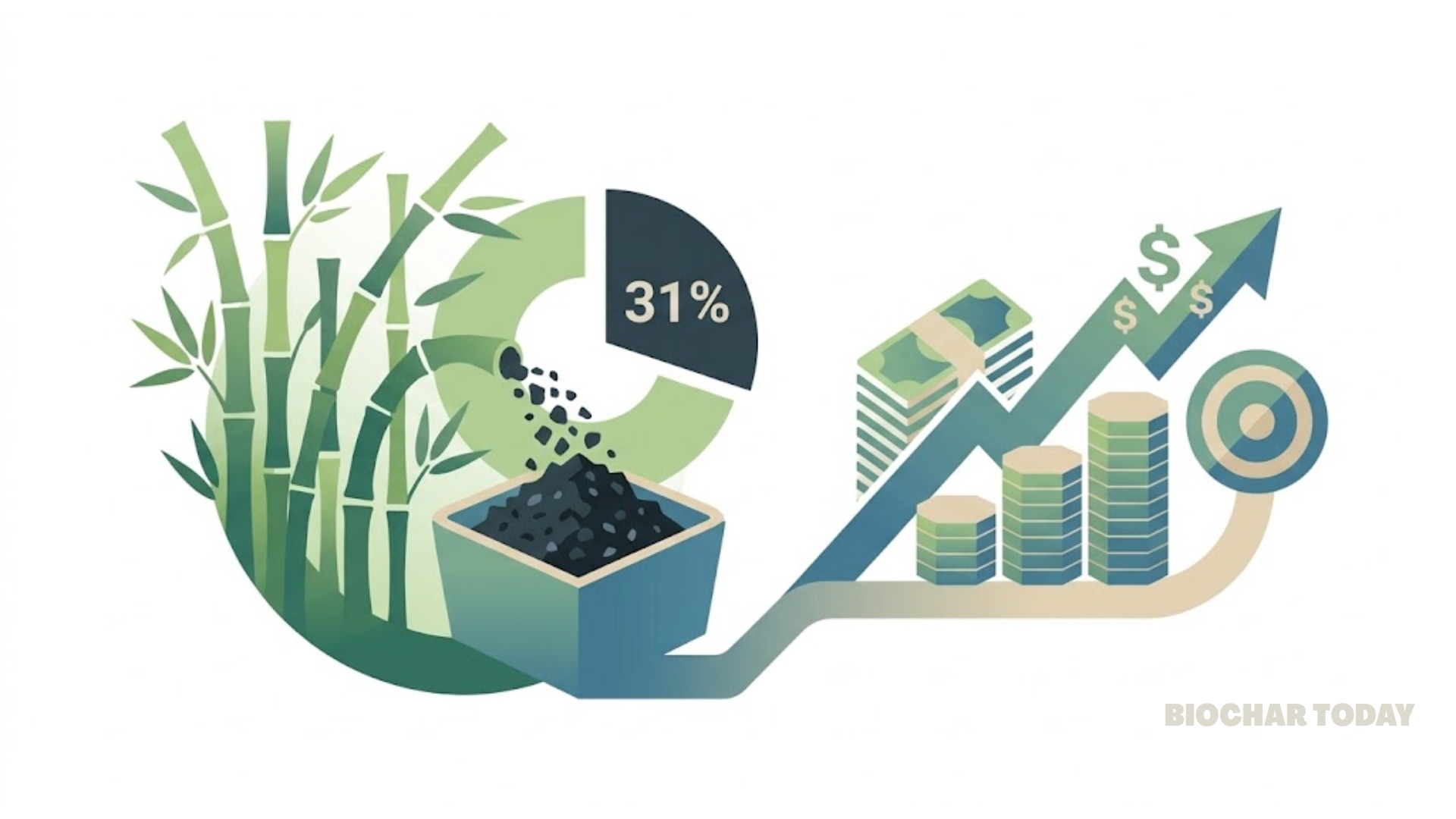
By focusing on chemical composition, the study identified Dendrocalamus strictus as the most promising candidate for high-value biochar production. The outer layer of this species contains a peak lignin concentration of 30.40% and a remarkably low ratio of specific lignin subunits, which delays thermal breakdown and maximizes carbon retention. When processed under controlled high temperatures, this material converts efficiently into a superior biochar, achieving a solid gravimetric yield of 31.14%. The resulting biochar is highly carbonized, boasting an elemental carbon content of 89.66% and a calculated stable fixed carbon content of 84.97%, which represents the resilient portion capable of remaining trapped in agricultural soils for decades without breaking down.
The physical structure of the generated biochar is highly favorable for environmental remediation and soil conditioning due to its extensive network of microscopic pores. It exhibits a high specific surface area of 120.154 square meters per gram and a predominantly mesoporous structure with an average pore diameter of 2.822 nanometers. This porous framework functions like a sponge, which can potentially hold water, capture essential plant nutrients, and provide a welcoming habitat for beneficial soil microbes, though direct field testing is still required to fully validate these crop benefits. Furthermore, its exceptionally low volatile matterVolatile matter refers to the organic compounds that are released as gases during the pyrolysis process. These compounds can include methane, hydrogen, and carbon monoxide, which can be captured and used as fuel or further processed into other valuable products. More and low sulfur content minimize any environmental risks like soil acidification.
A preliminary techno-economic assessment conducted by the authors highlights that commercializing this specific bamboo biomassBiomass is a complex biological organic or non-organic solid product derived from living or recently living organism and available naturally. Various types of wastes such as animal manure, waste paper, sludge and many industrial wastes are also treated as biomass because like natural biomass these More is highly lucrative. Assuming a standardized market price of 120 dollars per ton for agricultural-grade biochar and accounting for all operational costs, the production system generates a clear profit of 88.86 dollars per ton of biochar. When calculated on a larger scale under a sustainable three-year harvesting rotation cycle, this production method translates to an estimated annual profit of 1107 dollars per hectare. Ultimately, the research proves that selecting specific parts of target bamboo species can merge commercial profitability with ecological conservation, offering a viable path forward for green agro-industrial processing.
Source: Alves, K. S., Guimarães, T., Carneiro, A. C. O., Carvalho, A. M. M. L., Valverde, S. R., & Costa, M. M. (2026). Radial variability in bamboo properties: Implications for sustainable biochar production and agricultural applications. Bioresources and Bioproducts, 2(10), 1-31.



Leave a Reply