
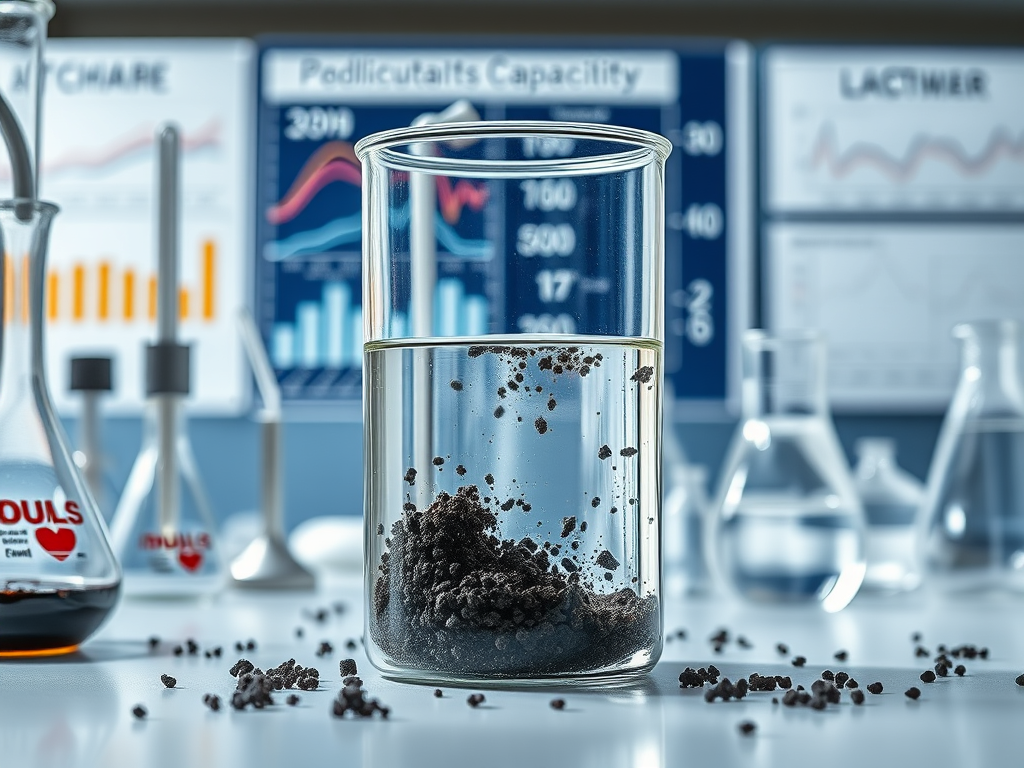
Water contamination by heavy metals such as lead (Pb), cadmium (Cd), copper (Cu), and zinc (Zn) poses a persistent threat to environmental and public health. These pollutants, stemming from sources like industrial discharge, mining, and agricultural runoff, are toxic and accumulate in ecosystems. A comprehensive review, Advances in biochar-based absorbents: Sustainable solutions for heavy metal removal from contaminated water, by Maithili Khamkar and Nita Mehta in the Indian Journal of Chemical Technology , highlights the potential of biocharBiochar is a carbon-rich material created from biomass decomposition in low-oxygen conditions. It has important applications in environmental remediation, soil improvement, agriculture, carbon sequestration, energy storage, and sustainable materials, promoting efficiency and reducing waste in various contexts while addressing climate change challenges. More as an efficient and sustainable solution for water remediation. Biochar is gaining interest due to its low cost, sustainability, diverse feedstockFeedstock refers to the raw organic material used to produce biochar. This can include a wide range of materials, such as wood chips, agricultural residues, and animal manure. More availability, and unique physicochemical properties.
Biochar’s effectiveness as an adsorbent is attributed to its high surface area (typically 100 to 1000 m2/g) and porosityPorosity of biochar is a key factor in its effectiveness as a soil amendment and its ability to retain water and nutrients. Biochar’s porosity is influenced by feedstock type and pyrolysis temperature, and it plays a crucial role in microbial activity and overall soil health. Biochar More (micropores and mesopores), which provide extensive sites for pollutant interaction. Furthermore, the presence of functional groups—such as carboxyl, hydroxyl, and carbonyl groups—is crucial. These groups facilitate key adsorption mechanisms: electrostatic interaction (where negatively charged sites bind metal cations), ion exchange (swapping surface ions like Na+ for toxic metal ions), complexation (forming stable bonds with the metal ions), and precipitation. The properties of biochar are strongly influenced by the feedstock (e.g., agricultural waste, wood chips, marine algae) and pyrolysisPyrolysis is a thermochemical process that converts waste biomass into bio-char, bio-oil, and pyro-gas. It offers significant advantages in waste valorization, turning low-value materials into economically valuable resources. Its versatility allows for tailored products based on operational conditions, presenting itself as a cost-effective and efficient More temperature. For instance, increasing the pyrolysis temperature from 300∘C to 600∘C can significantly increase surface area, with studies showing an increase from 50 m2/g to over 300 m2/g for sugarcane bagasse-derived biochar. However, excessively high temperatures (above 700∘C) may lead to a 50% reduction in surface oxygenated groups, diminishing the functional groups essential for chemisorption processes and metal ion interactions.
While raw biochar is effective, its performance can be greatly enhanced through surface modification techniques such as acid/base activation, metal doping, and gas activation. Treating biochar with acids, like sulfuric acid ( H2SO4), can introduce carboxylic functional groups, promoting ion exchange and leading to a 150% increase in Pb2+ adsorption capacity for corn stalk-derived biochar compared to untreated biochar. Impregnating biochar with metal oxides, such as iron oxide ( Fe2O3), enhances its ability to remove redox-sensitive contaminants like arsenic (As5+) and chromium (Cr6+) through reduction and surface complexation. In a key finding, ZnCl2-activated biochar (BZn7) demonstrated superior adsorption performance compared to unmodified biochar (B7) for emerging organic pollutants like ACE and AMX. The maximum adsorption capacities ( Qmax) derived from the Langmuir model were 332.08 mg/g for ACE and 175.86 mg/g for AMX on BZn7 , dramatically surpassing the 64.99 mg/g and 26.62 mg/g capacities of B7 for the same pollutants. This means the ZnCl2 activation resulted in a 411% increase in ACE adsorption capacity and a 561% increase in AMX adsorption capacity , highlighting the power of chemical modification to create a highly competitive adsorbent.
While single-metal studies often show high removal efficiencies (up to 90% for metals like lead and cadmium in controlled settings) , real-world multi-metal systems present challenges due to competition for limited binding sites. Studies found that lead ions tend to dominate adsorption, followed by copper and zinc, attributed to lead’s larger atomic radius and higher polarizability. The presence of copper and zinc led to a 15-20% reduction in the adsorption capacity of lead compared to its uptake in a single-metal system. Furthermore, the longevity and reusability of biochar is a concern; a study showed that after five regeneration cycles, the adsorption efficiency of biochar for copper and zinc was reduced by nearly 40%. To address these issues, future research should focus on optimizing modifications, developing multi-functional biochars (e.g.,Fe3O4 biochar composites for magnetic separation) , and integrating biochar with existing treatment technologies like electrocoagulation or advanced oxidation processes (AOPs) to maximize contaminant removal and extend its functional lifespan. Ultimately, the advancement of scalable, economically viable, and environmentally sound modification strategies will play a key role in optimizing biochar for diverse wastewater treatment needs.
Source: Khamkar, M., & Mehta, N. (2025). Advances in biochar-based absorbents: Sustainable solutions for heavy metal removal from contaminated water. Indian Journal of Chemical Technology, 32(9), 553–571.



Leave a Reply