
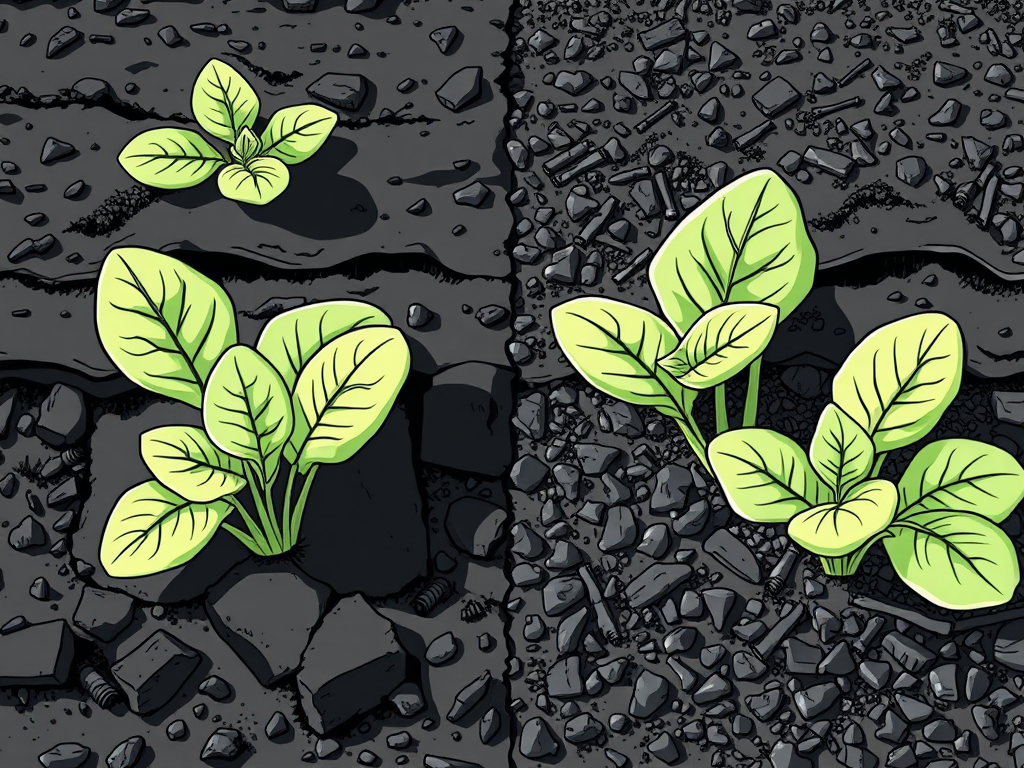
Declining soil fertility is a major challenge in modern agriculture, affecting food production worldwide. A recent study published in Journal of JSCE by Md. Ariful Islam and colleagues explores how biocharBiochar is a carbon-rich material created from biomass decomposition in low-oxygen conditions. It has important applications in environmental remediation, soil improvement, agriculture, carbon sequestration, energy storage, and sustainable materials, promoting efficiency and reducing waste in various contexts while addressing climate change challenges. More and plastic char can enhance soil quality and promote plant growth. By conducting controlled pot experiments, the researchers evaluated the effects of these amendments on soil properties and spinach yield.
Biochar, derived from organic biomassBiomass is a complex biological organic or non-organic solid product derived from living or recently living organism and available naturally. Various types of wastes such as animal manure, waste paper, sludge and many industrial wastes are also treated as biomass because like natural biomass these More, is known for its ability to improve soil health, but the study introduces plastic char—a pyrolyzed product of plastic waste—as an alternative. The research assessed five application rates (ranging from 1 t/ha to 20 t/ha in the first phase and 0.2 t/ha to 1 t/ha in the second phase) for biochar (B), plastic char (P), and their combination (B+P).
The results showed significant improvements in soil properties. Compared to untreated soil, both biochar and plastic char treatments increased pHpH is a measure of how acidic or alkaline a substance is. A pH of 7 is neutral, while lower pH values indicate acidity and higher values indicate alkalinity. Biochars are normally alkaline and can influence soil pH, often increasing it, which can be beneficial More, total organic carbon (TOC), and water holding capacityWater holding capacity is the amount of water that soil can retain. Biochar can significantly increase the water holding capacity of soil, improving its ability to withstand drought conditions and support plant growth. More (WHC). Plastic char, in particular, had a strong effect on soil pH and organic carbon, suggesting its potential as an effective soil amendmentA soil amendment is any material added to the soil to enhance its physical or chemical properties, improving its suitability for plant growth. Biochar is considered a soil amendment as it can improve soil structure, water retention, nutrient availability, and microbial activity. More. Fresh weight biomass (FWB) of spinach doubled with plastic char application, outperforming biochar alone. This finding indicates that both biochar and plastic char can enhance soil fertility at low application levels, making them viable options for sustainable agriculture.
The study suggests that plastic char could serve as a cost-effective alternative to biochar, addressing both soil degradation and plastic waste management. However, further research is needed to assess its long-term environmental impact and potential risks associated with plastic-derived compounds in soil systems. This research highlights their potential to improve soil health and boost crop production, contributing to global food security.
Source: Islam, M. A., Mamun, S. A., Nakagawa, K., & Asakura, H. (2024). Application of biochar and plastic char to increase agricultural soil fertility and evaluation of plant (spinach) growth. Journal of JSCE, 12(2), 24-27045.




Leave a Reply