
Key Takeaways
- Massive Methane Reduction: Adding biocharBiochar is a carbon-rich material created from biomass decomposition in low-oxygen conditions. It has important applications in environmental remediation, soil improvement, agriculture, carbon sequestration, energy storage, and sustainable materials, promoting efficiency and reducing waste in various contexts while addressing climate change challenges. More made from date palm seeds to cattle feed cut methane emissions by 50-59% in a lab simulation.
- More Energy for the Animal: The biochar supplement significantly increased the production of volatile fatty acids (VFAs), which are the main energy source for cattle.
- Better Feed Quality: Predicted energy values, like metabolizable energy (ME) and net energy for lactation (NEL), were all significantly improved compared to the standard diet.
- A “Win-Win” for Waste: The study shows that agricultural waste (date palm seeds) can be “valorized,” or turned into a valuable product that helps solve an environmental problem.
- No Negative Effects Seen: The supplement did not negatively affect key digestion metrics like dry matter or crude fiber degradability in this lab setting.
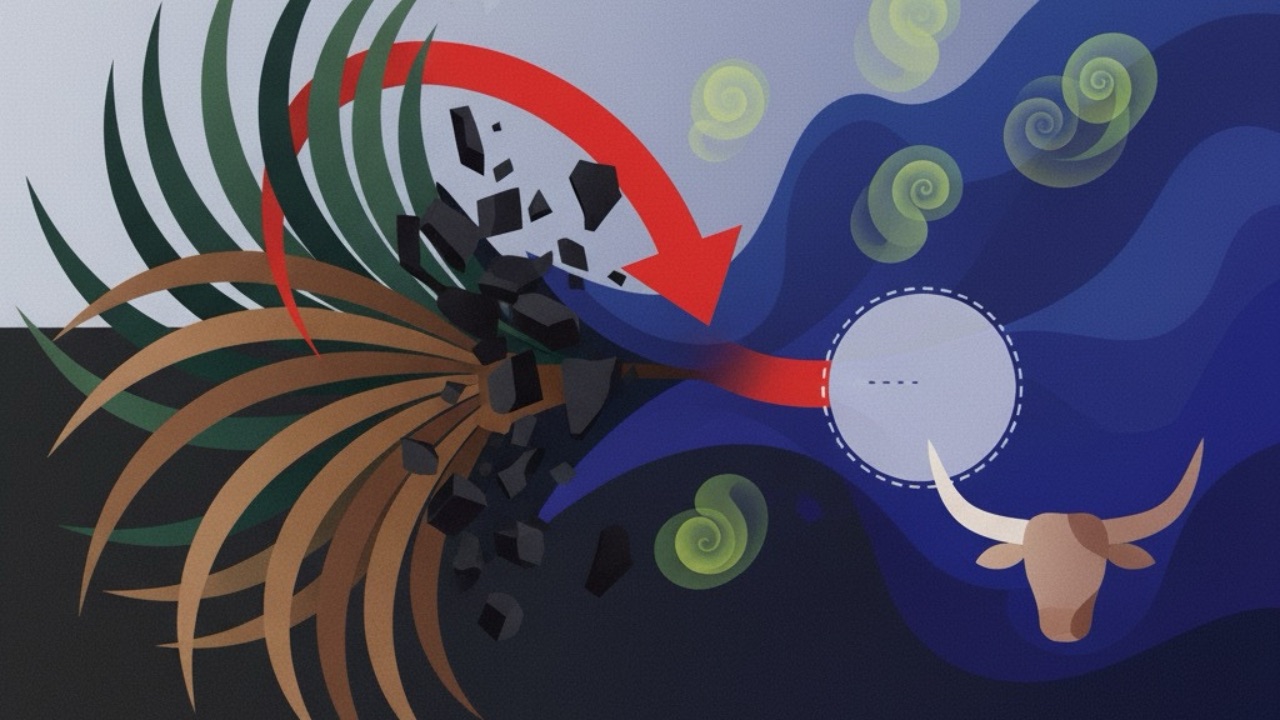
The global livestock industry faces two significant challenges: it’s a huge source of methane, a potent greenhouse gas, and farming creates enormous amounts of waste. What if we could use one problem to help solve the other? This is the focus of a new study by Hesham S. Ghazzawy and colleagues, published in BMC Veterinary Research. They investigated a novel solution: converting waste from date palm cultivation—specifically the seeds—into a “biochar” feed supplement. Their in vitro (lab-based) experiment results are striking, showing that this simple additive can dramatically cut methane emissions while simultaneously boosting key energy metrics for the animal.
Methane (CH4) from livestock is a serious contributor to climate change, accounting for a significant portion of global emissions. This methane is a natural byproduct of digestion in ruminants like cattle. Scientists have long searched for ways to reduce these emissions without harming the animals or their productivity. At the same time, the expanding cultivation of date palms, especially in arid regions, produces millions of tons of waste biomassBiomass is a complex biological organic or non-organic solid product derived from living or recently living organism and available naturally. Various types of wastes such as animal manure, waste paper, sludge and many industrial wastes are also treated as biomass because like natural biomass these More, including seeds, that are often burned or dumped, creating their own pollution problems. The study explores “valorization”—turning this low-value waste into a high-value product. The team created a phoenix dactylifera seed-derived biochar (PSB), a charcoal-like substance, by pyrolyzing (heating) the seeds in a low-oxygen environment.
The researchers tested the biochar by adding it to a standard cattle diet (hay and concentrate) at levels of 1%, 2%, and 4%. They then incubated this feed with rumen fluid collected from cattle to simulate digestion. The impact on methane was immediate and profound. After 48 hours, all PSB-supplemented groups showed a massive reduction in methane production compared to the control group. When measured per unit of dry matter, the 1% PSB diet cut methane by 50.0%, the 2% diet by 53.8%, and the 4% diet by 56.6%. When measured as a percentage of total gas produced, the reductions were even starker: 54.9%, 55.2%, and 58.9%, respectively. Essentially, adding just a small amount of this waste-derived biochar cut methane emissions by more than half.
You might think that less methane means less digestion, but the study found the opposite. Total gas production—a general indicator of fermentation—actually increased in the biochar groups, particularly at the 24-hour mark. This finding suggests the biochar isn’t stopping digestion; it’s shifting it. Rumen microbes produce hydrogen during digestion. This hydrogen can either be used by methanogens to create methane (CH4) or by other microbes to create volatile fatty acids (VFAs). VFAs are the main energy source for cattle, providing up to 75% of their metabolizable energy. The study’s results strongly imply that the biochar helped steer fermentation away from methane production and toward the creation of more useful energy for the animal.
This energy-boosting hypothesis is supported by the other findings. The addition of PSB at all levels (1%, 2%, or 4%) significantly improved the concentration of total volatile fatty acids (TVFA), the animal’s fuel. Consequently, the predicted performance values for the cattle also improved. Metabolizable energy (ME), net energy for lactation (NEL), and short-chain fatty acid (SCFA) concentrations were all significantly higher in the biochar-treated groups compared to the control. The biochar also appeared to benefit microbial protein synthesis , which is essential for animal growth and milk production. In short, the supplement not only tackled the environmental problem but also appeared to improve the nutritional quality and energy yield of the feed itself.
This study presents a compelling win-win scenario: a major agricultural waste product can be repurposed into a sustainable feed supplement that drastically reduces the carbon footprint of livestock while potentially improving nutrient availability. It’s important to note this was an in vitro study, essentially a lab-based “artificial rumen.” The authors call for further in vivo studies—experiments in live animals—to confirm these promising findings, optimize dosages, and test the effects in different species. However, these results open a promising new avenue for sustainable agriculture, turning date palm waste from a pollution challenge into a key tool for climate-friendly cattle farming.
Source: Ghazzawy, H. S., Alqahtani, N. K., Sheikh, A., El Sayed, M. S., Mathew, R. T., Ali-Dinar, H. M., El-Haroun, E., Eissa, E. H., Abd-Elkarim, M. M., & Abdelnour, S. A. (2025). Date palm seed-derived biochar as an environmentally sustainable feed supplement in cattle: impacts on gas production, methane emissions, fermentation parameters and performance predictions. BMC Veterinary Research, 21(624).


![Eucalyptus Wood Waste-Derived Biochar Achieves a Ninety-Eight Percent Removal Efficiency for Benzo[ghi]perylene in Vehicle-Wash Wastewater](https://biochartoday.com/wp-content/uploads/2026/10/SCIENCE-BLOGS-2026-2026-10-19T160523.703.jpg)

Leave a Reply