
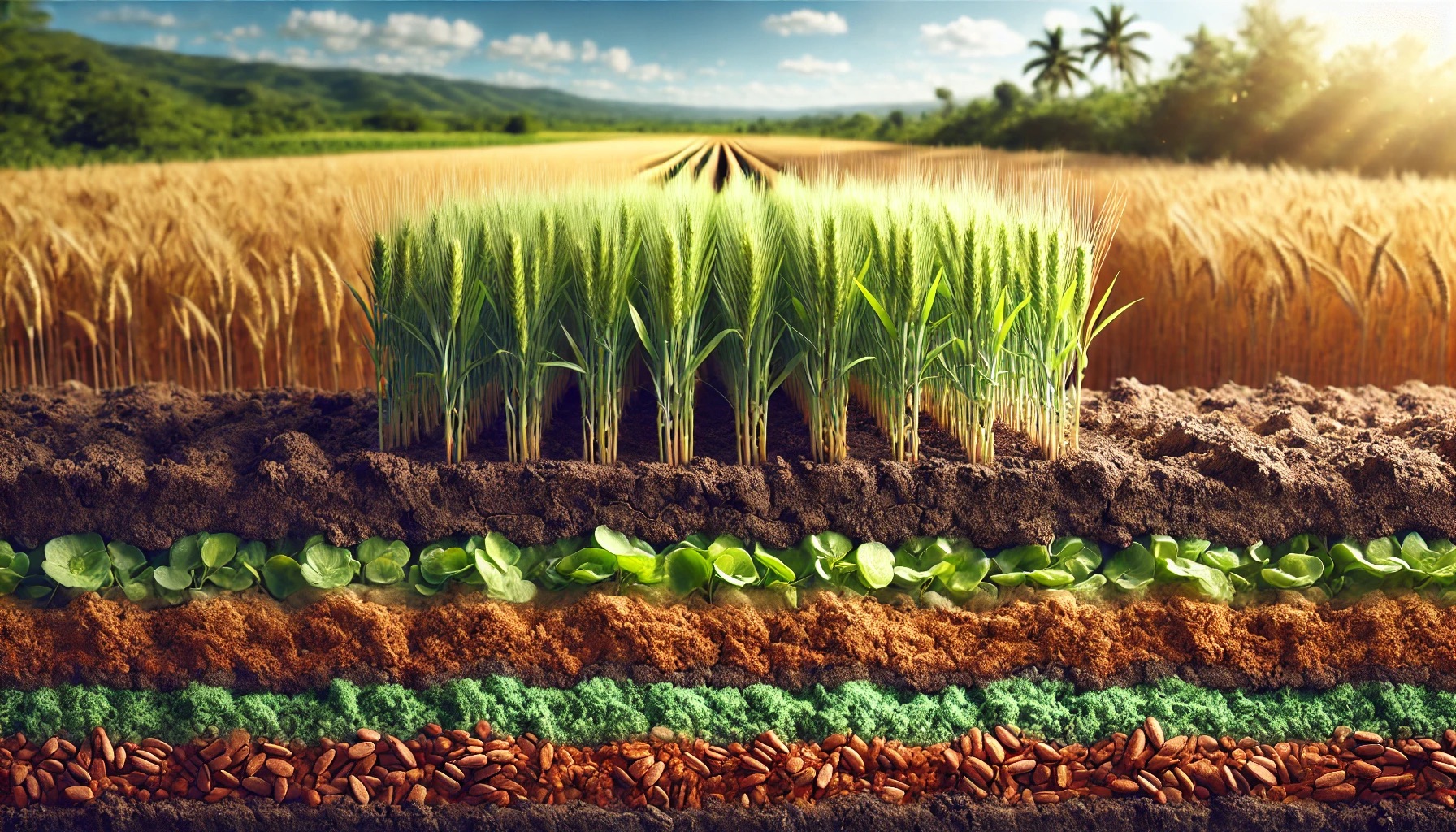
Copper (Cu) is an essential micronutrient for wheat growth, but its availability in tropical soils, such as Oxisols, is limited due to strong adsorption by soil colloids. A recent study evaluated Cu-doped biocharBiochar is a carbon-rich material created from biomass decomposition in low-oxygen conditions. It has important applications in environmental remediation, soil improvement, agriculture, carbon sequestration, energy storage, and sustainable materials, promoting efficiency and reducing waste in various contexts while addressing climate change challenges. More composites as an alternative to traditional Cu fertilizers to improve wheat productivity and nutrient use efficiencyNutrient use efficiency refers to how effectively plants can take up and utilize nutrients from the soil. Biochar can improve nutrient use efficiency by enhancing nutrient availability and retention in the soil. More. These composites were synthesized from organic waste materials—chicken manure, shrimp shells, and sewage sludge—doped with either copper sulfate (CuSO4) or copper oxide (CuO) and processed at different pyrolysisPyrolysis is a thermochemical process that converts waste biomass into bio-char, bio-oil, and pyro-gas. It offers significant advantages in waste valorization, turning low-value materials into economically valuable resources. Its versatility allows for tailored products based on operational conditions, presenting itself as a cost-effective and efficient More temperatures (300°C and 550°C).
Key findings highlighted the composites’ potential to address soil Cu deficiencies sustainably. High-temperature pyrolysis (550°C) enhanced biochar stability, pHpH is a measure of how acidic or alkaline a substance is. A pH of 7 is neutral, while lower pH values indicate acidity and higher values indicate alkalinity. Biochars are normally alkaline and can influence soil pH, often increasing it, which can be beneficial More, and nutrient retention, while low-temperature biochar (300°C) facilitated more controlled Cu release. Composites doped with CuSO4 generally released Cu more readily than those doped with CuO, offering flexibility for soil-specific applications.
Greenhouse trials demonstrated that tailored composites improved wheat growth and Cu uptake compared to traditional fertilizers. For sandy, low-organic-matter soils (RYL Oxisols), shrimp shell-based composites processed at 300°C (CSC/CS-3) provided optimal nutrient release, boosting dry matter and grain yield. Conversely, clay-rich soils (DRL Oxisols) benefited most from sewage sludge-based composites processed at 550°C (CSS/CS-5), which combined slow Cu release with enhanced soil amendmentA soil amendment is any material added to the soil to enhance its physical or chemical properties, improving its suitability for plant growth. Biochar is considered a soil amendment as it can improve soil structure, water retention, nutrient availability, and microbial activity. More properties.
Beyond productivity, the study emphasized the environmental benefits of biochar composites. By reducing Cu leachingLeaching is the process where nutrients are dissolved and carried away from the soil by water. This can lead to nutrient depletion and environmental pollution. Biochar can help reduce leaching by improving nutrient retention in the soil. More and residual accumulation in soils, these materials minimize environmental risks while supporting long-term soil fertility. This aligns with sustainable agricultural practices and highlights the role of biochar in improving soil health and crop performance under challenging tropical conditions.
Future research could focus on field trials and long-term effects of biochar application to optimize its integration into agricultural systems. By leveraging waste-derived materials and advanced processing techniques, Cu-doped biochar composites represent a promising step toward sustainable and efficient nutrient management.
SOURCE: Chisté, et al (2025) Evaluating Copper-Doped Biochar Composites for Improving Wheat Nutrition and Growth in Oxisols. Agronomy. https://doi.org/10.3390/agronomy15010144




Leave a Reply