
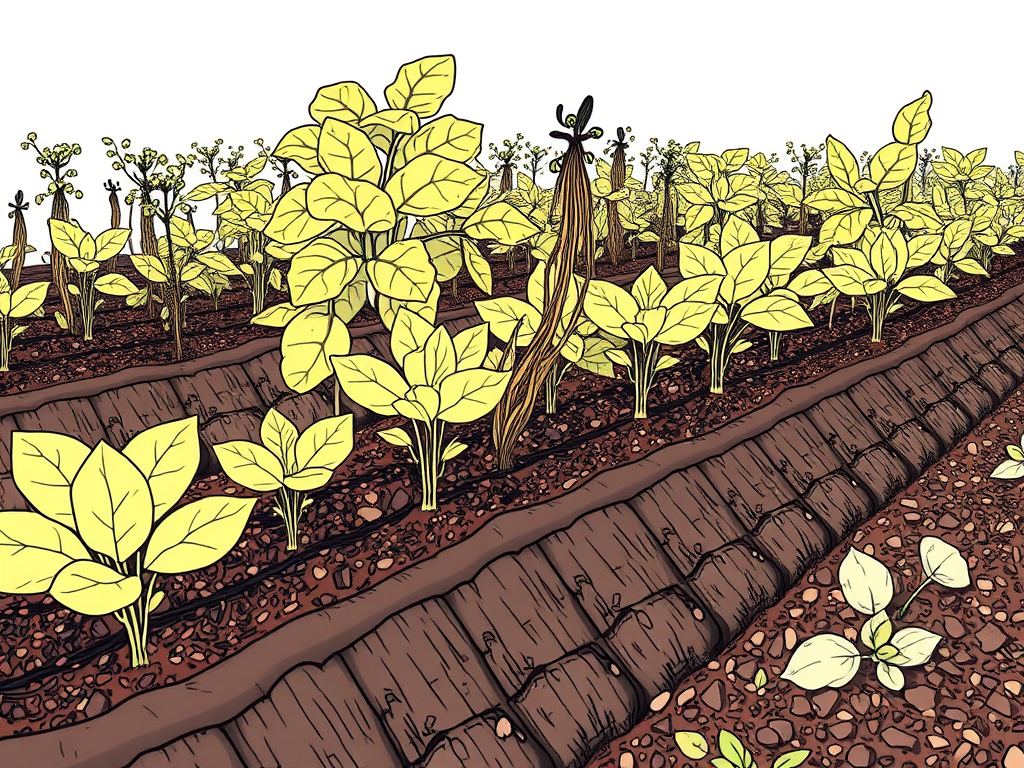
In modern agriculture, particularly in facility vegetable cultivation, maintaining healthy soil can be a significant challenge. Continuous cropping, along with often inefficient irrigation and fertilization methods, can degrade soil quality, leading to nutrient imbalances and increased susceptibility to plant diseases. Addressing these “soil barriers” is crucial for sustainable food production. A recent study by Minhan Sun, Shuanxi X. Fan, and Nan Zhang, published in Scientific Reports, explores an effective and innovative solution: the combined application of biocharBiochar is a carbon-rich material created from biomass decomposition in low-oxygen conditions. It has important applications in environmental remediation, soil improvement, agriculture, carbon sequestration, energy storage, and sustainable materials, promoting efficiency and reducing waste in various contexts while addressing climate change challenges. More, plant ashAsh is the non-combustible inorganic residue that remains after organic matter, like wood or biomass, is completely burned. It consists mainly of minerals and is different from biochar, which is produced through incomplete combustion. Ash Ash is the residue that remains after the complete More, and Effective Microorganisms (EM) to improve facility-agriculture soil. Their findings offer valuable insights into how these amendments can work together to restore soil health and boost fertility.
The research team conducted a field trial with several treatment groups, including a control and six different dosage combinations of biochar, plant ash, and EM bacteria. Biochar, a carbon-rich material from burning organic waste in a low-oxygen environment, is known for its ability to improve soil structure and nutrient retention. Plant ash, derived from burning wood and straw, is a natural source of essential minerals, especially potassium, phosphorus, and calcium. EM bacteria consist of beneficial microorganisms that enhance the soil’s microbial balance and nutrient cycling.
The results of the study demonstrated that this combined approach significantly improved various soil properties. Soil pHpH is a measure of how acidic or alkaline a substance is. A pH of 7 is neutral, while lower pH values indicate acidity and higher values indicate alkalinity. Biochars are normally alkaline and can influence soil pH, often increasing it, which can be beneficial More, a critical factor influencing nutrient availability, increased by an average of 1.1-24.0% across different treatments and stages. This is particularly beneficial in mitigating soil acidification, a common problem in intensively cultivated soils. The T4 treatment, which utilized plant ash at 3030 kg/hm², biochar at 6060 kg/hm², and EM bacteria at a 37.5:1 water-bacteria volume ratio, showed the most significant impact on soil pH, with improvements ranging from 11.11-26.00% during the fruiting and ending stages.
Soil bulk density, a measure of soil compaction, also saw significant improvements. A lower bulk density indicates better soil porosityPorosity of biochar is a key factor in its effectiveness as a soil amendment and its ability to retain water and nutrients. Biochar’s porosity is influenced by feedstock type and pyrolysis temperature, and it plays a crucial role in microbial activity and overall soil health. Biochar More, aeration, and water-holding capacity, all vital for root growth. The treatments reduced soil bulk density by an average of 6.09-9.83% over the entire growth period. The T5 treatment exhibited the highest reduction rate in bulk density, leading to more favorable physical conditions for plant roots. This reduction is attributed to the porous nature of biochar and plant ash, combined with the EM bacteria’s role in soil particle aggregation.
Beyond physical properties, the combined amendments dramatically enhanced soil nutrient levels. Total nitrogen increased by 32.22-61.26% across treatments, with some soil layers seeing an increase of up to 92.59% by the end of the growth period. Total phosphorus levels rose by 11.82-47.82%, with the T4 treatment showing the most pronounced effect on increasing soil total phosphorus. Similarly, total potassium increased by 1.44-6.99% on average across all treatments and the T4 treatment led to an average increase in available potassium of 93.64%. Organic matter content, a cornerstone of soil health, improved by an impressive 19.42-77.23%. These increases highlight the synergistic effects of the amendments in enhancing nutrient availability and promoting healthy plant growth.
The study also introduced an Integrated Fertility Index (IFI) to assess overall soil health. The T4 treatment consistently demonstrated the best comprehensive fertility, indicating that this specific combination and dosage achieved an optimal balance in nutrient supply, soil structure improvement, and microbial activity. However, the researchers observed a “bottleneck effect,” where increasing the dosage beyond a certain point (as seen in T5 and T6 for some parameters) led to a decrease in comprehensive soil fertility. This suggests that excessive application of these high-carbon materials can disrupt the soil’s carbon-to-nitrogen ratio, leading to nutrient imbalances as microorganisms compete with plants for available nitrogen.
This research provides a practical and innovative approach to addressing soil degradation in facility agriculture. While the long-term effects and precise interaction mechanisms warrant further investigation, the immediate improvements in soil pH, bulk density, and nutrient content are undeniable. This approach offers a sustainable pathway for enhancing soil quality, leading to better crop yields and contributing to food security.
Source: Sun, M., Fan, S. X., & Zhang, N. (2025). Effects of biochar combined with the application of plant ash and effective microorganisms on the soil in the vegetable facility. Scientific Reports, 15(15824).





Leave a Reply