
Key Takeaways
- Incorporating a small amount of waste-derived biocharBiochar is a carbon-rich material created from biomass decomposition in low-oxygen conditions. It has important applications in environmental remediation, soil improvement, agriculture, carbon sequestration, energy storage, and sustainable materials, promoting efficiency and reducing waste in various contexts while addressing climate change challenges. More into cement can increase carbon dioxide storage and make concrete stronger.
- Treating biochar-cement mixtures with carbon dioxide helps lock in carbon while keeping harmful heavy metals safely trapped inside.
- The natural chemical changes caused by carbonation do not cause metals to leak out, but instead help bind them securely.
- Adding between one and five percent biochar offers the best balance between maintaining structural strength and maximizing carbon capture.
Building sustainable infrastructure requires rethinking conventional cement materials to help fulfill global net-zero emission targets by 2050. Incorporating biochar into cement matrices offers a dual advantage by serving as a permanent carbon sink while partially replacing traditional cement. However, a major challenge in using waste-derived biochar, such as sewage sludge or incineration ashAsh is the non-combustible inorganic residue that remains after organic matter, like wood or biomass, is completely burned. It consists mainly of minerals and is different from biochar, which is produced through incomplete combustion. Ash Ash is the residue that remains after the complete More, is the carbonation-induced drop in concrete pHpH is a measure of how acidic or alkaline a substance is. A pH of 7 is neutral, while lower pH values indicate acidity and higher values indicate alkalinity. Biochars are normally alkaline and can influence soil pH, often increasing it, which can be beneficial More. This reduction in alkalinity historically raised concerns about triggering the leachingLeaching is the process where nutrients are dissolved and carried away from the soil by water. This can lead to nutrient depletion and environmental pollution. Biochar can help reduce leaching by improving nutrient retention in the soil. More of heavy metals like lead, zinc, and cadmium. To understand how these systems truly behave, the researchers conducted a systematic review of one hundred twenty-two experimental studies, analyzing pore dynamics, heavy metal immobilization, and mechanical performance.
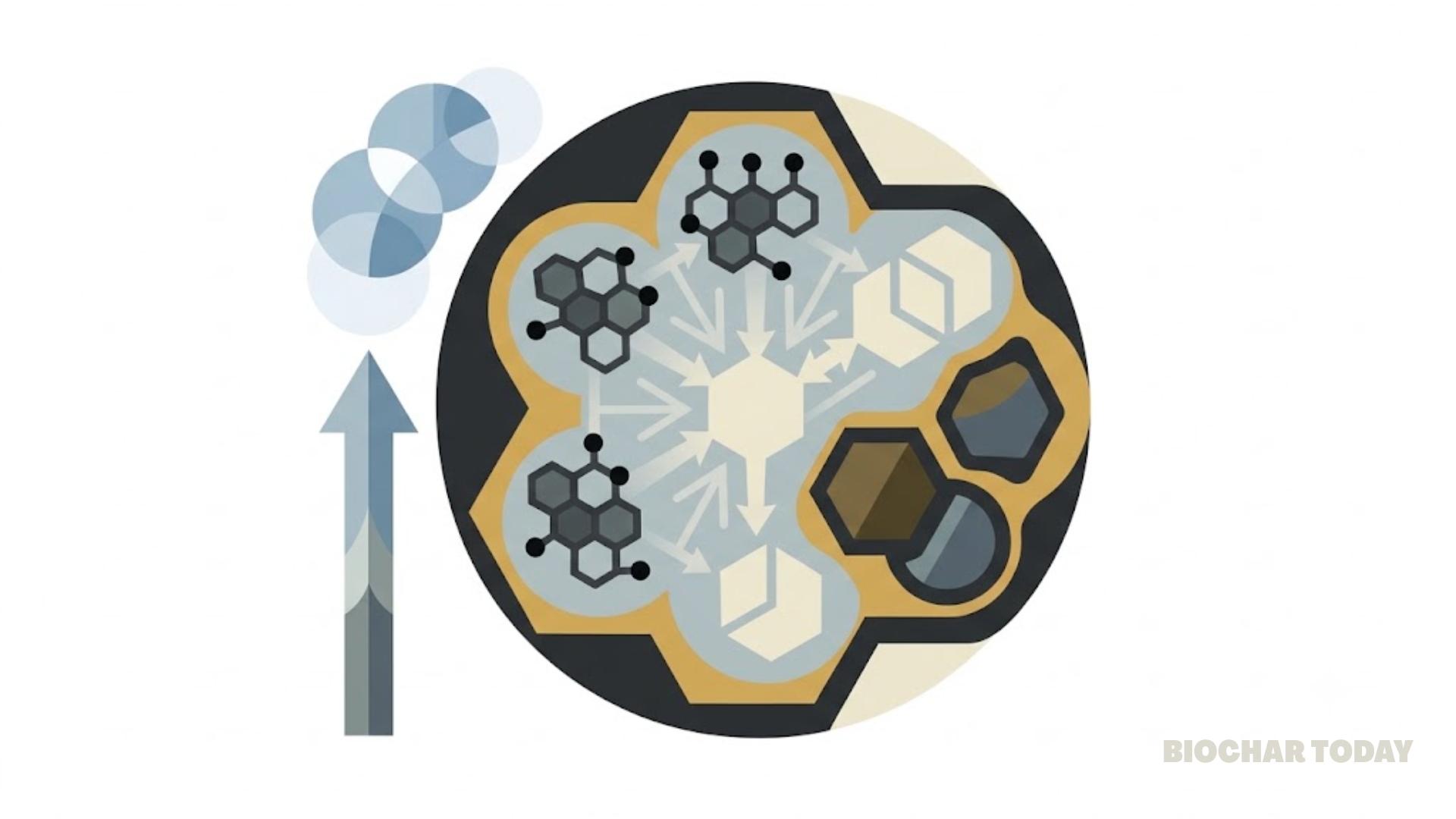
The findings demonstrate that accelerated carbonation causes calcium carbonate crystals to deposit within the hierarchical pores of the biochar. Rather than acting as a barrier that stops gas diffusion entirely, this pore-filling mechanism serves as a structural seal that retains internal moisture. This trapped moisture aids internal curing, reduces autogenous shrinkage by up to twenty-five percent, and strengthens the interfacial transition zone between the biochar and the cement paste. Furthermore, the review challenges the conventional assumption that a lower pH causes environmental risks. Instead, a stable pH window between nine and ten and a half provides optimal thermodynamic conditions for metal-carbonate precipitation and surface complexation, effectively immobilizing amphoteric metals.
The optimal balance for engineering these materials relies on a safe operating space where biochar replacement is maintained at one to five percent of the cement weight. Within this threshold, carbon dioxide uptake can approach or exceed fifty kilograms per cubic meter under controlled accelerated curing conditions, while mechanical strength losses remain minimal. Higher replacement rates improve carbon storage potential but typically require targeted curing strategies to offset any early-age strength reductions. Ultimately, this systematic review highlights that combining waste-derived biochar with accelerated carbonation offers a promising, scalable pathway for producing carbon-negative infrastructure without compromising environmental safety.
Source: Syafei, A. D., Febriwati, M., Hermana, J., Assomadi, A. F., Habieb, A. B., Sutrisno, W., & Zuki, F. M. (2026). Accelerated CO2 curing of waste-derived biochar-cementitious systems: A systematic review of carbon permanence and metal stability. Acta Innovations, (63), 237-256.




Leave a Reply