
Key Takeaways
- Wood shrinks at different rates and directions when heated into charcoalCharcoal is a black, brittle, and porous material produced by heating wood or other organic substances in a low-oxygen environment. It is primarily used as a fuel source for cooking and heating. More, affecting its final micro-structure and strength.
- The first shrinkage direction across the wood width is mainly triggered when the supportive plant glue components begin breaking down under heat.
- Shrinkage along the vertical length of the wood is tightly controlled by the main structural cellulose fibers and happens only after those fibers largely decompose.
- Natural or added mineral salts, such as sodium and potassium, can cause wood to start shrinking at lower temperatures.
- Hardwoods shrink wider than softwoods due to their distinct cellular architecture, but high temperatures eventually remove all directional differences.
In a recent publication in the academic journal BiocharBiochar is a carbon-rich material created from biomass decomposition in low-oxygen conditions. It has important applications in environmental remediation, soil improvement, agriculture, carbon sequestration, energy storage, and sustainable materials, promoting efficiency and reducing waste in various contexts while addressing climate change challenges. More, researchers Yu Wang, Ramadan Eljamal, Misao Yokoyama, Takashi Nomura, Eiji Minami, and Haruo Kawamoto investigated the complex physical transformations that occur when wood is heated into charcoal. Converting raw biomassBiomass is a complex biological organic or non-organic solid product derived from living or recently living organism and available naturally. Various types of wastes such as animal manure, waste paper, sludge and many industrial wastes are also treated as biomass because like natural biomass these More into high-quality biochar requires a deep, mechanistic understanding of how wood changes shape during high-temperature carbonization processes. When tree trunks, branches, and woody biomass are subjected to thermal pyrolysisPyrolysis is a thermochemical process that converts waste biomass into bio-char, bio-oil, and pyro-gas. It offers significant advantages in waste valorization, turning low-value materials into economically valuable resources. Its versatility allows for tailored products based on operational conditions, presenting itself as a cost-effective and efficient More, they do not shrink uniformly in every spatial direction. Instead, they exhibit distinct directional shrinkage, which profoundly influences the resulting microscopic pore structures, surface areas, adsorption capacities, and overall material performance. Understanding these structural changes is essential for optimizing biochar production for various environmental remediation, soil improvement, carbon sequestration, and advanced catalytic applications across diverse industrial sectors.
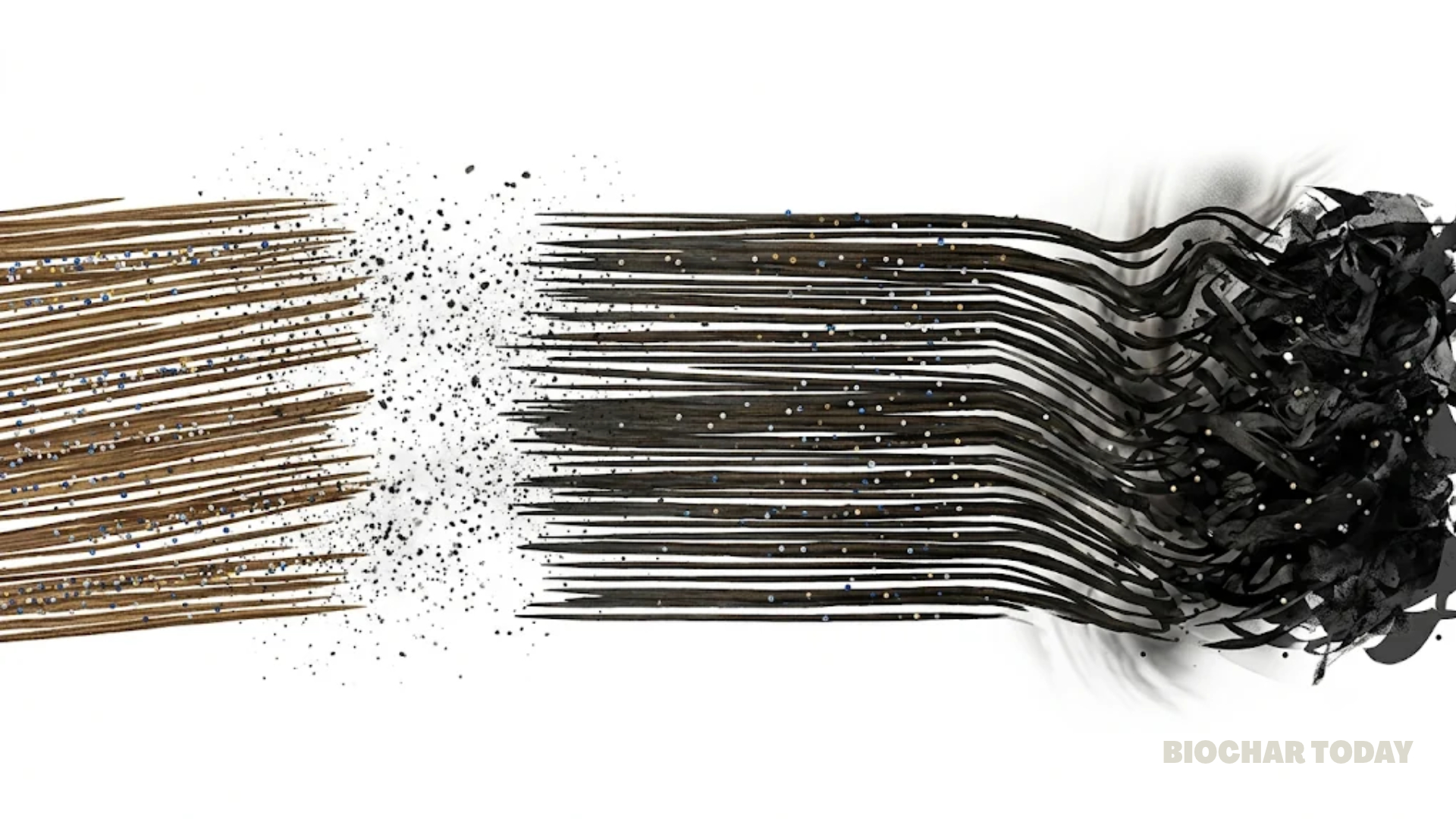
The researchers analyzed ten different wood species, comprising five softwoods and five hardwoods, along with various chemically modified derivatives, to uncover the underlying drivers of dimensional instability. By tracking dimensional changes continuously alongside thermal degradation profiles, the team discovered that shrinkage along the radial direction across the wood width begins primarily when hemicellulose components break down thermally. In stark contrast, shrinkage along the longitudinal direction running parallel to the tree trunk is tightly bound to cellulose degradation processes. Longitudinal contraction occurs rapidly only after most of the crystalline cellulose microfibrils have already decomposed, highlighting the critical load-bearing and restraining role that cellulose fibers maintain throughout the early and intermediate stages of the heating process.
Further chemical analysis revealed that exchangeable metal cations naturally present within the wood cell walls exert a powerful influence on these degradation and shrinkage patterns. Specifically, the introduction of monovalent alkali metal ions such as sodium and potassium significantly lowers the thermal degradation temperatures of wood polysaccharides, thereby reducing the temperature at which shrinkage starts by approximately thirty degrees Celsius. Conversely, divalent cations like calcium tend to stabilize the cell wall matrix and suppress excessive dimensional changes during heating. These findings demonstrate that precisely controlling the chemical environment inside the plant cell wall provides a reliable, direct method for tuning carbonization behavior and engineering customized biochar microstructures.
Anatomical differences between softwoods and hardwoods also dictate how biochar forms on a microscopic level and how it reacts to thermal stress. Hardwoods consistently displayed greater radial shrinkage than softwoods, a phenomenon linked to their complex cellular architecture, including wider vessel elements and specialized ray parenchyma cells. These structural arrangements make hardwoods significantly more susceptible to inward contraction as internal binding matrices degrade. However, as the carbonization temperature surpasses four hundred degrees Celsius, the remaining cellulose framework completely breaks down, removing all structural restraints and causing shrinkage anisotropy to vanish entirely as the carbonized material stabilizes into final, uniform charcoal.
Furthermore, the research highlights how exceptional species exhibit unique variations due to distinctive chemical and structural compositions. For instance, species containing specialized polysaccharides or persistent mineral inclusions deviate from standard behavioral trends, underscoring the delicate interplay between native plant chemistry and thermal response. These insights are particularly valuable for industrial operations seeking to upgrade low-value forestry residues into high-value porous carbon materials with consistent physical integrity.
Ultimately, these comprehensive findings bridge the fundamental gap between biomass chemistry and structural engineering. By recognizing that anisotropic shrinkage is governed by polysaccharide-specific thermal decomposition and modulated by exchangeable cations and cellular anatomy, manufacturers can move far beyond traditional trial-and-error approaches. Tailoring feedstockFeedstock refers to the raw organic material used to produce biochar. This can include a wide range of materials, such as wood chips, agricultural residues, and animal manure. More selection and chemical pretreatments will enable industries to produce high-performance biochar with predictable pore architectures and enhanced functional properties, supporting a more sustainable, efficient, and economically viable biochar industry worldwide.
Source: Wang, Y., Eljamal, R., Yokoyama, M., Nomura, T., Minami, E., & Kawamoto, H. (2026). Cell-wall chemistry governs anisotropic shrinkage during wood carbonization: roles of polysaccharide degradation and exchangeable cations. Biochar, 8, 144.


Leave a Reply