
Key Takeaways
- Applying biocharBiochar is a carbon-rich material created from biomass decomposition in low-oxygen conditions. It has important applications in environmental remediation, soil improvement, agriculture, carbon sequestration, energy storage, and sustainable materials, promoting efficiency and reducing waste in various contexts while addressing climate change challenges. More to abandoned rainfed agricultural lands significantly helps conserve both soil and water resources.
- This organic material decreases water runoff from rainfall and noticeably minimizes the total amount of soil lost to erosion.
- The application of biochar improves essential soil qualities, including its overall structure, moisture retention, and porosityPorosity of biochar is a key factor in its effectiveness as a soil amendment and its ability to retain water and nutrients. Biochar’s porosity is influenced by feedstock type and pyrolysis temperature, and it plays a crucial role in microbial activity and overall soil health. Biochar More.
- It boosts beneficial soil biological activity and enhances important chemical properties like organic carbon and nutrient levels.
In a newly published article in the journal International Soil and Water Conservation Research, authors Gilda Moafi, Leila Gholami, Ataollah Kavian, and Hosein Kheirfam explore how utilizing biochar can serve as a highly effective and sustainable strategy for land management. The researchers focused their investigation on the Zarinehroud sub-watershed, which is located within the ecologically vulnerable Urmia Lake watershed in West Azerbaijan Province, Iran. Over recent decades, this region has experienced extensive land-use changes that have transformed traditional rangelands into agricultural fields. When these rainfed agricultural lands are eventually abandoned, they are left highly vulnerable to severe environmental degradation because they lack protective vegetative cover and suffer from the long-term impacts of non-standard tillage practices. Consequently, natural rainfall events trigger high rates of soil erosion and water loss, which washes immense volumes of sediment into Lake Urmia and severely threatens local biodiversity. To combat this critical issue, the scientific team established standard erosion field plots to evaluate whether adding an organic soil amendmentA soil amendment is any material added to the soil to enhance its physical or chemical properties, improving its suitability for plant growth. Biochar is considered a soil amendment as it can improve soil structure, water retention, nutrient availability, and microbial activity. More could stabilize the landscape under natural weather conditions over a two-year monitoring period.
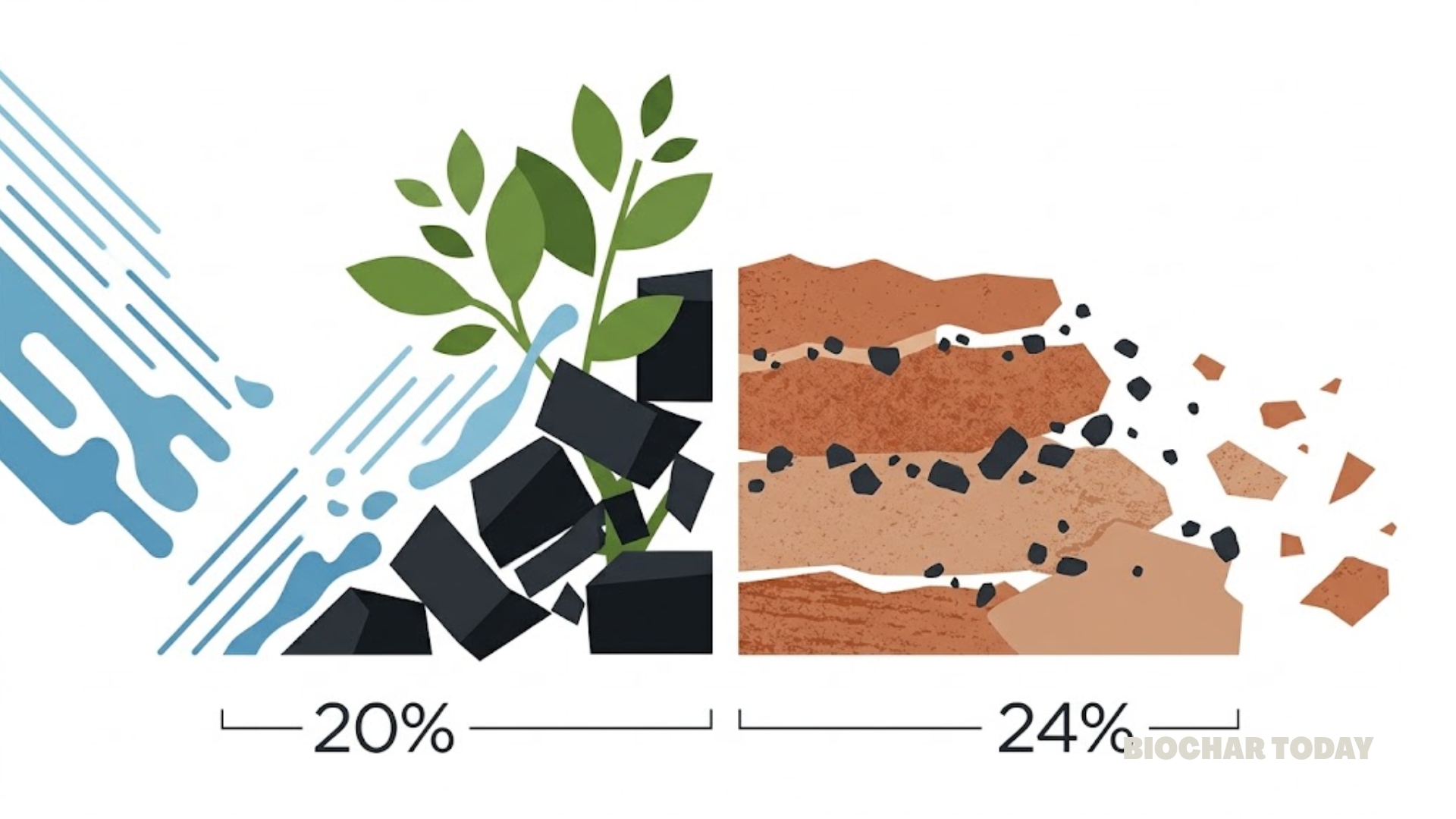
The authors produced a specialized organic biochar by utilizing the wood waste of Tabrizi poplar branches, a biological resource that is abundantly available throughout the region. This biomassBiomass is a complex biological organic or non-organic solid product derived from living or recently living organism and available naturally. Various types of wastes such as animal manure, waste paper, sludge and many industrial wastes are also treated as biomass because like natural biomass these More underwent a pyrolysisPyrolysis is a thermochemical process that converts waste biomass into bio-char, bio-oil, and pyro-gas. It offers significant advantages in waste valorization, turning low-value materials into economically valuable resources. Its versatility allows for tailored products based on operational conditions, presenting itself as a cost-effective and efficient More process under minimal oxygen conditions to create a highly porous, carbon-rich material characterized by an irregular shape and a unique honeycomb-like internal skeleton. By introducing this organic amendment into the top layer of the soil at a designated field rate, the research team successfully altered the physical dynamics of the earth. The field data revealed that the biochar application functioned as an exceptional defense mechanism against water erosion. Over the course of eight distinct, naturally occurring erosive rainfall events that generated surface runoff, the treated plots consistently outperformed the untreated control plots. On average, the presence of the biochar layer led to a 20% reduction in total surface runoff volume, a 24% decrease in total soil loss, and an 8% drop in overall sediment concentration. These substantial reductions highlight how the amendment mitigates the destructive kinetic energy of raindrops and prevents splash erosion.
Beyond simply mitigating the immediate loss of water and topsoil, the field application induced widespread, positive transformations across the physical, chemical, and biological properties of the soil. Physically, the amendment increased soil aggregate stability, which was carefully measured using the mean weight diameter index. The soil structure showed a remarkable capacity to hold itself together, with the aggregate stability values reaching their peak performance approximately one year following the initial application. Because biochar is naturally lightweight and possesses a much lower density than regular soil minerals, its incorporation successfully lowered the bulk density of the earth, reduced harmful soil compaction, and significantly elevated the total soil porosity. This expanded pore network provided vital space for moisture retention, causing the gravimetric soil moisture content to rise substantially during the first year of monitoring.
Chemically and biologically, the application of this alkaline organic amendment raised the average soil pHpH is a measure of how acidic or alkaline a substance is. A pH of 7 is neutral, while lower pH values indicate acidity and higher values indicate alkalinity. Biochars are normally alkaline and can influence soil pH, often increasing it, which can be beneficial More by 4.5% and boosted the electrical conductivity by an impressive 20.5% relative to the control plots. Most notably, because the material functions as a highly stable carbon sink, the soil organic carbon content experienced a significant increase of 21%. This accumulation of organic matter stimulated the local subterranean ecosystem and fostered enhanced biological activity. The researchers measured a 31% increase in chlorophyll-a content within the soil, a biological indicator that points directly to an expansion of cyanobacterial biomass and healthy biocrust development. Ultimately, the study concludes that utilizing regional poplar wood waste to produce biochar offers a highly efficient, cost-effective, and ecologically advantageous solution for preserving vital soil and water resources in semi-arid environments.
Source: Moafi, G., Gholami, L., Kavian, A., & Kheirfam, H. (2026). Two-year monitoring of biochar effects on soil and water conservation in USLE plots under field conditions. International Soil and Water Conservation Research.





Leave a Reply