

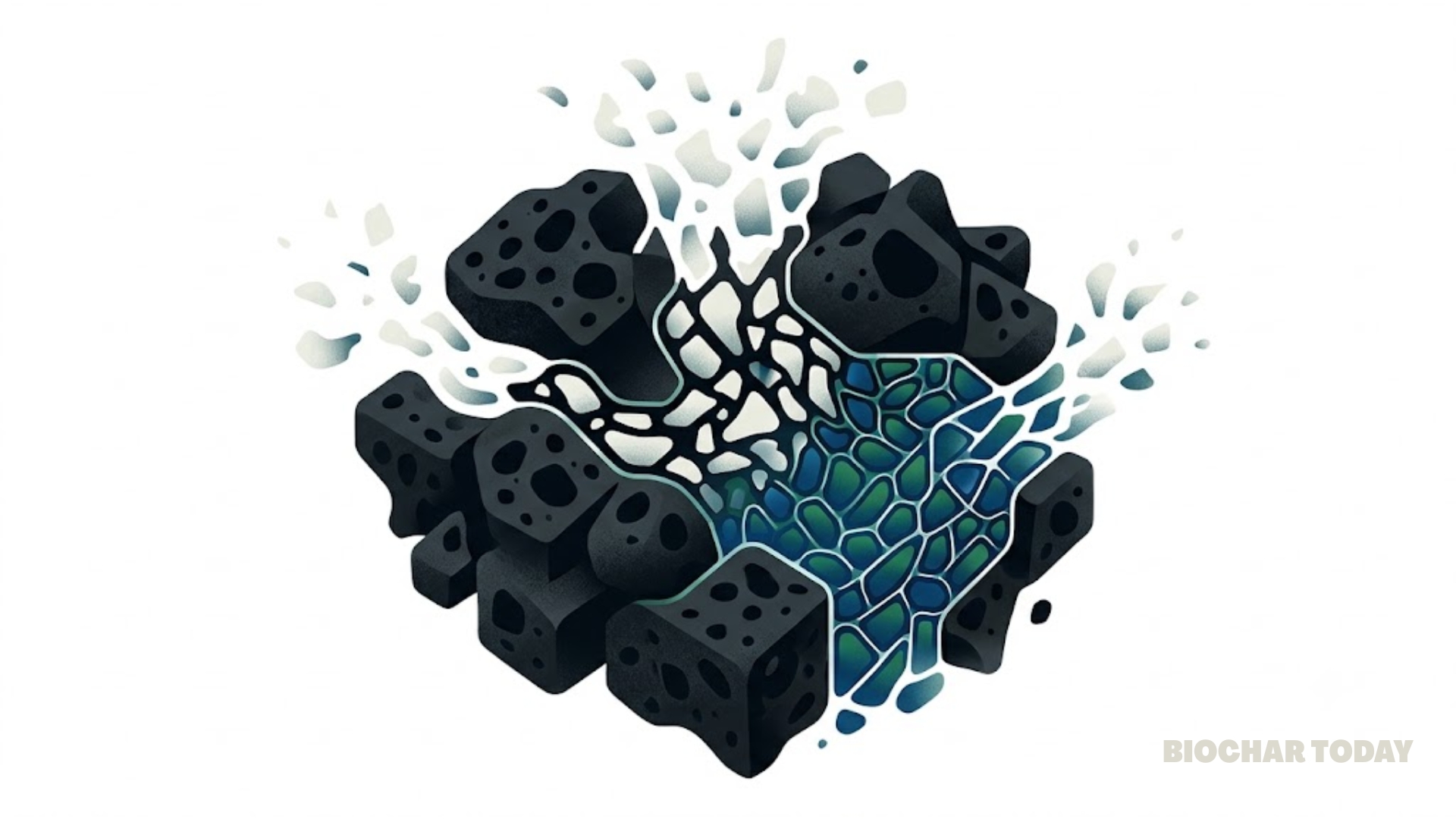
In a recent research article published in Next Materials, Siew Choo Chin and her team investigated the compelling potential of bamboo biocharBiochar is a carbon-rich material created from biomass decomposition in low-oxygen conditions. It has important applications in environmental remediation, soil improvement, agriculture, carbon sequestration, energy storage, and sustainable materials, promoting efficiency and reducing waste in various contexts while addressing climate change challenges. More as a sustainable filler in cement mortar. Their findings demonstrate that this innovative additive not only enhances structural performance but also significantly contributes to carbon dioxide (CO₂) sequestration, addressing critical environmental concerns in the construction industry. The construction sector faces increasing pressure to adopt sustainable materials, especially as global cement consumption is projected to rise significantly, reaching 4.68 gigatons by 2050. Traditional CO₂ emission reduction measures in the cement industry may not suffice, making novel solutions like biochar essential. Biochar, a porous and carbon-rich material produced from biomassBiomass is a complex biological organic or non-organic solid product derived from living or recently living organism and available naturally. Various types of wastes such as animal manure, waste paper, sludge and many industrial wastes are also treated as biomass because like natural biomass these More pyrolysisPyrolysis is a thermochemical process that converts waste biomass into bio-char, bio-oil, and pyro-gas. It offers significant advantages in waste valorization, turning low-value materials into economically valuable resources. Its versatility allows for tailored products based on operational conditions, presenting itself as a cost-effective and efficient More, is recognized for its ability to adsorb CO₂, making it a promising additive for reducing the carbon footprint of building materials.
Chin and her colleagues prepared mortar mixes with varying water-to-cement (w/c) ratios (0.45–0.55) and bamboo biochar dosages (2%–8%). The biochar, sourced from a by-product of bamboo charcoalCharcoal is a black, brittle, and porous material produced by heating wood or other organic substances in a low-oxygen environment. It is primarily used as a fuel source for cooking and heating. More production, was processed through pyrolysis at 600 °C, followed by shredding, grinding, and sieving to achieve a fine particle size, mostly below 3 µm. This fine particle size and porous microstructure are crucial, as they allow the biochar to function as a filler, absorb water for internal curing, and provide nucleation sites for C-S-H gels, all contributing to enhanced mortar strength.
The study revealed that an optimal mix design with a 0.45 w/c ratio and 6% biochar addition yielded impressive mechanical properties. This specific combination achieved compressive and flexural strengths of 46.98 MPa and 9.60 MPa, respectively. While the early strength (7-day) of biochar-modified mortars was slightly lower than the control, strengths generally increased with curing time, with significant gains observed at 28 days and continuing up to 56 days. The researchers noted that adding more than 6% biochar could lead to a reduction in strength due to a “diluting effect” and increased porosityPorosity of biochar is a key factor in its effectiveness as a soil amendment and its ability to retain water and nutrients. Biochar’s porosity is influenced by feedstock type and pyrolysis temperature, and it plays a crucial role in microbial activity and overall soil health. Biochar More, emphasizing the importance of optimal dosage.
Beyond mechanical improvements, a key finding was biochar’s significant contribution to carbon sequestration through carbonation. Carbonation occurs when CO₂ diffuses into the mortar and reacts with calcium hydroxide to form calcium carbonate, enhancing strength and durability. The addition of bamboo biochar dramatically increased carbonation depth and CO₂ uptake. Specifically, samples with 3% biochar showed a 53% increase in carbonation depth after 56 days compared to the control, reaching 32.2 mm. This enhanced CO₂ absorption was attributed to biochar’s high porosity and surface area, which provide more sites for CO₂ interaction and facilitate its diffusion into the cement matrix.
Thermogravimetric analysis (TGA) further confirmed these findings, showing a greater mass loss in samples with 3% biochar, indicative of increased carbonate formation and CO₂ sequestration. Carbonation also directly improved mechanical strengths: a 3% biochar sample, after 56 days of carbonation, exhibited a 9% increase in flexural strength (8.3 MPa compared to 7.6 MPa for the control) and a remarkable 24% increase in compressive strength (31.4 MPa versus 25.4 MPa for the control).
This dual benefit of enhanced mechanical performance and significant carbon capture positions bamboo biochar as a highly promising material for sustainable construction practices, aligning with global efforts toward climate action and sustainable cities. Future research will focus on the long-term durability and weathering performance of these biochar-modified mortars.
Source: Chin, S. C., Gunasekaran, P. K., Che, J., Anand, N., & Gimbun, J. (2025). Bamboo biochar and carbonation enhanced the compressive and flexural strength of cement mortar. Next Materials, 9, 100959.



Leave a Reply