
Key Takeaways
- Applying biocharBiochar is a carbon-rich material created from biomass decomposition in low-oxygen conditions. It has important applications in environmental remediation, soil improvement, agriculture, carbon sequestration, energy storage, and sustainable materials, promoting efficiency and reducing waste in various contexts while addressing climate change challenges. More to soils is a popular method used to trap carbon and help combat climate change.
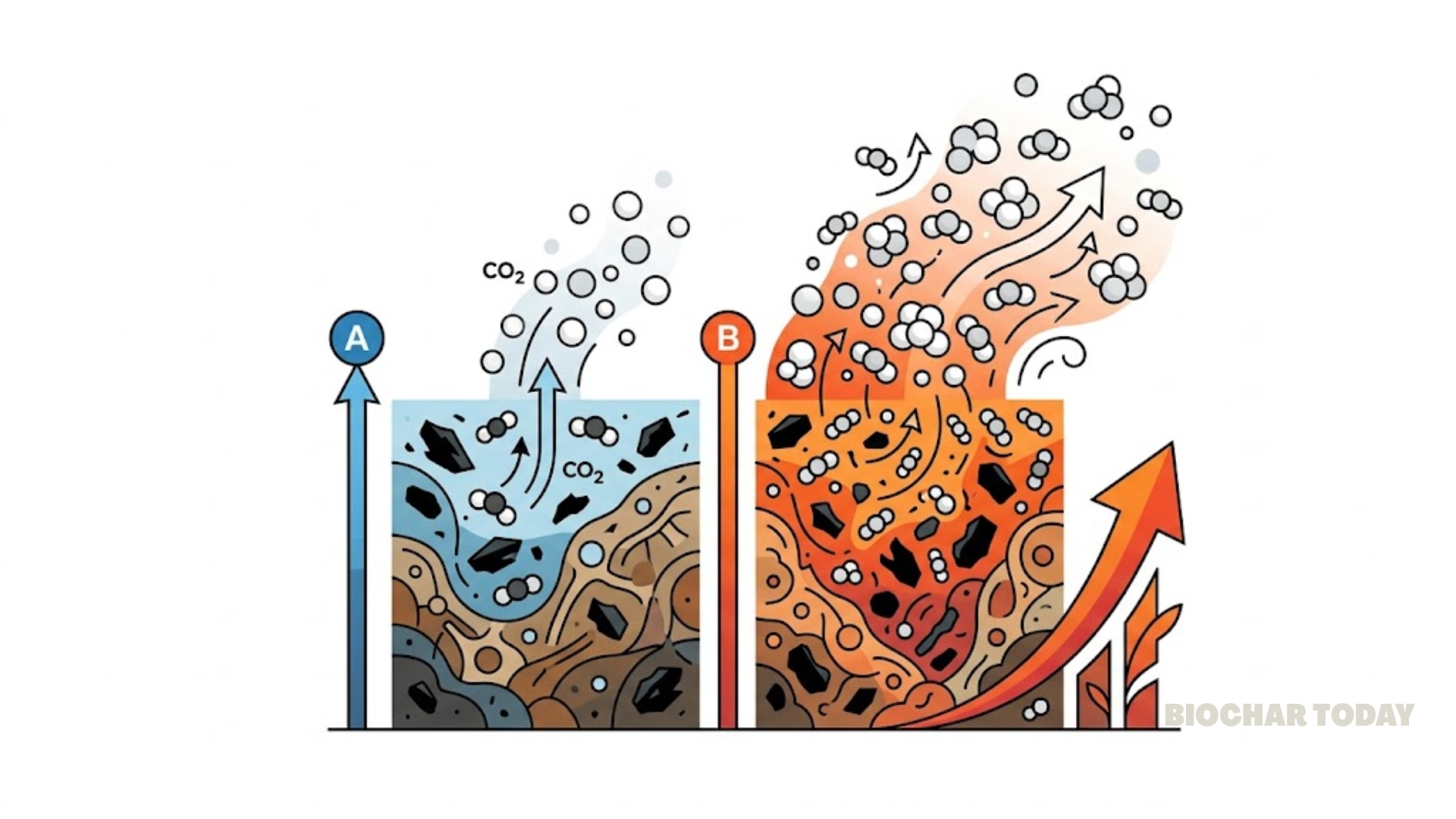
- Rising global temperatures cause these biochar-treated soils to release significantly more carbon dioxide gas back into the atmosphere.
- Farm soils are much more vulnerable to these temperature increases than natural forest environments.
- Materials made from wood cause a larger increase in emissions under warming conditions than materials derived from crops or grasses.
- Current estimates of how well biochar traps carbon may be too high because they fail to account for the impact of global warming.
In a recent paper published in the journal Biochar, authors Tongyu Xu, Qiufeng Xu, Yan Lei, Fei Li, Amit Kumar, Dafeng Hui, Jianming Xue, Shengdao Shan, Yongfu Li, Hepeng Li, and Junjie Lin examined how climate warming alters carbon dioxide release from treated soils. The team analyzed thousands of observations from past scientific publications to determine whether rising temperatures might undermine the ability of biochar to trap carbon underground. Their investigation revealed that while adding biochar is widely considered an excellent strategy for carbon sequestration, its long-term benefits depend heavily on local climate realities. Rising temperatures accelerate the breakdown of organic material, which triggers a troubling feedback loop that releases more greenhouse gas back into the air.
The primary finding of this global evaluation is that warming increases soil carbon dioxide emissions across all studied environments. However, the severity of this reaction changes dramatically depending on how the land is used. Croplands experienced a massive 117.5 percent surge in gas emissions when subjected to higher temperatures. This response is nearly four times higher than the 30.9 percent increase observed in forest environments. Farmland soils are inherently more vulnerable because common agricultural practices break down natural soil aggregates. This disruption exposes trapped carbon to hungry soil microbes. Furthermore, typical crop residues provide a steady supply of easily digestible carbon that stimulates microbial activity far more than the tough organic matter native to forests.
Beyond land use, the physical properties of the biochar itself heavily influence the scale of gas release under a warmer climate. Material created from wood generated the strongest emission response when heated, followed by crop residues, while grass-derived materials showed the weakest reaction. This aligns with classic ecological theories suggesting that highly resistant, complex organic structures require more energy to break down and are therefore more sensitive to temperature changes. Particle size also plays an important role, as smaller fragments offer a larger surface area for microbes to colonize. These microscopic hotspots speed up the breakdown of nearby soil nutrients, ultimately accelerating carbon loss.
Mathematical modeling from the study pinpointed the exact intensity of temperature change as the single most critical factor driving these increased emissions. After the magnitude of warming, the secondary drivers that most heavily dictated carbon loss were the application rate of the material and the specific nutrient ratios present in both the soil and the added biochar. In agricultural fields, the carbon-to-nitrogen ratio of the biochar proved to be a major secondary driver, whereas the inherent properties of the soil itself were more influential in forest environments. Higher application rates consistently led to greater carbon dioxide release when temperatures rose, showing that simply adding more biochar is not always a reliable path to climate mitigation.
These results suggest that international models may be overestimating the true climate mitigation potential of soil amendments by overlooking warming-induced carbon losses. To ensure that future carbon storage initiatives remain effective as the planet warms, management practices must become more precise and tailored to local conditions. Scientists recommend prioritizing non-woody raw materials, utilizing lower processing temperatures during manufacturing, and sticking to moderate soil application rates. This careful approach is especially urgent for vulnerable agricultural systems where the risk of accelerating greenhouse gas emissions is highest.
Source: Xu, T., Xu, Q., Lei, Y., Li, F., Kumar, A., Hui, D., Xue, J., Shan, S., Li, Y., Li, H., & Lin, J. (2026). Warming increases CO2 emissions in biochar-amended cropland soil. Biochar, 8(106).



Leave a Reply