
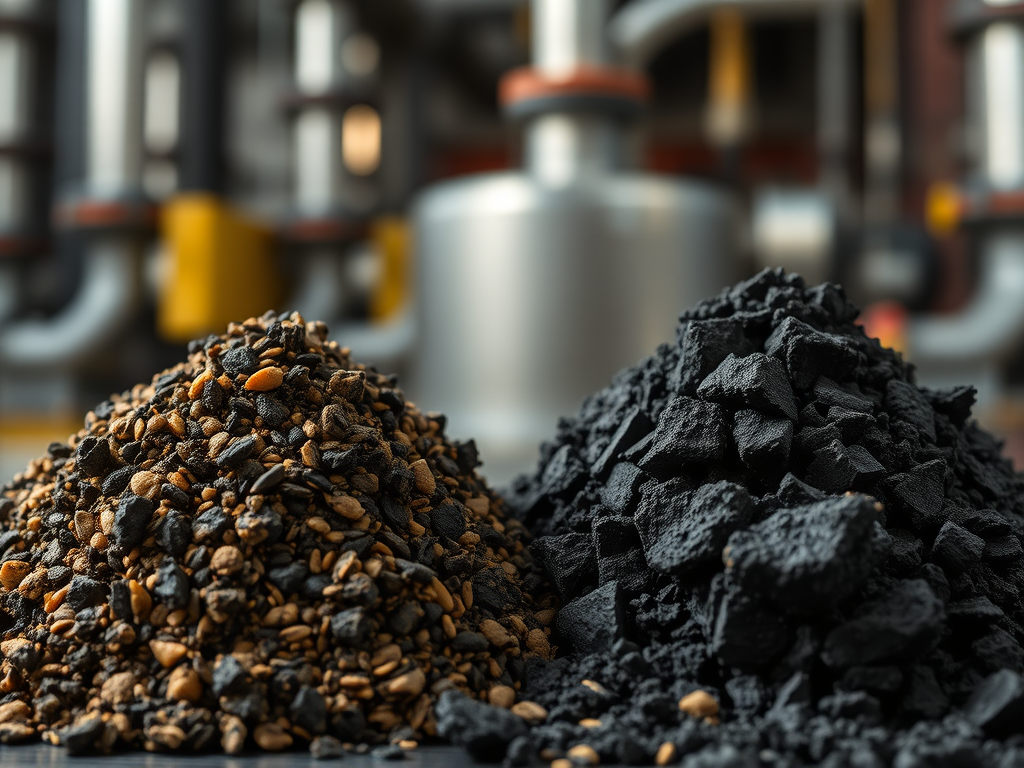
A recent study by Mohammad Meysami, Amin Rabie, Reza Amini Najafabadi, Amirhossein Meysami, and Taghi Isfahani published in Results in Engineering, a recent study delves into the fascinating world of biocharBiochar is a carbon-rich material created from biomass decomposition in low-oxygen conditions. It has important applications in environmental remediation, soil improvement, agriculture, carbon sequestration, energy storage, and sustainable materials, promoting efficiency and reducing waste in various contexts while addressing climate change challenges. More, a charcoal-like substance made from organic matter. This research compares biochar derived from two distinct sources: rapeseed meal, a byproduct of oil extraction, and Fraxinus excelsior sawdust, a common wood waste. The aim was to assess their thermal and structural properties, ultimately determining their suitability as sustainable, carbon-rich materials for high-temperature industrial uses, such as in ferroalloy and ferrosilicon production.
The study’s findings reveal that both rapeseed meal biochar (RM350) and Fraxinus excelsior sawdust biochar (FS350) exhibit high fixed carbon contents, 59.3% and 57.6% respectively, with sulfur levels below 0.1%. A bootstrap analysis confirmed that RM350 had a statistically significant 0.90% higher mean carbon content than FS350 (95% CI: 0.04, 1.76). This indicates RM350’s slight advantage in carbon richness, a critical factor for many industrial applications. The calculated hydrogen-to-carbon ratio was 0.079 for RM350 and 0.070 for FS350, with RM350 also showing twice the nitrogen content of FS350.
Fraxinus excelsior Biochar Shows Superior Energy Retention by 291.48 J/g While RM350 showed slightly higher carbon content, the Fraxinus excelsior biochar (FS350) demonstrated superior energy retention characteristics. The enthalpy of formation was significantly higher for FS350 than for RM350, with an estimated difference of -291.48 J/g (95% CI: -339.06, -243.78). This finding was further supported by a remarkably large negative Cohen’s d effect size of -8.61 for enthalpy, emphasizing FS350’s substantially higher capacity to hold onto energy. This makes FS350 particularly promising for applications where thermal stability and sustained energy release are paramount.
Both biochars exhibited robust thermal stability, with residual masses of 42% for rapeseed and 47% for wood biochars at 1000°C, indicating their resilience at high temperatures. FTIR and Raman spectroscopy further confirmed the successful formation of stable carbonaceous structures and characteristic functional groups in both biochars. The presence of these stable carbon structures is crucial for their performance in demanding industrial environments. The analytical methods included CHNS, FTIR, Raman spectroscopy, TGA/DTG, and DSC, providing a comprehensive characterization of the biochars’ properties.
This research differentiates itself from previous studies by offering a comprehensive comparative analysis of biochars, integrating multiple analytical techniques with advanced statistical evaluations like bootstrap resampling and Bayesian estimation. This integrated approach provides a deeper understanding of carbon content, stability, and energy retention, filling a critical gap in existing literature. The study concludes that both rapeseed meal and Fraxinus excelsior sawdust biochars hold significant promise as sustainable, carbon-rich alternatives to fossil fuels in high-temperature industrial applications, offering a pathway towards reduced carbon emissions and more environmentally friendly practices.
Source: Meysami, M., Rabie, A., Najafabadi, R. A., Meysami, A., & Isfahani, T. (2025). Comparative Thermal and Structural Analysis of Biochar from Rapeseed Meal and Fraxinus excelsior Sawdust. Results in Engineering.




Leave a Reply