
In a recent article published in the journal Agriculture, researchers Vinicius John and colleagues investigated the economic feasibility of producing and using biocharBiochar is a carbon-rich material created from biomass decomposition in low-oxygen conditions. It has important applications in environmental remediation, soil improvement, agriculture, carbon sequestration, energy storage, and sustainable materials, promoting efficiency and reducing waste in various contexts while addressing climate change challenges. More in small-scale farming in the Central Amazonia region. Their study, “Investigation, Prospects, and Economic Scenarios for the Use of Biochar in Small-Scale Agriculture in Tropical,” explores the potential for biochar made from açai agro-industrial waste to improve soil health and increase crop revenue for smallholder and family farms. The authors found that while biochar has numerous benefits, its economic viability is highly dependent on the production method used.
When applied to acidic soils, biochar can raise the pHpH is a measure of how acidic or alkaline a substance is. A pH of 7 is neutral, while lower pH values indicate acidity and higher values indicate alkalinity. Biochars are normally alkaline and can influence soil pH, often increasing it, which can be beneficial More, alter nutrient dynamics, and increase soil carbon stocks, making it a promising strategy for climate change mitigation and adaptation. The researchers focused on using waste from açai, a palm fruit widely consumed in the Amazon, as the feedstockFeedstock refers to the raw organic material used to produce biochar. This can include a wide range of materials, such as wood chips, agricultural residues, and animal manure. More for their biochar. In 2022, the production of 1.7 million tons of açai fruit generated an estimated 1.2 to 1.6 million tons of waste, which is often underutilized. Using this waste as biochar feedstock can provide soil benefits like pH elevation and increased nutrient content, as well as improved crop yields.
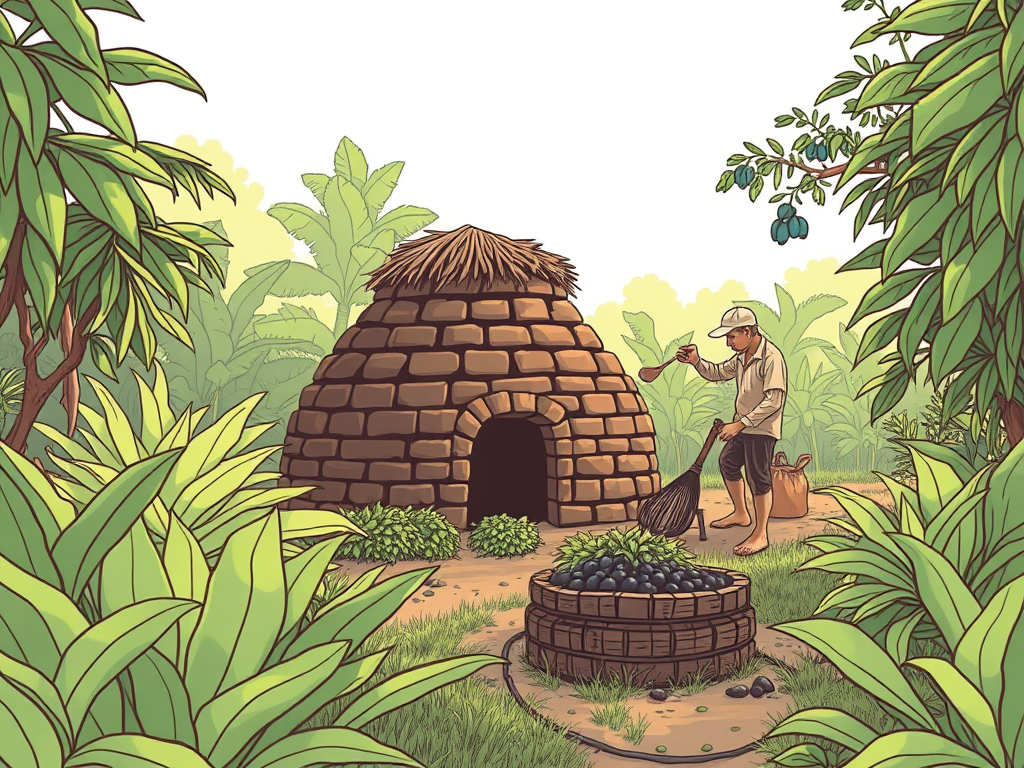
To assess the economic viability of biochar, the study compared two different kiln types: a mobile prototype kiln developed for the study and a traditional earth-brick kiln. The prototype kiln produced biochar at a high cost, ranging from $0.87 to $2.06 per kilogram, depending on whether labor costs were included. In contrast, the traditional earth-brick kiln, which is commonly used by local charcoalCharcoal is a black, brittle, and porous material produced by heating wood or other organic substances in a low-oxygen environment. It is primarily used as a fuel source for cooking and heating. More producers, significantly reduced production costs to just $0.03-$0.08 per kilogram. This cost difference is staggering, with the traditional kiln producing biochar up to 29 times more cheaply than the prototype. The study highlighted that the high cost of the prototype kiln made biochar production economically unfeasible for small-scale farmers.
The researchers conducted a field trial with cowpea crops to evaluate the economic outcomes of biochar application. Applying biochar alone increased cowpea revenue by 34% compared to the control group, which received no biochar or lime. The most significant increase in revenue came from a combination of biochar and lime, which boosted revenues by up to 84.6%. However, when using the expensive biochar from the prototype kiln, the control treatment actually generated a higher net revenue due to the high input costs and low value of the crop. This finding underscores the importance of a low-cost production method for biochar to be economically viable for small farmers who often don’t use commercial inputs.
When the economic scenario was recalculated using the lower production costs of the traditional earth-brick kiln, the results were dramatically different. In this scenario, the biochar-only treatment provided a net revenue that was 13% higher than the control group. More impressively, the biochar-only treatment generated a 94% higher net revenue compared to the treatment that used only lime. This finding suggests that producing biochar with a traditional kiln is a competitive and economically advantageous practice compared to the exclusive use of dolomitic limestone.
The study also looked at other potential sources of income, or “externalities,” from biochar application. The most significant of these was the potential for carbon credits. The researchers estimated that applying 12 tons of biochar per hectare could generate approximately $2,217 in CORCCHAR carbon credits. While this value was not enough to offset the high production costs of the prototype kiln, it was nearly six times the production cost of biochar made with the traditional kiln, providing a strong financial incentive for farmers. Additionally, using biochar reduced the need for lime by 14.5%, representing a potential savings of about $121 per hectare.
Overall, the research shows that public policies and technological adaptations are crucial for the widespread adoption of biochar by small-scale tropical farmers. Fractional application of biochar over a period of 4 to 10 years, which would retain over 97% of its carbon content in the soil, is a key strategy for reducing initial investment and aligning with the practices of smallholders. The study concludes that while the developed prototype kiln is not economically viable, the low-cost traditional earth-brick kiln holds promise for decentralized biochar production. By leveraging local knowledge and low-cost kilns, biochar can strengthen food security, reduce dependency on external inputs, and generate rural income, contributing to a more sustainable agricultural model.
Source: John, V., Braga, A. R. de O., Danielli, C. K. A. de O., Sousa, H. M., Danielli, F. E., Falcão, N. P. de S., Guerra, J., Lasmar, D. J., & Marques-dos-Santos, C. S. C. (2025). Investigation, Prospects, and Economic Scenarios for the Use of Biochar in Small-Scale Agriculture in Tropical. Agriculture, 15(15), 1700.




Leave a Reply