
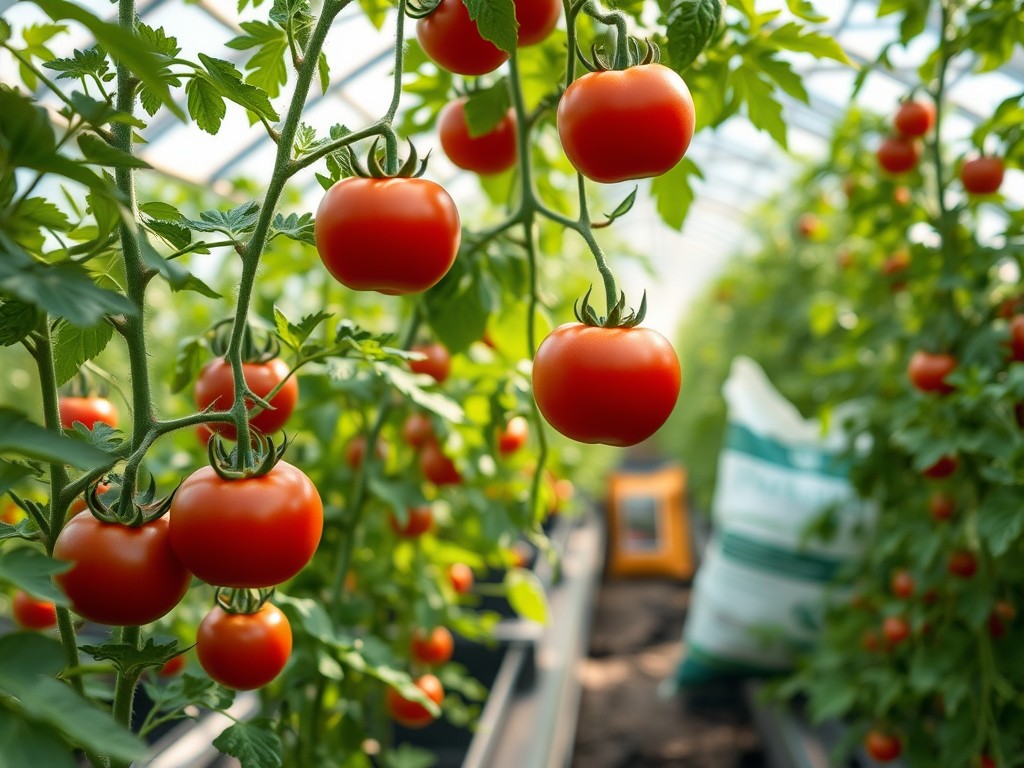
A two-season study in the journal Nitrogen from researchers Qinglin Sa, Jian Zheng, Haolin Li, Yan Wang, and Zifan Li reveals an optimal fertilization strategy for greenhouse tomatoes that boosts yield while significantly cutting greenhouse gas emissions. The research found that a combined treatment of biocharBiochar is a carbon-rich material created from biomass decomposition in low-oxygen conditions. It has important applications in environmental remediation, soil improvement, agriculture, carbon sequestration, energy storage, and sustainable materials, promoting efficiency and reducing waste in various contexts while addressing climate change challenges. More and dicyandiamide with biogas slurry increased tomato yield by up to 10.19% and reduced soil nitrous oxide (N2O) emissions by as much as 16.16% compared to conventional fertilization methods.
Greenhouse agriculture often relies on high inputs of chemical fertilizers, which can lead to environmental problems like nutrient imbalance and increased greenhouse gas emissions. While nitrogen fertilizer is applied in high amounts, its utilization efficiency remains low, at only 20-35%, resulting in significant nitrogen loss. Biogas slurry, a nutrient-rich byproduct of anaerobic fermentation, can be a sustainable alternative, but improper use can lead to nitrogen leachingLeaching is the process where nutrients are dissolved and carried away from the soil by water. This can lead to nutrient depletion and environmental pollution. Biochar can help reduce leaching by improving nutrient retention in the soil. More and N2O emissions. This study explored how adding soil amendments like biochar and dicyandiamide (DCD) could improve the use of biogas slurry and reduce environmental impact.
The experiment tested seven different treatments, with all plots receiving the same amount of nitrogen fertilizer. The standout performer was the T5 treatment, which combined 2% biochar, DCD, and biogas slurry. This treatment consistently showed the best results in both the autumn 2023 and spring 2024 growing seasons.
The T5 treatment significantly boosted tomato root development. Compared to conventional fertilization, T5 led to a substantial increase in root length, average diameter, total surface area, and total volume. The improved root structure allowed for better nutrient uptake and water use, which was reflected in the high irrigation water use efficiency (IWUE) and partial factor productivity of nitrogen (PFPN) observed in this treatment.
In terms of crop yield, T5 delivered the highest production. In autumn 2023, the yield increased by 8.13% over the conventional treatment, and in spring 2024, it rose by an impressive 10.19%. This success is attributed to the synergistic effects of the added materials. Biochar’s porous structure improves soil aeration and water retention, creating an ideal environment for roots. DCD, a nitrification inhibitor, slows nitrogen conversion, ensuring a stable supply of nitrogen to the roots and promoting a more extensive root system.
Beyond yield, the T5 treatment proved to be an effective tool for reducing environmental impact. The study found that soil N2O emission fluxes were significantly lower in the T5 treatment than in other treatments, with the largest reduction reaching 16.16% compared to conventional fertilization. This was particularly notable during the peak emission periods of flowering and fruit setting. Biochar’s ability to improve soil aeration and DCD’s role in inhibiting nitrification both contributed to this reduction by suppressing the conditions necessary for N2O production.
Using an Analytic Hierarchy Process (AHP) to conduct a comprehensive evaluation, the researchers concluded that the T5 treatment had the highest overall score, confirming its superiority in balancing high yield, efficient resource use, and environmental benefits. These findings provide a valuable, practical pathway for farmers to enhance productivity while developing a more sustainable and low-carbon agricultural model.
Source: Sa, Q., Zheng, J., Li, H., Wang, Y., & Li, Z. (2025). Effects of Biochar and Dicyandiamide on Root Traits, Yield, and Soil N2O Emissions of Greenhouse Tomato Under a Biogas Slurry Hole Irrigation System. Nitrogen, 6(3), 73.





Leave a Reply