
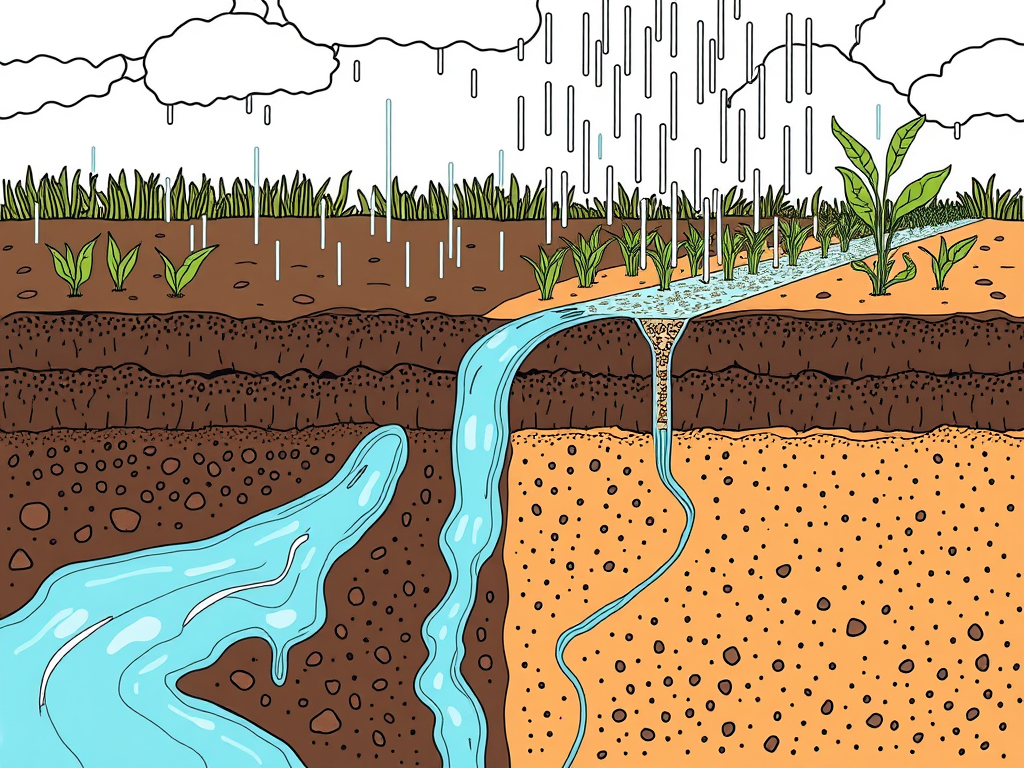
In a recent study published in Water Air Soil Pollution, Gurparshad Singh Brar, Kritika Malhotra, Rakesh Kumar, Jasmeet Lamba, Thomas R. Way, Rishi Prasad, and Sushil Adhikari investigated effective methods to reduce phosphorus leachingLeaching is the process where nutrients are dissolved and carried away from the soil by water. This can lead to nutrient depletion and environmental pollution. Biochar can help reduce leaching by improving nutrient retention in the soil. More from broiler litter applied to no-till pasture fields. Their findings highlight the significant impact of application techniques on environmental outcomes, particularly in areas prone to preferential flow. The research, conducted using undisturbed soil cores from Alabama, focused on how surface versus subsurface application of broiler litter, with and without pine wood biocharBiochar is a carbon-rich material created from biomass decomposition in low-oxygen conditions. It has important applications in environmental remediation, soil improvement, agriculture, carbon sequestration, energy storage, and sustainable materials, promoting efficiency and reducing waste in various contexts while addressing climate change challenges. More, affected the leaching of dissolved reactive phosphorus (DRP) during simulated rainfall events.
Broiler litter, a mixture of manure, bedding, and feathers, is a nutrient-rich fertilizer widely used in agriculture, especially in the southeastern United States where poultry production is concentrated. Alabama alone generates approximately 1.8 million Mg of broiler litter annually. While beneficial for increasing biomassBiomass is a complex biological organic or non-organic solid product derived from living or recently living organism and available naturally. Various types of wastes such as animal manure, waste paper, sludge and many industrial wastes are also treated as biomass because like natural biomass these More yield and nutrient concentration in forages, repeated and long-term application can lead to elevated phosphorus levels in soils, posing a significant risk of eutrophication in surface water bodies. Traditional application often involves surface broadcasting, which can result in substantial nutrient runoff and leaching.
This study used 15 intact soil cores, each 150 mm in diameter and 500 mm in length, collected from a pasture field in north Alabama. The soil columns underwent successive rainfall simulations over 10 days, with measurements taken on day 0, day 5, and day 10. Five treatments were tested: surface-applied broiler litter, subsurface-banded broiler litter, surface-applied broiler litter plus biochar, subsurface-banded broiler litter plus biochar, and a control with no amendments. The broiler litter was applied at a rate of 10 Mg ha−1 (wet basis), and biochar at 20.4 Mg ha−1 (wet basis).
A critical finding was that preferential flow pathways, where water moves rapidly through large pores in the soil, significantly contributed to DRP losses. Bromide breakthrough curves confirmed that early breakthrough of solutes occurred in all soil columns, indicating the presence of such pathways. During the first rainfall simulation, all treatments involving broiler litter, with or without biochar, resulted in significantly higher DRP concentrations in the leachate compared to the untreated control columns. This phenomenon, known as the “first flush,” demonstrates the immediate transport of phosphorus into the soil profile after manure application.
However, the application method proved crucial. Subsurface banding consistently reduced DRP leaching compared to surface broadcasting. In the first simulation, surface broadcast broiler litter leached significantly more DRP than subsurface-banded broiler litter and the control. For instance, the highest DRP concentration in leachate from surface-applied broiler litter in simulation 1 was 3.37 mg L−1 at 0.43 pore volume, while subsurface application peaked at 1.30 mg L−1 at 0.60 pore volume. This reduction is attributed to the subsurface method limiting direct contact between the litter and water moving through the soil, and potentially causing some soil compaction that reduces macropore continuity.
Interestingly, the co-application of pristine pine wood biochar with broiler litter did not significantly reduce DRP leaching. In fact, DRP leaching curves for broiler litter alone and broiler litter combined with biochar were very similar, indicating that the biochar used in this study offered no additional mitigation benefit. This could be due to the biochar itself contributing to phosphorus leaching, as it contained 456.7 mg kg−1 of phosphorus, with 16.6 mg kg−1 being water-extractable. Previous research has also noted that some biochars can increase phosphorus leaching, particularly in slightly acidic soils like those at the study site.
Overall, DRP leaching consistently decreased with successive rainfall events across all treatments after the initial flush. The study strongly supports the hypothesis that subsurface band application of broiler litter is a more effective strategy for controlling DRP losses than surface broadcasting. These findings have direct implications for agricultural management practices, recommending that farmers adopt subsurface application techniques to minimize nutrient runoff, protect water quality from phosphorus pollution, and enhance nutrient retention in soils. Future research will explore modified or engineered biochars and different feedstocks to identify options that can effectively reduce phosphorus loss from agricultural soils.
Source: Brar, G. S., Malhotra, K., Kumar, R., Lamba, J., Way, T. R., Prasad, R., & Adhikari, S. (2025). Investigating the Impact of Broiler Litter Application Method and Biochar on Phosphorus Leaching. Water Air Soil Pollut, 236(558).





Leave a Reply