
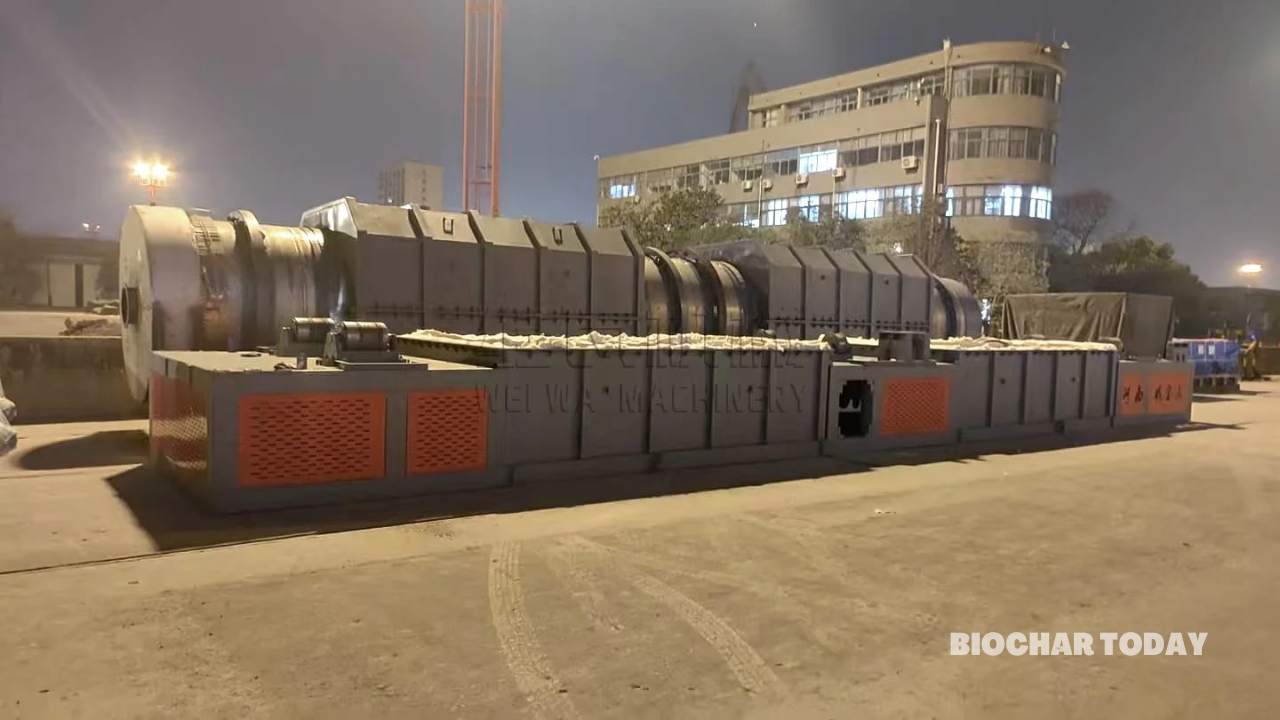
Weiwa Machinery has successfully completed the shipment and delivery of a specialized continuous carbonization furnace to a client in Uganda. This industrial equipment is designed to process agricultural biomassBiomass is a complex biological organic or non-organic solid product derived from living or recently living organism and available naturally. Various types of wastes such as animal manure, waste paper, sludge and many industrial wastes are also treated as biomass because like natural biomass these More into high-quality biocharBiochar is a carbon-rich material created from biomass decomposition in low-oxygen conditions. It has important applications in environmental remediation, soil improvement, agriculture, carbon sequestration, energy storage, and sustainable materials, promoting efficiency and reducing waste in various contexts while addressing climate change challenges. More on a commercial scale. The transaction signifies an expansion of technological exchange between Chinese manufacturing and the East African agricultural sector. By providing the necessary hardware for localized production, Weiwa Machinery is enabling a transition toward more sophisticated, automated carbonization processes within the Ugandan market.
The primary challenge addressed by this deployment is the inefficiency and environmental impact of traditional batch-processing methods common in the region. Producers in Uganda often struggle with inconsistent product quality and high labor costs associated with manual kilns. Furthermore, the inability to process large volumes of biomass continuously limits the scalability of biochar operations, making it difficult for local enterprises to meet the growing demand for soil amendments and carbon sequestration products in a timely and cost-effective manner.
To resolve these operational bottlenecks, Weiwa Machinery provided a continuous carbonization furnace that utilizes an automated feeding and discharging system. This technical solution allows for 24-hour operation, significantly increasing the throughput compared to traditional methods. The furnace is engineered to maintain precise temperature controls, ensuring a uniform carbon content and high surface area in the resulting biochar. By shipping a pre-assembled and tested unit, the company ensured that the Ugandan facility could minimize downtime and move rapidly from installation to full-scale production.
The outcomes of this equipment acquisition include a substantial increase in biochar production capacity for the Ugandan client and a reduction in the carbon footprint of the production process itself. The shift to continuous carbonization technology allows for better combustible gas recovery, improving energy efficiency. Economically, the deployment supports local job creation in the processing sector and provides Ugandan farmers with a reliable domestic source of biochar. This successful international logistics and installation project underscores the growing demand for advanced carbonization technology in developing biochar markets.




Leave a Reply