
Key Takeaways
- Climate change and land degradation are increasingly limiting the availability of global arable land for food production.
- Controlled-climate soilless horticultural systems like hydroponics offer a viable method to sustain crop productivity.
- Inert soilless media such as coco peat lack natural nutrients and require efficient, sustainable nutrient management.
- Desalinated seaweed biocharBiochar is a carbon-rich material created from biomass decomposition in low-oxygen conditions. It has important applications in environmental remediation, soil improvement, agriculture, carbon sequestration, energy storage, and sustainable materials, promoting efficiency and reducing waste in various contexts while addressing climate change challenges. More combined with vermicompost can serve as an eco-friendly, nutrient-rich growing substrate.
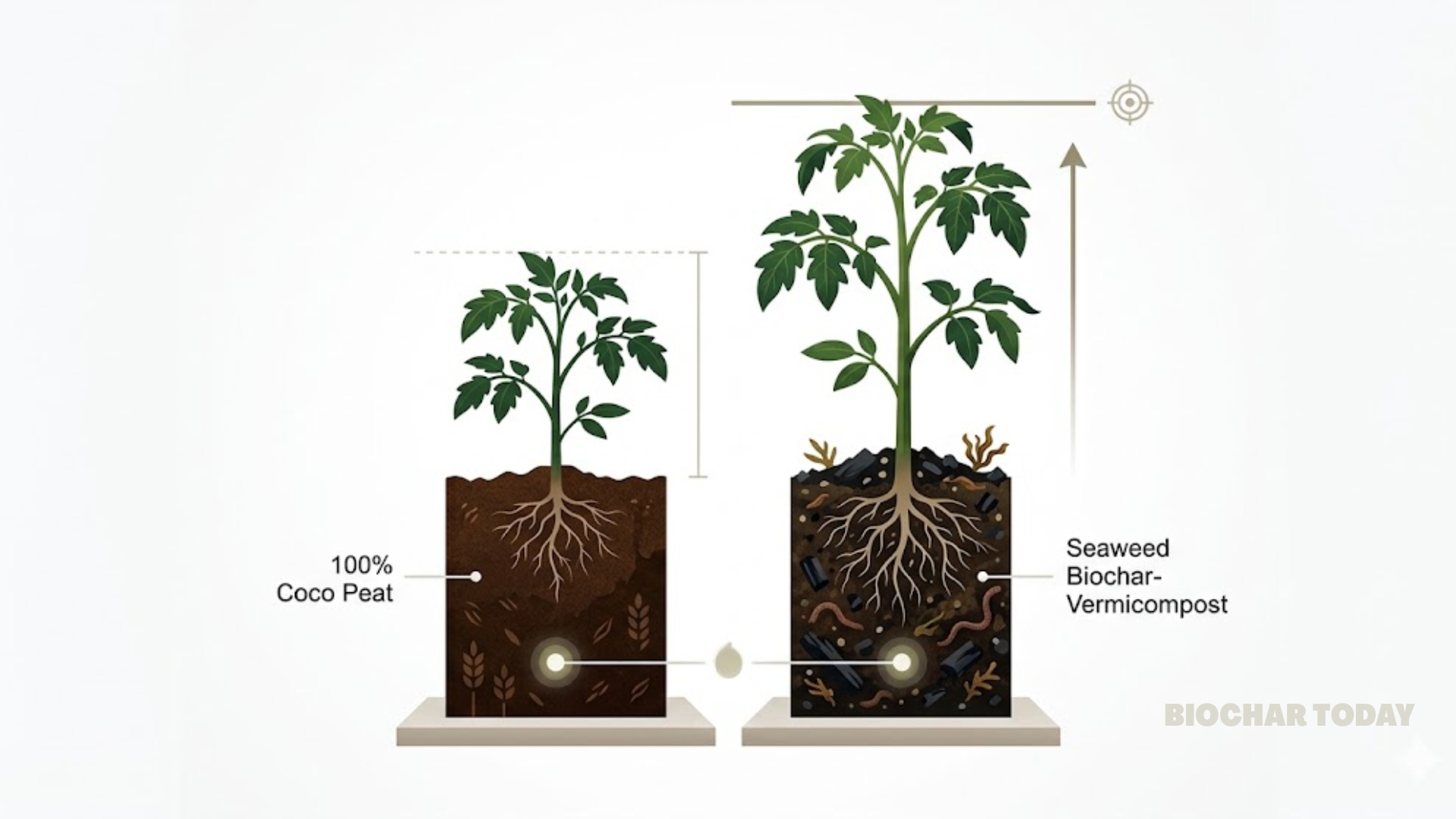
- Substituting coco peat with 100% seaweed-vermicompost increases fertilized tomato seedling heights to 13.69 centimeters.
In a recent study published in the journal Horticulturae, researchers Elia N. M. Ruben, Nils Haneklaus, Simeon S. Hamukoshi, Bethold Handura, and Hupenyu A. Mupambwa evaluated new methods to combat agricultural constraints. The impacts of climate change are intensifying globally, complicating the optimization of conventional agriculture due to severe fluctuations in regional temperature and rainfall patterns. Furthermore, widespread land degradation linked to green revolution technologies—such as the excessive utilization of chemical fertilizers and unsustainable conventional farming practices—has drastically limited the amount of arable land available for food production. This shrinkage of fertile land occurs alongside a steadily growing global population, which is projected to reach 9.8 billion people by the year 2050. To adapt to these environmental pressures, climate-smart agricultural initiatives must be promoted, particularly in arid countries like Namibia that suffer disproportionately under changing climate regimes. Controlled-climate horticultural practices and integrated nutrient management strategies, such as soilless hydroponic farming systems that minimize water use, offer a promising technological alternative. However, these systems are inherently constrained by the high nutrient demands of inert media like coco peat, which traditionally require heavy chemical fertilizer inputs that can lead to environmental issues like greenhouse gas emissions and eutrophication.
To address these sustainability gaps, the authors conducted a greenhouse experiment at the University of Namibia, Sam Nujoma Campus, to evaluate organic media alternatives. They investigated the performance of a red macroalga commonly found along the Namibian coastline, Gracilariopsis funicularis, which was collected, pre-soaked in cold water to remove excess salts, and pyrolyzed into a climate-smart biochar. This desalinated seaweed biochar was incorporated at a 9% ratio into a cow manure and shredded paper mixture, vermicomposted for 12 weeks, and used to progressively substitute standard coco peat at ratios ranging from 0% to 100%. The team evaluated these growth media blends under both unfertilized conditions and fertilized conditions supplemented with ammonium sulfate fertilizer to observe impacts on tomato (Solanum lycopersicum variety STAR 9009) early seedling establishment and late vegetative growth stages.
The experimental results revealed that the inclusion of desalinated seaweed biochar-amended vermicompost can successfully support tomato cultivation, though plant responses varied depending on the incorporation rate and the specific growth stage. During the early seedling establishment phase, the highest vermicompost concentration (100% replacement of coco peat) caused a notable 10.42% reduction in overall seedling emergence compared to the unamended control. This initial inhibition was likely triggered by the higher electrical conductivity and elevated pHpH is a measure of how acidic or alkaline a substance is. A pH of 7 is neutral, while lower pH values indicate acidity and higher values indicate alkalinity. Biochars are normally alkaline and can influence soil pH, often increasing it, which can be beneficial More of the pure organic substrate, which can induce osmotic stress or restrict germination enzyme activities. However, despite the lower emergence rate, the seedlings that did establish in the 100% vermicompost medium exhibited superior vegetative traits when supplemented with ammonium sulfate fertilizer. Under these fertilized conditions, the 100% vermicompost treatment produced the highest seedling height of 13.69 centimeters and a substantial seedling leaf area of 49.45 square centimeters per plant. This enhanced early growth highlights a positive synergistic interaction between the fast-releasing mineral nitrogen fertilizer and the organic nutrient pools within the seaweed-biochar vermicompost matrix.
In contrast, the trends observed during the subsequent eight-week vegetative growth stage shifted back in favor of lower vermicompost inclusion rates. In the post-transplant vegetative phase, the unamended coco peat control treatment (0% vermicompost) achieved the highest overall dry shoot biomassBiomass is a complex biological organic or non-organic solid product derived from living or recently living organism and available naturally. Various types of wastes such as animal manure, waste paper, sludge and many industrial wastes are also treated as biomass because like natural biomass these More at 9.55 grams and the maximum plant height at 67.43 centimeters. Increasing the seaweed biochar-vermicompost levels during this later growth stage led to a gradual decrease in plant height, stem diameter, and dry biomass. This reduction was potentially caused by accumulated salts from the marine feedstockFeedstock refers to the raw organic material used to produce biochar. This can include a wide range of materials, such as wood chips, agricultural residues, and animal manure. More or an overabundance of ammonium ions in the root zone, which can restrict late-stage vegetative expansion. Interestingly, while the 100% vermicompost medium retarded overall physical dimensions, it triggered a massive 133.2% increase in leaf chlorophyll content, yielding up to 31.67 SPAD units compared to only 13.58 SPAD units in the control. Visual observations further supported this, showing that while the control plants suffered from visible physiological stress, leaf senescence, and yellowing due to running out of nutrients in the inert coco peat, the plants grown in 100% vermicompost remained highly vigorous and dark green due to the broader spectrum of micronutrientsThese are essential nutrients that plants need in small amounts, kind of like vitamins for humans. They include things like iron, zinc, and copper. Biochar can help hold onto these micronutrients in the soil, making them more available to plants. More retained by the seaweed biochar. The authors concluded that desalinated seaweed biochar-amended vermicompost can serve as an effective, eco-friendly component in soilless horticultural media, though substrate management practices, such as pre-planting flushing to leach out soluble salts, should be optimized to mitigate early emergence constraints and maximize long-term crop performance.
Source: Ruben, E. N. M., Haneklaus, N., Hamukoshi, S. S., Handura, B., & Mupambwa, H. A. (2026). Desalinated Seaweed-Based Biochar-Amended Vermicompost as a Coco Peat Substitute for Tomato (Solanum lycopersicum) Seedling Production and Growth. Horticulturae, 12(6), 702.





Leave a Reply