
Key Takeaways
- Adding biocharBiochar is a carbon-rich material created from biomass decomposition in low-oxygen conditions. It has important applications in environmental remediation, soil improvement, agriculture, carbon sequestration, energy storage, and sustainable materials, promoting efficiency and reducing waste in various contexts while addressing climate change challenges. More to soil increases the total amount of stored carbon, but its success depends heavily on the initial nitrogen levels already present in the ground.
- Soil with low nitrogen levels responds much better to biochar treatments, showing larger increases in both living and dead microbial matter.
- In environments rich in nitrogen, the added carbon is primarily protected by physical trapping within the soil structure.
- In nitrogen-poor environments, the carbon is captured and stabilized through chemical bonds formed between dead microbes and minerals.
- Effective carbon storage strategies require farmers to adjust their application amounts based on the baseline nutrient levels of their specific fields.
In a newly published research paper in the journal Biochar, authors Shuwei Shen, Ranran Zhou, Le Wu, Peng Ning, Kai Wang, and Xuejun Liu provide a comprehensive global analysis of how baseline soil chemistry dictates the success of carbon storage. The research reveals that the initial nitrogen level of agricultural soil functions as the primary steering mechanism determining how effectively biochar can build up carbon pools. By evaluating hundreds of paired comparisons from around the world, the authors established that applying biochar to nitrogen-poor soils triggers a significantly stronger carbon storage response than applying it to nutrient-rich soils. This finding challenges simple chemical assumptions that nutrient-deficient soils would lack the biological capacity to process and retain newly introduced carbon elements efficiently.
The study demonstrates that biochar applications successfully expand multiple types of soil carbon pools across different environmental settings, but the scale of these gains is highly unequal. In fields characterized by low initial nitrogen levels, soil organic carbon increased by 47.9 percent, while living microbial biomassBiomass is a complex biological organic or non-organic solid product derived from living or recently living organism and available naturally. Various types of wastes such as animal manure, waste paper, sludge and many industrial wastes are also treated as biomass because like natural biomass these More carbon grew by 37.4 percent, and the dead microbial residue, known as necromass carbon, expanded by 14.0 percent. Conversely, in high-nitrogen soils, the accumulation metrics were markedly more muted, with soil organic carbon rising by 29.4 percent, living microbial biomass growing by 22.7 percent, and microbial necromass increasing by only 6.15 percent. This clear divergence proves that the relative abundance of nitrogen modifies how underground ecosystems respond to carbon-rich amendments, making site-specific nutrient baselines a critical factor for agricultural planning.
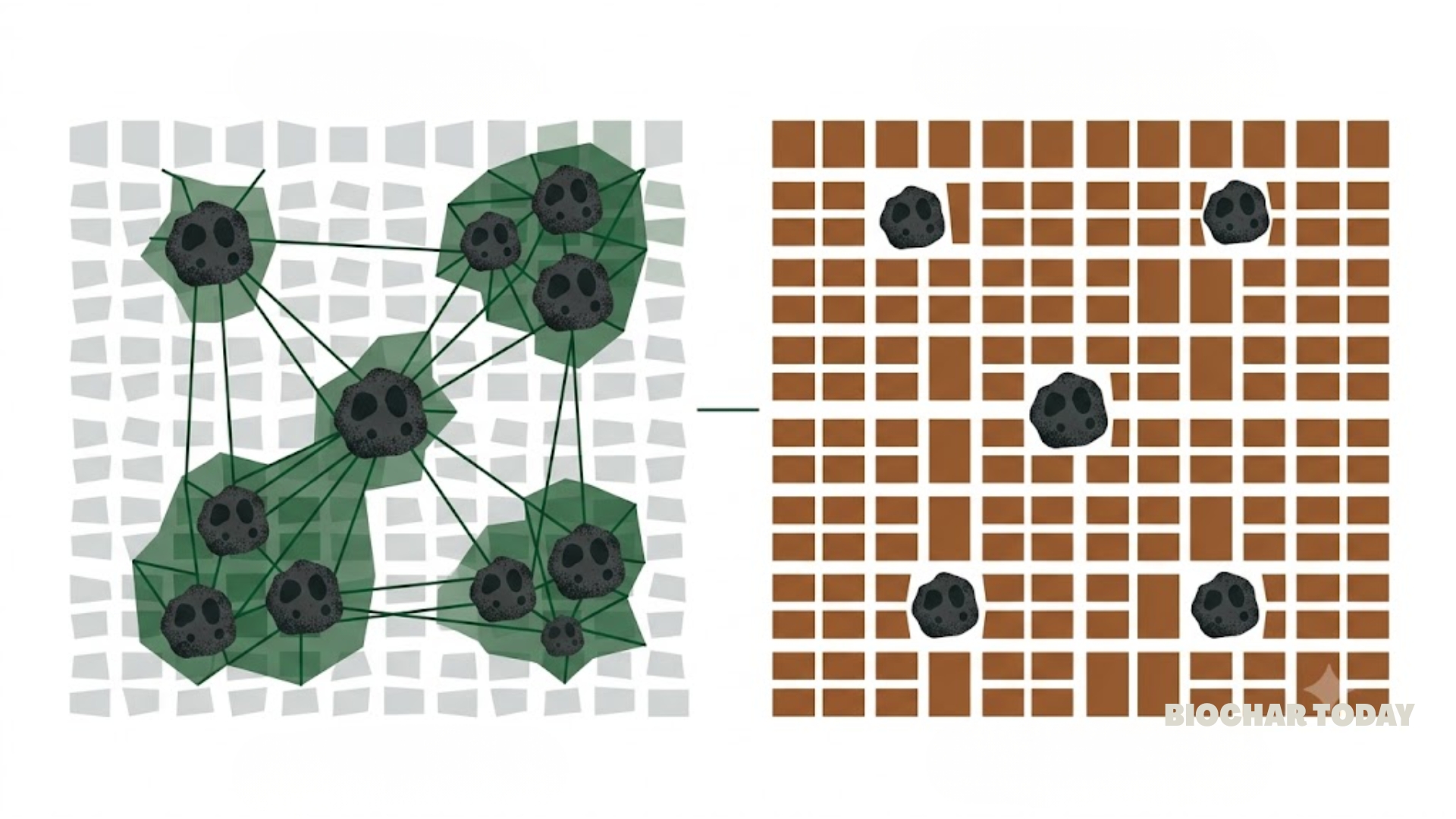
Beyond the raw numbers, the researchers uncovered that completely different biological and physical pathways drive carbon storage depending on the baseline nitrogen environment. In fields with high nitrogen levels, the accumulation of living microbial biomass is closely linked with particulate organic carbon, meaning that the newly stored carbon is primarily safeguarded through physical protection inside soil aggregates. Fungal threads and microbial secretions in these environments act as binding agents that trap carbon particles within tiny soil structures, preventing decomposers from breaking them down. This physical stabilization pathway operates best under specific conditions, showing the highest efficiency in warmer climates, with higher biochar application rates, and when the initial ratio of soil carbon to nitrogen is relatively low.
In contrast, nitrogen-poor agricultural soils bypass this physical trapping mechanism and instead rely on a direct mineral-absorption pathway. In these low-nitrogen environments, the dead microbial residue or necromass shows a strong positive relationship with mineral-associated organic carbon. This means that the carbon is chemically bound directly to the surfaces of soil minerals and clay particles, forming highly stable and long-lasting complexes. The study reveals that this mineral-association pathway is heavily influenced by the properties of the biochar itself rather than the climate, with the largest accumulation of microbial residues occurring when the experiments run for longer durations, when lower rates of biochar are applied, and when the biochar contains a high percentage of total carbon.
These contrasting dynamics reveal that long-term environmental factors and application strategies must be tailored to the specific chemical reality of the field. For instance, while high biochar application rates maximize living microbial carbon in nitrogen-rich soils, lower application rates actually yield better results for accumulating stable microbial residues in low-nitrogen soils. Additionally, the time scale of the experiment plays a universal role, as longer durations allow for continuous microbial turnover, giving dead cells more time to bond with mineral surfaces or become trapped in soil pores. By defining these distinct, nitrogen-dependent pathways, the investigation provides a practical framework for precision soil management, allowing land managers to select the exact biochar characteristics and application rates needed to optimize climate-smart agriculture and maximize carbon retention based on local soil conditions.
Source: Shen, S., Zhou, R., Wu, L., Ning, P., Kai, W., & Liu, X. (2026). Soil nitrogen level controls biochar’s enhancement of microbial-derived carbon sequestration. Biochar, 8(127), 1-15.


![Eucalyptus Wood Waste-Derived Biochar Achieves a Ninety-Eight Percent Removal Efficiency for Benzo[ghi]perylene in Vehicle-Wash Wastewater](https://biochartoday.com/wp-content/uploads/2026/10/SCIENCE-BLOGS-2026-2026-10-19T160523.703.jpg)


Leave a Reply